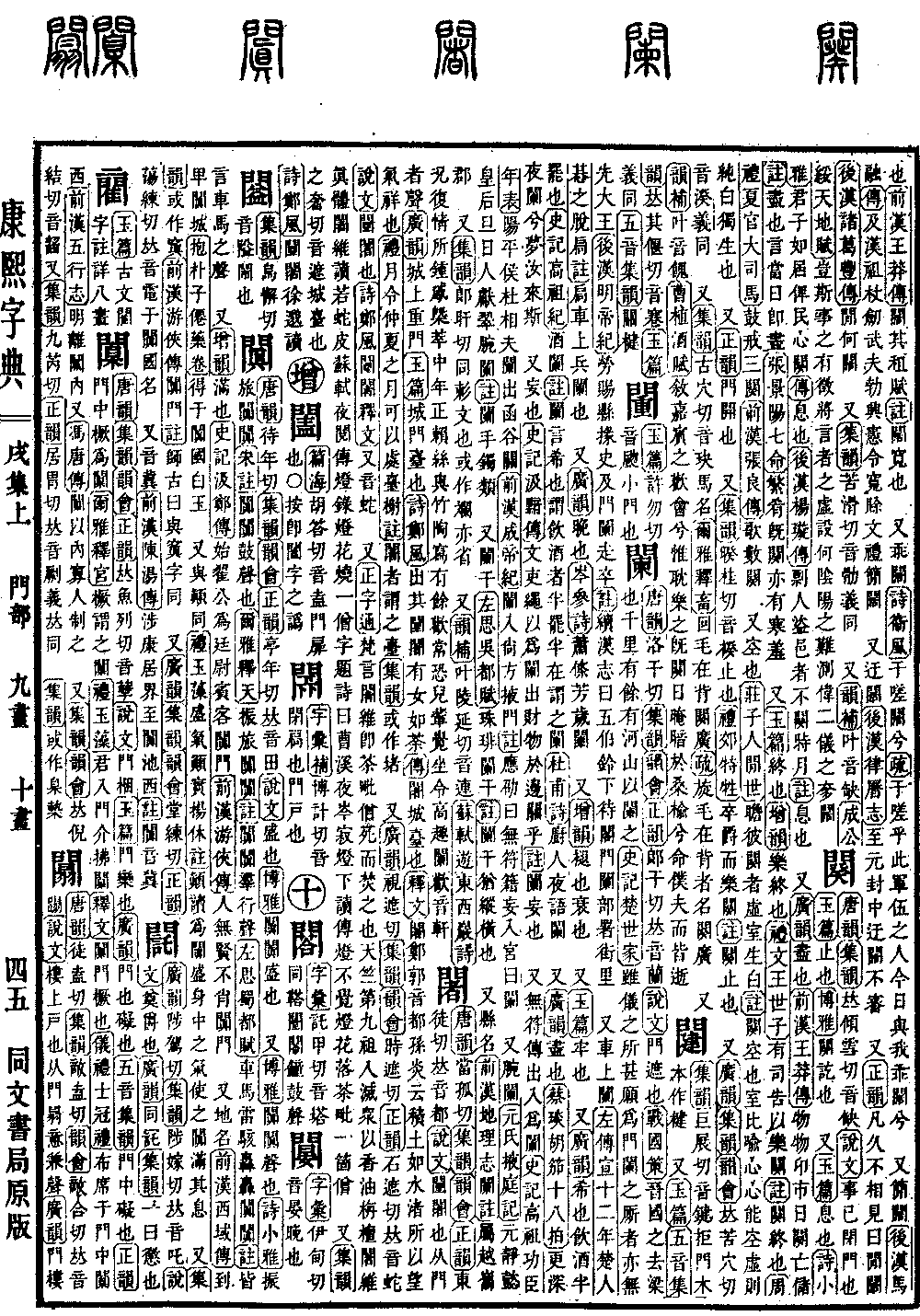
Xu Collection, Upper Volume
Radical: Gate (mén)
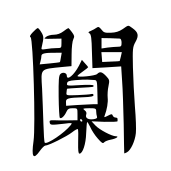
Entry: 闑
Kangxi Stroke Count: 18
Page 1339, Entry 14
Tang Rhymes (Tangyun), Collected Rhymes (Jiyun), Rhyme Compendium (Yunhui), and Correct Rhymes (Zhengyun): Pronounced nie.
According to Explaining Graphs and Analyzing Characters (Shuowen): A wooden threshold in a doorway.
According to Jade Articles (Yupian): The central post of a door.
According to Broad Rhymes (Guangyun): A door post; an obstacle.
According to Collected Rhymes of the Five Sounds (Wuyin Jiyun): An obstruction in the middle of a door.
According to Correct Rhymes (Zhengyun): A stake or post in the middle of a doorway is called a nie.
According to Literary Expositor (Erya), Chapter on Explaining Palaces (Shigong): A stake is called a nie.
According to Book of Rites (Liji), Chapter on Jade Bead Pendants (Yuzao): When the ruler enters the gate, he brushes past the nie.
According to the Explanatory Text (Shiwen): Nie is the stake of a door.
According to Book of Etiquette and Ceremonial (Yili), Chapter on Capping Rituals for Scholars (Shiguanli): Place the mat to the west of the gate nie.
According to History of the Former Han (Qianhan Shu), Chapter on the Treatise of the Five Elements (Wuxingzhi): The bright sun inside the nie.
Also, in the Biography of Feng Tang (Fengtang Zhuan): Within the nie, I, the ruler, control it.
Also, according to Collected Rhymes (Jiyun) and Rhyme Compendium (Yunhui): Pronounced nie.
Also, according to Collected Rhymes (Jiyun): Pronounced jue; according to Correct Rhymes (Zhengyun): Pronounced jue. The meaning is the same.
According to Collected Rhymes (Jiyun): Sometimes written in variant forms (nie) or (nie).