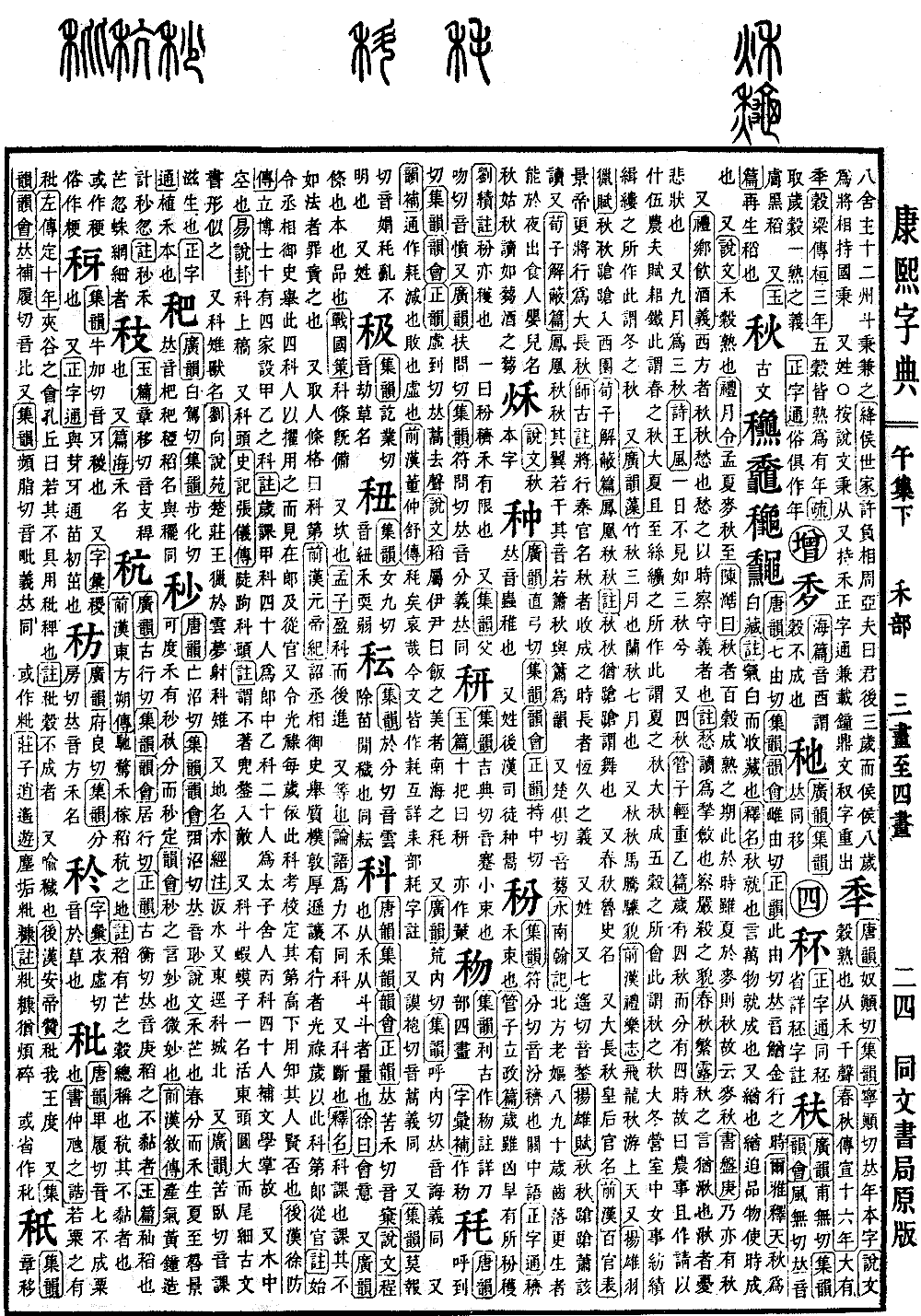
Wu Collection, Lower Volume, Radical: Grain (hé); Kangxi stroke count: 8; Page 850, Entry 01
Pronounced nian (level tone). This is the original form of the character for year. According to the Explaining Graphs and Analyzing Characters (Shuowen Jiezi), it refers to the ripening of grain. The character is formed with the radical for grain and the phonetic component for thousand. The Spring and Autumn Annals (Chunqiu), in the sixteenth year of Duke Xuan, records a great abundance of grain. The Guliang Commentary (Guliang Zhuan), under the third year of Duke Huan, states that when the five grains are fully ripened, it is called a year of abundance. The commentary explains that this is derived from the meaning that grain ripens once per year. The True Character Guide (Zhengzitong) states that in modern times it is typically written as the simplified form for year.
Regarding the ancient form of the character for year: Pronounced nian (level tone). According to the Explaining Graphs and Analyzing Characters, the original form is the character with the grain radical. It refers to the ripening of grain. The character is formed with the radical for grain and the phonetic component for thousand. The Spring and Autumn Annals, under the third year of Duke Huan, records a year of abundance. The Guliang Commentary states that when the five grains are fully ripened, it is called a year of abundance. The sixteenth year of Duke Xuan records a great abundance of grain. The Guliang Commentary states that when the five grains have a great harvest, it is called a great year of abundance.
It also refers to age or years. The Approaches to Meaning (Er Ya), in the chapter on heaven, states that in the Xia Dynasty it was called sui, in the Shang Dynasty it was called si, in the Zhou Dynasty it was called nian, and in the eras of Yao and Shun it was called zai. The annotation explains: sui is derived from the movement of Jupiter through one zodiacal sign; si is derived from the completion of a cycle of the four seasons; nian is derived from the grain ripening once per year; and zai is derived from the cycle of things ending and beginning again. The commentary explains: nian is the term for the ripening of grain. Because it ripens once every year, it is used as the name for the measurement of years. The Rites of Zhou (Zhouli), in the section on the Ministry of Spring, records the regulation of years and months to order affairs. The annotation explains: the cycle from one winter solstice to the next is called sui, and the cycle from one first day of the lunar month to the next is called nian. The commentary explains: within one year, there are twenty-four solar terms. The primary solar terms come first, followed by the middle solar terms. Primary solar terms are also called new moon solar terms. When the middle solar terms complete a cycle, it is a sui; when the new moon solar terms complete a cycle, it is a nian. The Zuo Commentary (Zuo Zhuan), in the third year of Duke Xuan, records a divination foretelling a seven-hundred-year reign.
It also refers to age or years of life. The Explaining Names (Shiming) explains: nian means to advance, to move forward. The Record of Rites (Liji), in the chapter on royal regulations, records that the rulers of the Xia, Shang, and Zhou dynasties, when caring for the elderly, would practice引年 (yin nian). The annotation explains that yin nian means to verify age. The Zuo Commentary, in the fourth year of Duke Ding, records that King Wu of Zhou had eight younger brothers born of the same mother. The Duke of Zhou served as Minister of State, Kang Shu as Minister of Justice, and Shu as Minister of Works, while the other five brothers held no official posts. Does this not show a respect for age and the order of seniority? The annotation explains that this indicates merit was the standard for ranking, not age.
It is also a surname. The Comprehensive Genealogy of Ten Thousand Surnames (Wanxing Tongpu) records that during the Yongle period of the Ming Dynasty, there was a man named Nian Dang from Huaiyuan who served as Minister of Revenue.
Also, the poetic pronunciation (ye yin) is read as ren (level tone), rhyming with the character for string. The History of the Former Han (Qian Hanshu), in the narrative chapter, records that at the sacrifice to heaven and earth, all the hundred spirits were summoned to their positions, and the musical temperaments were harmonized to rectify the calendar, enjoying these long years. Cui Si, in his Inscription on Socks, writes: long enjoying great fortune until billions of years have passed. The sovereign heaven and ancestors have already blessed us, and thus prosperity has arrived.
Also, pronounced ning (level tone), used in names. The Gongyang Commentary (Gongyang Zhuan), in the thirtieth year of Duke Xiang, records Nian Fu. The Explanatory Text (Shiwen) provides the phonetic reading for Nian as ning. The Zuo Commentary and the Guliang Commentary both write the name as Ning Fu. The Collection of Sounds (Jiyun) also writes it with a variant form. During the Tang Dynasty, Wu Zetian created a character to write it.
Verification note: Regarding the poetic pronunciation (ye yin) read as ren (level tone), rhyming with the character for common people (min). Careful check: the pronunciation given is not for the character for common people. According to the sound and meaning, the character for common people has been corrected to the character for string.