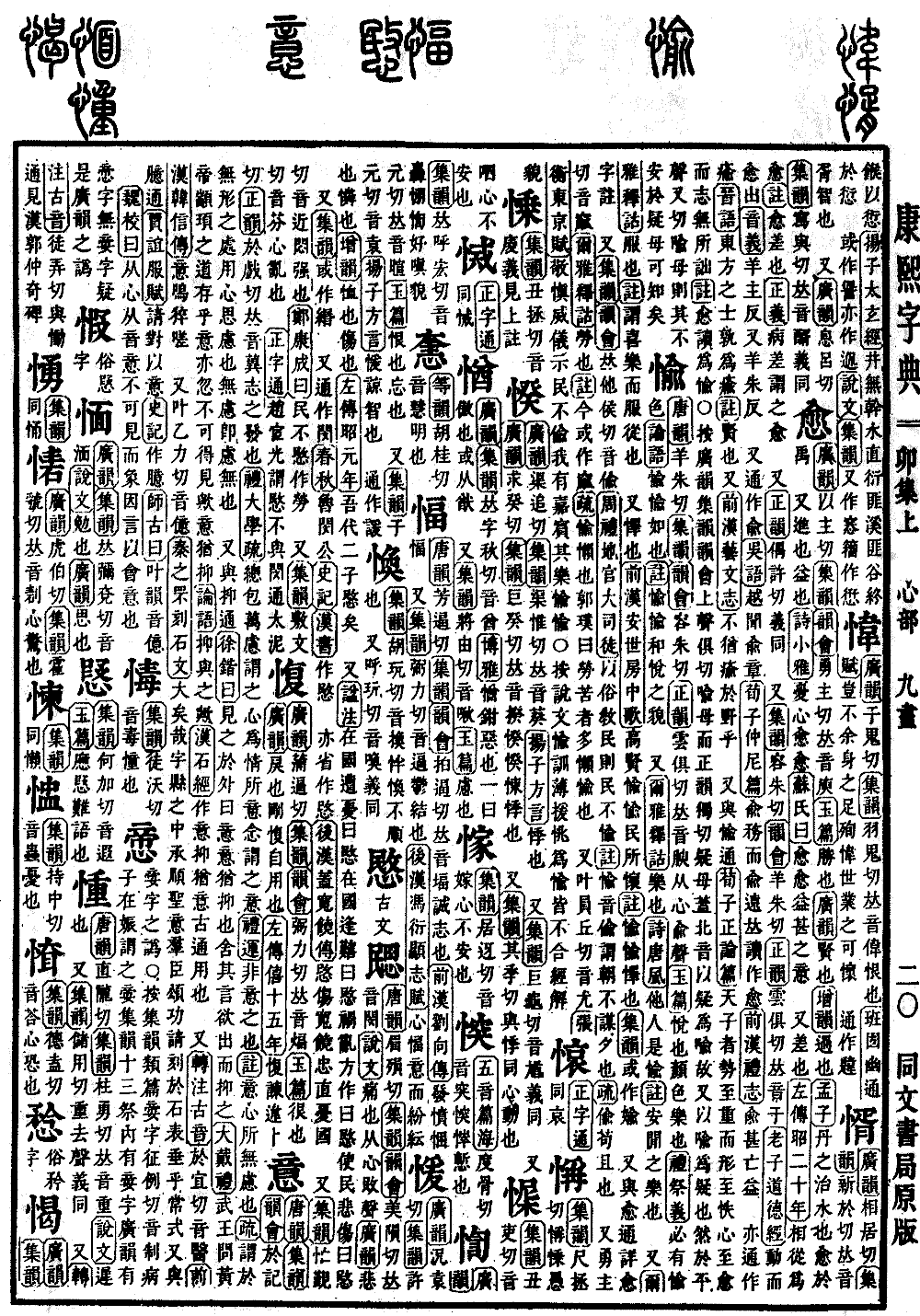
Mao Collection, Upper Volume
Radical: Heart (xīn)
愍
Kangxi strokes: 13
Page 394, Entry 19
Classical citations:
Tang Rhymes (Tangyun) and Collected Rhymes (Jiyun) and Collection of Rhymes (Yunhui) record the pronunciation as min (third tone).
Shuowen Jiezi explains it as: pain. The character structure is derived from the Heart radical, with min as the phonetic component.
Guangyun explains it as: sorrow, pity.
Zengyun explains it as: relief, injury.
Zuo Tradition (Zuo Zhuan), First Year of Duke Zhao: I grieve for these two gentlemen.
Additionally, the Law of Posthumous Titles (Shifa) records: To experience calamity in the nation is called min; to encounter hardship in the nation is called min; when chaos and disaster occur it is called min; to cause the people sorrow is called min.
Also, Jiyun records: Sometimes written as a variant form (min).
Also used as a phonetic loan for min.
In the Spring and Autumn Annals (Chunqiu), the record of Duke Min of Lu is written as min in the Records of the Grand Historian (Shiji) and Book of Han (Hanshu). Also written in simplified form.
Book of the Later Han (Hou Hanshu), Biography of Gai Kuanrao records: Mourning Kuanrao, who was loyal, upright, and worried for the nation.
Also, Jiyun records: Pronounced men (fourth tone). Meaning: strong.
Zheng Kangcheng says: The people do not regret their labor.
Also, Jiyun records: Pronounced fen (first tone). Meaning: mental confusion.
Zhengzitong records: Zhao Huanguang considered that min should not be used interchangeably with min, which is an overly rigid view.