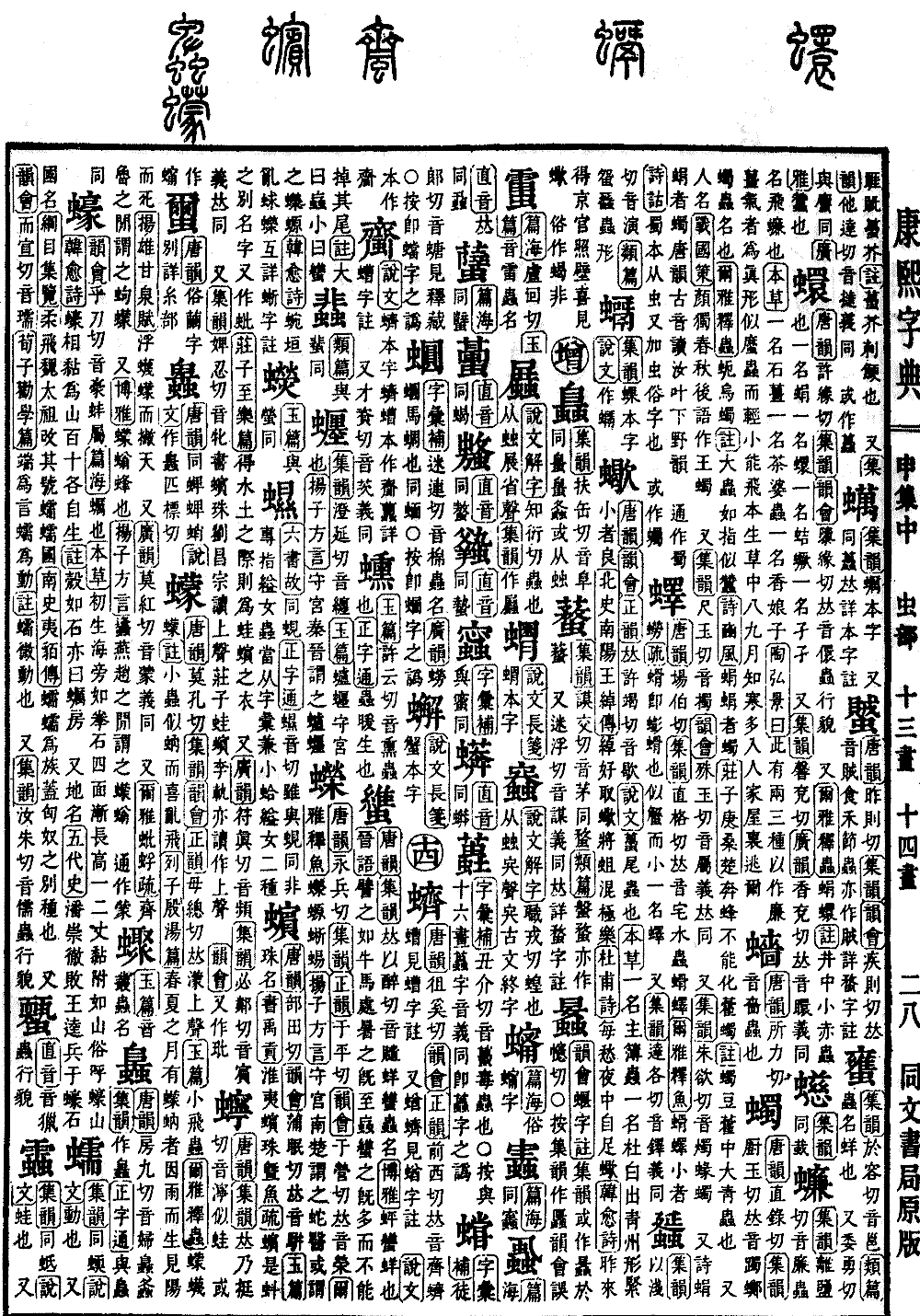
Shen Collection, Lower Volume
Radical: Insect (chóng)
Entry: Meng
Kangxi strokes: 20
Page 1100, Entry 46
Pronounced meng (rising tone). According to Tang Rhymes (Tangyun), Collected Rhymes (Jiyun), Rhyme Meetings (Yunhui), and Correct Rhymes (Zhengyun), it is pronounced like the rising tone of meng. According to the Jade Chapters (Yupian), it refers to a small flying insect. According to the Literary Expositor (Erya), in the section Explanation of Insects, it is also called miemeng. The commentary notes that it is a type of small insect, similar to a gnat, that tends to swarm. According to the Book of Master Lie (Liezi), in the chapter Questions of Tang, during the spring and summer seasons, insects such as gnats and midges are born from rainfall and perish upon contact with sunlight. According to the Rhapsody on the Sweet Springs (Ganquan Fu) by Yang Xiong, it describes the way the swarms fly and drift across the sky.
Also, according to the Broad Rhymes (Guangyun), it is pronounced meng. The meaning is the same. According to the commentary on the Eusocial Insects (Pifu Shu) from the Literary Expositor, in the regions of Qi and Lu, it is known as goumeng. According to the Wide Encyclopedia (Boya), mengweng refers to a type of bee. According to the Regional Speech (Fangyan) by Yang Xiong, in the regions of Yan and Zhao, bees are called mengweng. It is also written interchangeably as meng.
Textual Research: In the Literary Expositor, Explanation of Insects, the commentary describes it as a small insect, similar to a gnat, that tends to swarm. Note that the original text omitted the character er. In the Book of Master Lie, the chapter title Yin Tang has been corrected to Questions of Tang.