You Collection, Upper Volume
Radical: Speech (yán)
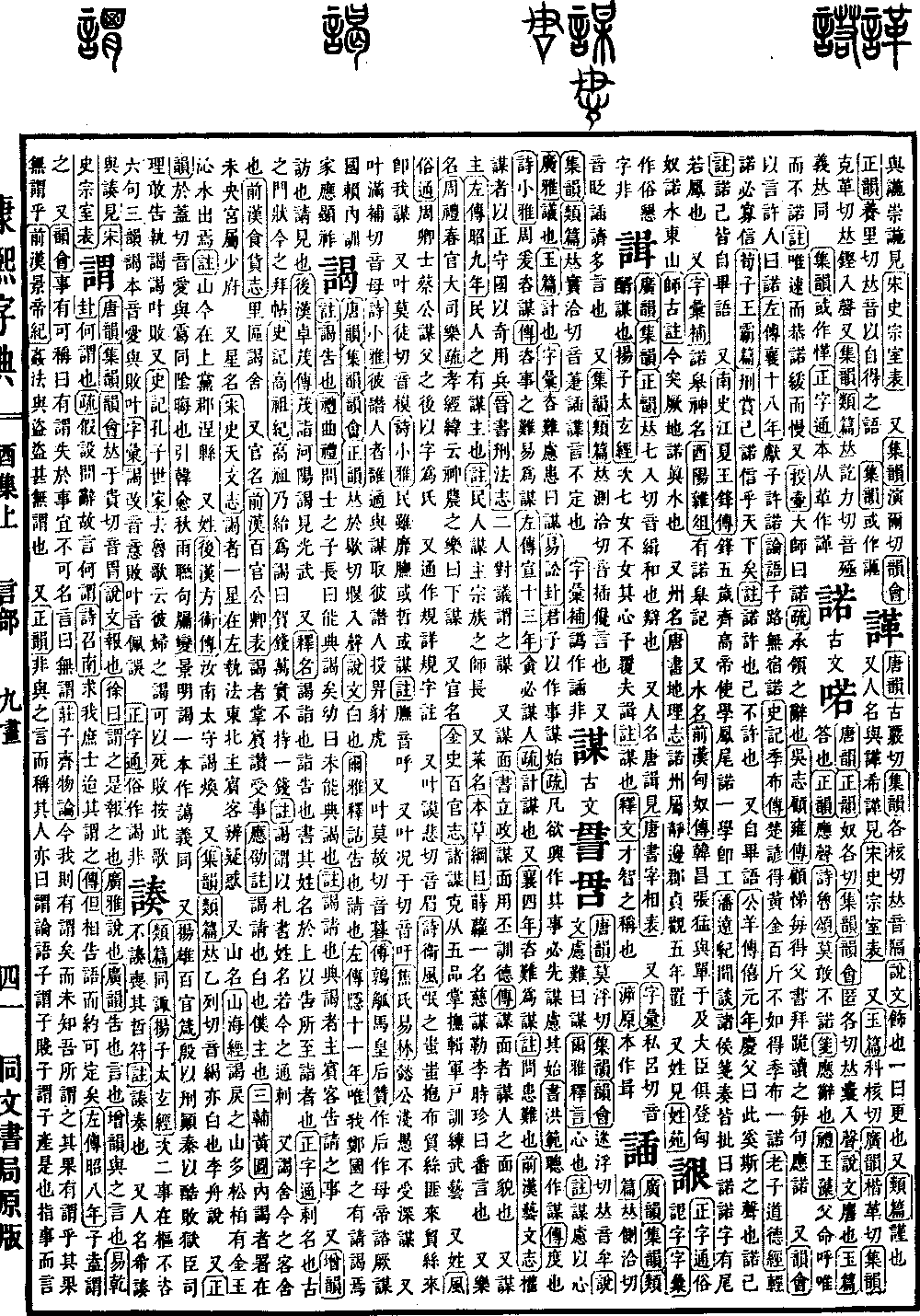
谋
Kangxi stroke count: 16
Page 1173, Entry 02
Ancient script form.
Pronounced mou.
According to the Explaining Graphs and Analyzing Characters (Shuowen jiezi), to deliberate on difficulties is called mou.
According to the Er Ya, which explains words, it means the mind. The commentary states: to deliberate and ponder using the mind.
According to the Guang Ya, it means to discuss.
According to the Yu Pian, it means to calculate.
According to the Zi Hui, to consult on difficulties and ponder over disasters is called mou.
In the Book of Changes (Yijing), hexagram for Litigation (Song), it is said: The superior man, in initiating affairs, deliberates on the beginning. The commentary explains: Whenever one intends to initiate an affair, one must first deliberate and ponder its beginning.
In the Book of Documents (Shujing), section Great Plan (Hongfan), it is said: Listening creates deliberation. The commentary explains: This refers to assessment.
In the Book of Odes (Shijing), section Minor Odes of the Kingdom (Xiaoya), it is said: Everywhere I consult and deliberate. The commentary explains: Consulting on the difficulties or ease of a matter is called deliberation.
In the Zuo Commentary (Zuozhuan), fourteenth year of Duke Xuan, it is said: The greedy will certainly plot against others. The commentary explains: This means to calculate and plot.
Also, in the fourth year of Duke Xiang, it is said: To consult on difficulties is called deliberation. The commentary explains: This refers to inquiring about distress and difficulties.
In the History of the Former Han (Qianhan shu), Treatise on Arts and Literature (Yiwenzhi), it is said: Those who practice statecraft and strategy (quanmou) use propriety to defend the state and extraordinary tactics to employ troops.
In the Book of Jin (Jinshu), Treatise on Law (Fazhi), it is said: When two people discuss issues together, it is called mou.
Also, to consult one's face. In the Book of Documents (Shujing), section Establishing Government (Lizheng), it is said: In consulting on face, use great teaching of virtue. The commentary explains: Consulting on face refers to judging the appearance of a person.
Also, a mastermind. In the Zuo Commentary (Zuozhuan), ninth year of Duke Zhao, it is said: The people have a mastermind. The commentary explains: A mastermind for the people is a teacher and elder of the clan.
Also, a name of a vegetable. In the Compendium of Materia Medica (Bencao gangmu), dill is also known as cimo le. Li Shizhen notes: This is a foreign word.
Also, a name of a music piece. In the Rites of Zhou (Zhouli), Spring Officials, commentary on the Great Director of Music, the Classic of Filial Piety Apocrypha (Xiaojing wei) states: The music of Shennong is called Xia mou.
Also, a name of an official post. In the History of the Jin (Jinshi), Treatise on Officials (Baiguanzhi), the various mouke are officials of the fifth rank, responsible for comforting and gathering military households and training in martial arts.
Also, a surname. According to the Fengsu tong, they are descendants of the Zhou minister Cai Gong Moufu, who took the character as their clan name.
Also, commonly written as the character for regulate (gui). See the entry for regulate for details.
Also, pronounced mei (level tone). In the Book of Odes (Shijing), Odes of Wei (Weifeng), it is said: The simple-looking boy with the tuft of hair, came with cloth to exchange for silk. It was not that you came to exchange for silk, you came to consult with me.
Also, pronounced mo (level tone). In the Book of Odes (Shijing), Minor Odes of the Kingdom (Xiaoya), it is said: Though the people have no thick meat, some are wise and some are calculating. (The character wu is pronounced hu).
Also, pronounced xu (rising tone). In the Jiao Shi Yilin, it is said: The duke is shallow and foolish, unable to accept deep strategies.
Also, pronounced mu (falling tone). In the Book of Odes (Shijing), Minor Odes of the Kingdom (Xiaoya), it is said: That slandering person, with whom does he plot? Take that slandering person and cast him to the jackals and tigers.
Also, pronounced mu (falling tone). In the Pan Chun-gu Ma Huanghou Zan, it is said: Being an empress, being a mother, the emperor consulted on her strategies. The state relied on inner teachings, and the family responded with manifest blessings.
Editorial Note: In the Zuo Commentary, thirteenth year of Duke Xuan, the text is corrected to the fourteenth year.