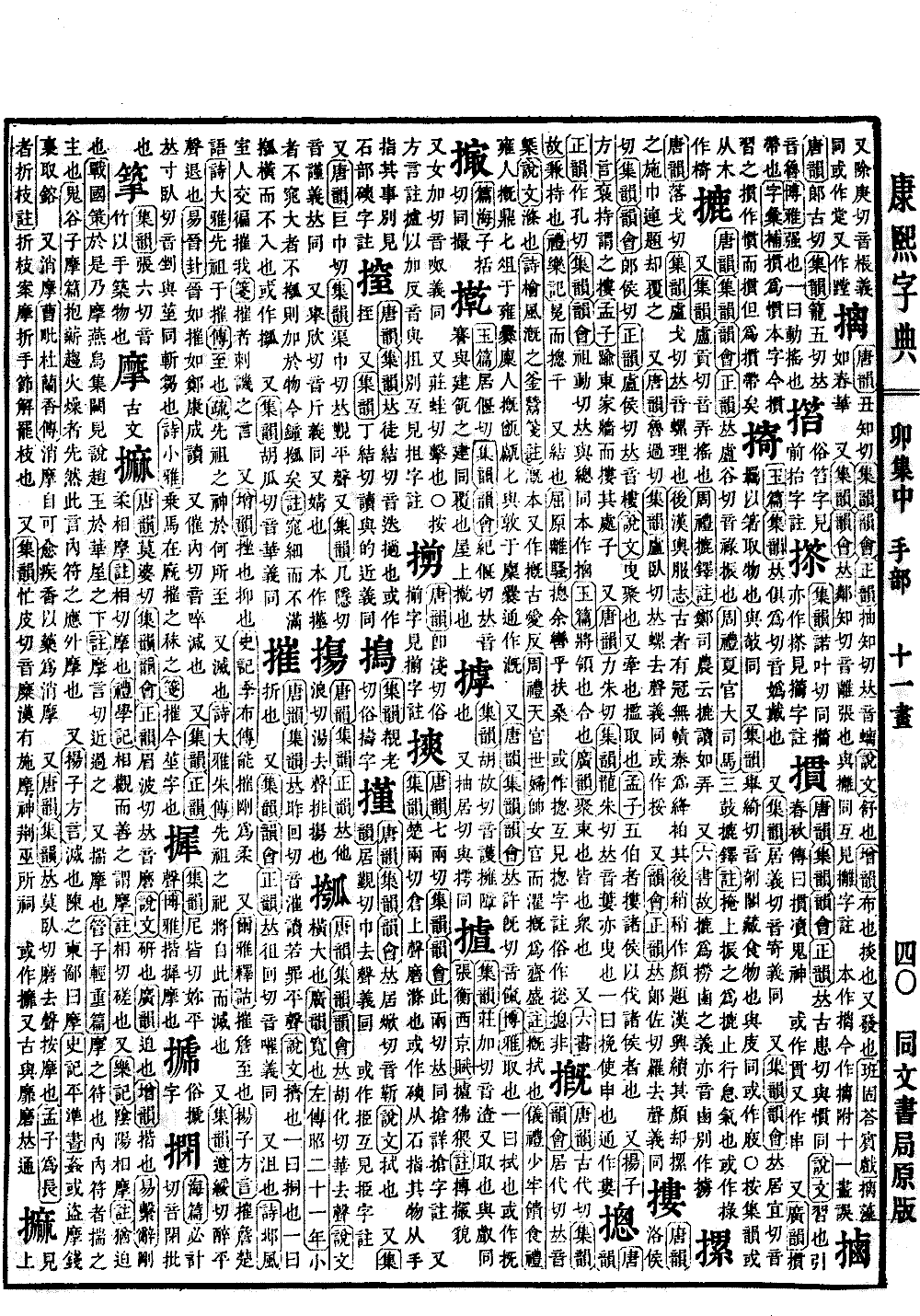
Mao Collection, Middle Volume. Radical: Hand (shǒu). Kangxi strokes: 15. Page 450, Entry 28.
Ancient script. Pronounced mo. Sayings from the Tang Dynasty (Tangyun) state it is the result of mo and po. Gathered Rhymes (Jiyun), Collected Rhymes (Yunhui), and Correct Rhymes (Zhengyun) state it is the result of mei and bo. Pronounced mo. According to the Explaining Graphs and Analyzing Characters (Shuowen), it means to grind. According to the Extended Rhymes (Guangyun), it means to press. According to the Augmented Rhymes (Zengyun), it means to rub. From the Book of Changes (Yijing), Appended Statements: Hard and soft rub against each other. Note: This means to cut and rub against one another. From the Book of Rites (Liji), Record on Education: Observing one another to become good is called rubbing. Note: This means to cut and polish one another. Also, from the Record of Music (Yueji): Yin and yang rub against each other. Note: This means to press. From the Strategies of the Warring States (Zhanguoce): Thereupon he rubbed against the Yanwu gathering gate and saw the King of Zhao beneath the decorated hall. Note: Rubbing means to press close and pass by. Also, it means to calculate or estimate. From Guiguzi: The tally of rubbing is internal; the internal tally is the master of estimation. Holding firewood and rushing to a fire, the dry part ignites first. Pouring water on flat ground, the wet part gets damp first. Also, according to Master Yang’s Dialects (Fangyan), it means to extinguish. In the eastern borderlands, it is called mo. From the Records of the Grand Historian (Shiji), Book of the Balanced Standard: Traitors would steal and rub the edges of coins to melt them down. Also, to dissipate or rub away. From the Biography of Du Lanxiang by Cao Pi: Dissipating and rubbing can heal illnesses; Xiang used medicine for dissipation and rubbing. Also, pronounced mo (falling tone). Massage. From the Mencius, Commentary on bending limbs for elders: Bending limbs and massaging means to bend the hand joints and loosen the weary branches. Also, according to the Collected Rhymes (Jiyun), pronounced mi. During the Han Dynasty, there was a Shi Mo spirit, worshipped by the shamans of Jing. Sometimes written as a variant form (mo). Also, in ancient times it was used interchangeably with mi and mo. Textual Research: The phrase concerning the tally of rubbing is taken from Guiguzi, not from the Guanzi. The original text incorrectly attributed the passage starting from the tally of rubbing to the Guanzi, which has been corrected to the Guiguzi, including the reference to holding firewood and the flow of water.