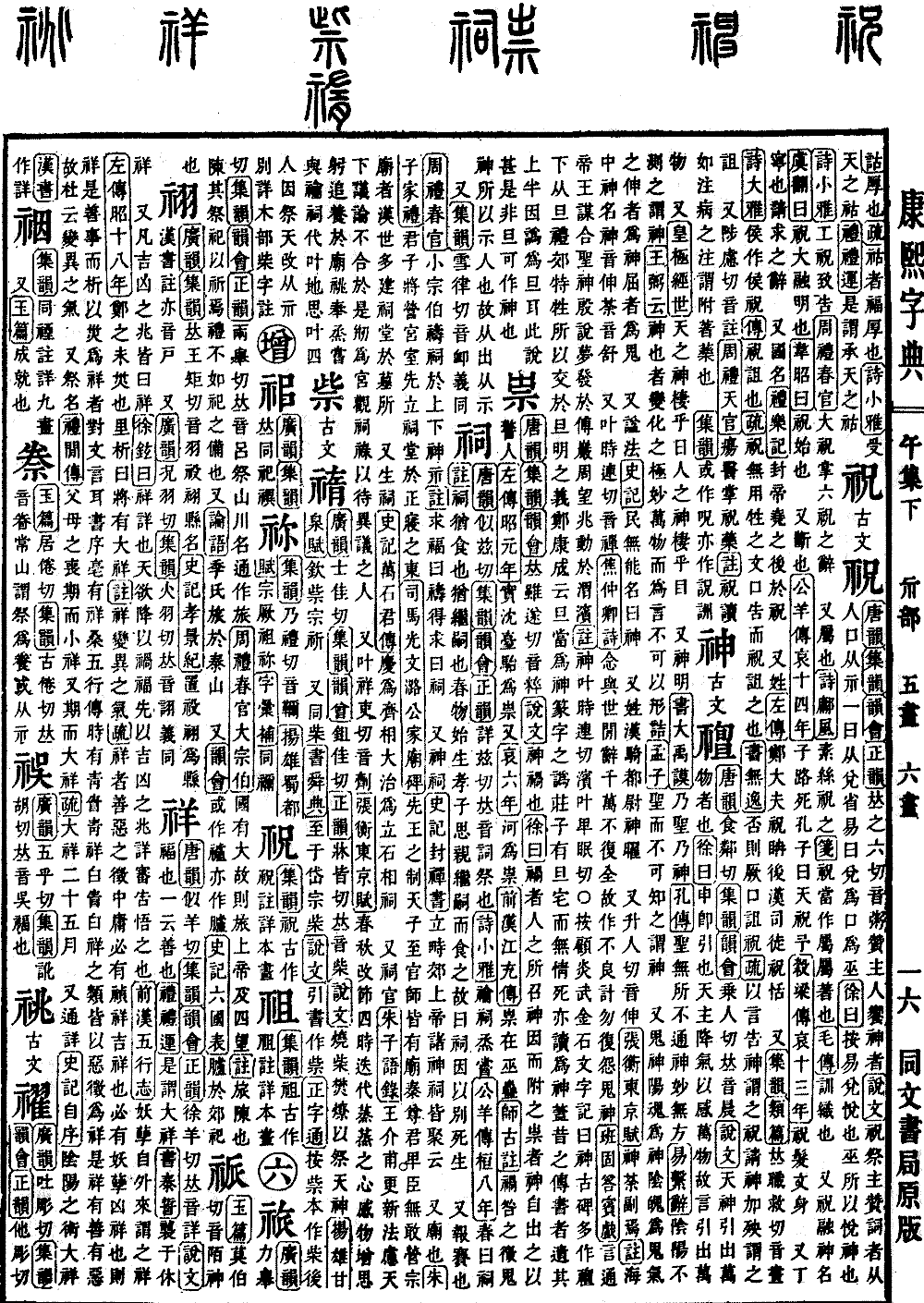
Wu Collection, Lower Volume
Radical: Spirit (shì)
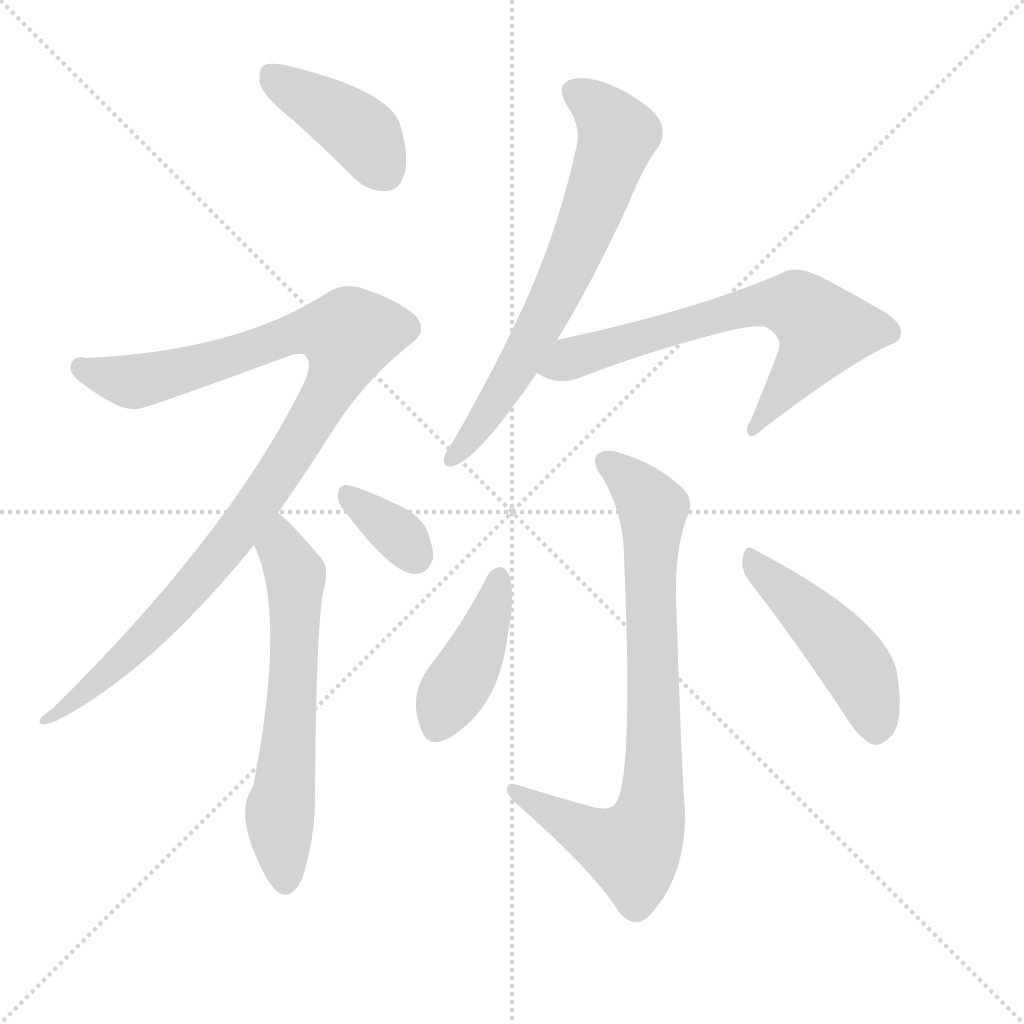
祢
Kangxi strokes: 19
Page 842, Entry 10
Pronounced ni (rising tone).
Rhapsody on the Capital of Shu (Shudu Fu) by Yang Xiong: Honor the ancestors and the ancestral temples.
Dictionary Supplement (Zihui Bu): Equivalent to the variant form (ni).
禰
Pronounced ni (rising tone).
Shuowen Jiezi: The ancestral temple of one's father.
Expanded Rhymes (Zengyun): A father's temple is called ni.
Commentary on the Gongyang Commentary (Gongyang Zhuan): When alive, one is called father; when dead, one is called the late father; upon entering the temple, one is called ni.
Sub-commentary (Shu): The character ni is composed of the spirit radical and the character er, indicating that while they have entered the temple as spirits, they remain the closest to oneself, hence the term ni. It also refers to a portable ancestral tablet.
Record of Rites (Liji): When in the army, one guards the lord's portable tablet.
Commentary (Zhu): The lord's portable tablet is a traveling ancestral tablet. It is called ni because it represents the closest kin while away from home.
Also a place name.
Classic of Poetry (Shijing): Drinking and feasting at Ni.
Also a surname. Ni Heng of the Wei dynasty. According to the commentary and sub-commentary on the lord's portable tablet, it should be read as written; there is no need to follow the reading by Hao as tiao. The Dictionary (Zihui) incorrectly classifies this under the xiao rhyme based on that reading, which is incorrect.