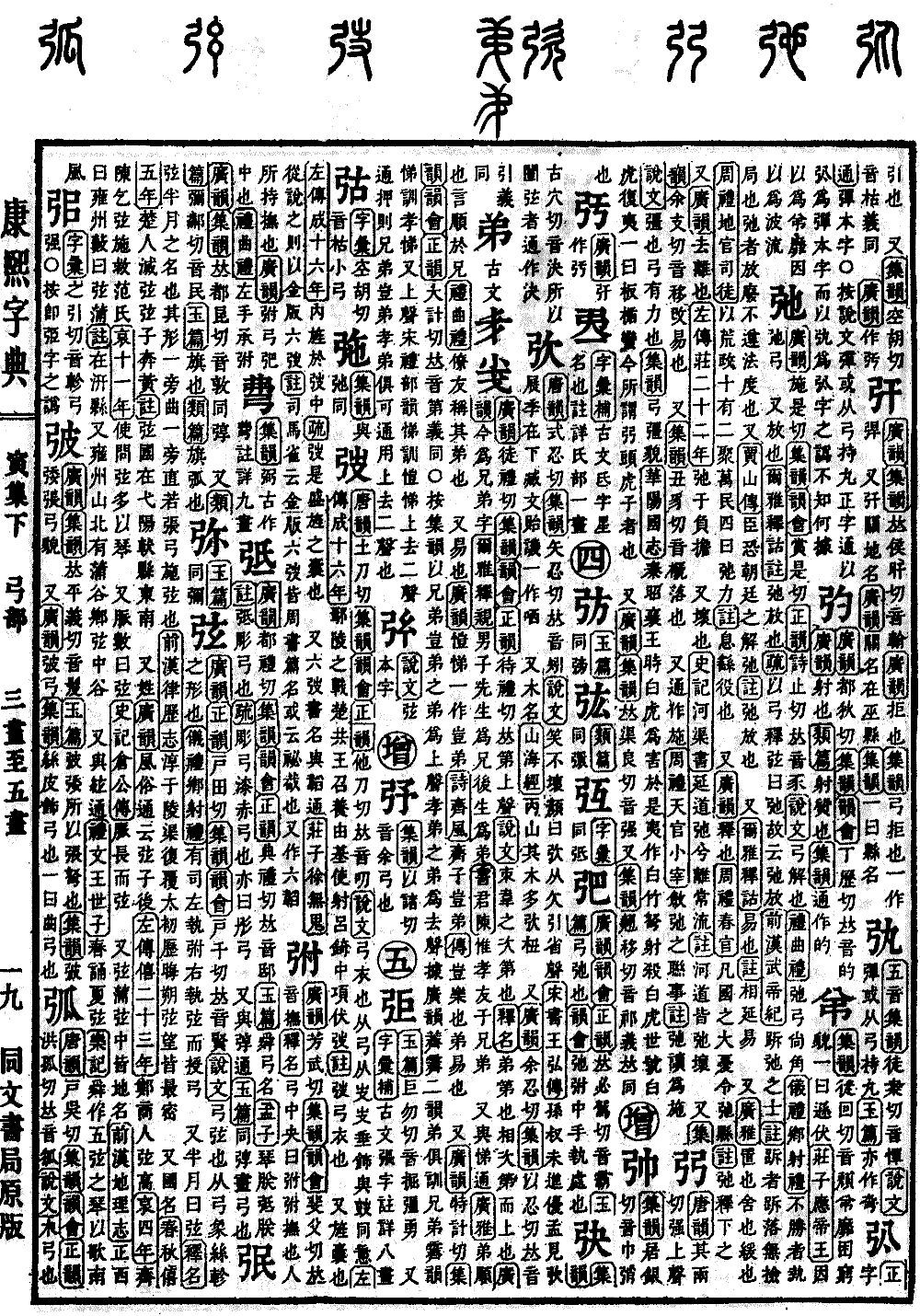
Yin Collection, Lower Volume
Radical: Bow (gōng)
Kangxi Strokes: 17
Page 357, Entry 30
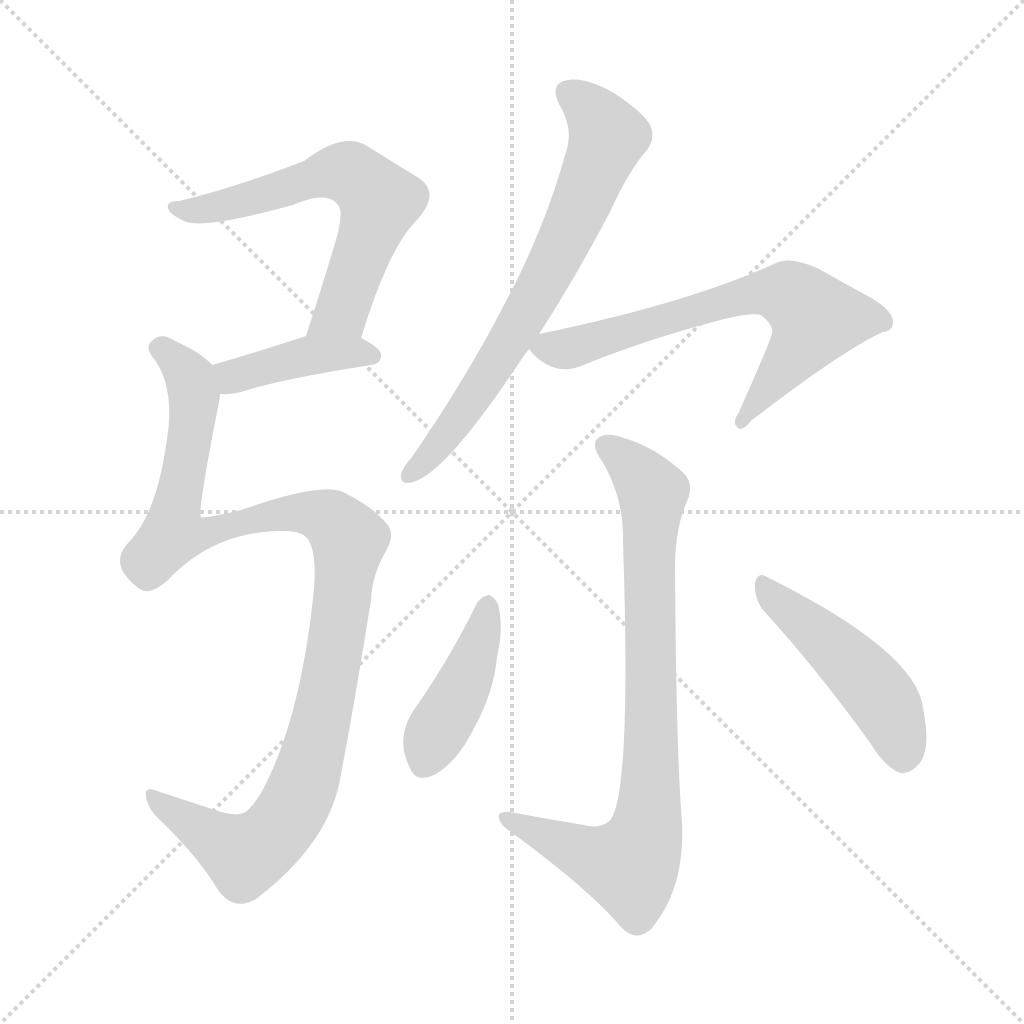
Jade Chapters (Yupian) states it is the same as the character pronounced mi. This is an ancient form of the character. According to Broad Rhymes (Guangyun), pronounced mi. According to Collection of Rhymes (Jiyun) and Rhyme Anthology (Yunhui), pronounced mi. In the Explanations of Graphs and Analysis of Characters (Shuowen), it means to relax a bow. Also, according to Jade Chapters, it means everywhere or all-encompassing. In the Rites of Zhou (Zhouli), Spring Offices, Great Invoker, it says: to perform rites for the soil and grain spirits throughout (mi). The commentary states that mi means throughout. Also, according to Classified Chapters (Leipian), it means to end or complete. In the Book of Odes (Shijing), Greater Odes, it says: giving birth at the completion (mi) of her months. The commentary states that mi means to end. Also, according to Broad Rhymes, it means to increase or heighten. In the Analects (Lunyu), it says: The more I look at it, the higher (mi) it seems; the more I drill into it, the harder it becomes. Also, according to Broad Rhymes, it means long or enduring. Also, it means far. In the Zuo Tradition (Zuozhuan), 23rd year of Duke Ai, it says: so that Fei might obtain the support of a distant (mi) nephew. The commentary states that mi means far. Also, it means a baleful halo. In the Rites of Zhou, Spring Offices, regarding omens, it says: seven is called mi. The commentary states that mi is a white rainbow spanning (mi) the sky. Also, mi-feng means to mend or repair deficiencies. In the Book of Changes (Yijing), Appended Remarks, it says: to encompass and regulate (mi-lun) the way of heaven and earth. The sub-commentary states that mi refers to mending and filling gaps. In the Zuo Tradition, 26th year of Duke Xi, it says: to mend (mi-feng) his shortcomings. Also, mi-mi means gradually or little by little. In the History of the Former Han (Qianhan), Biography of Wei Xian, it says: gradually (mi-mi) his errors grew. Also, mi-long refers to carriage decorations. In the Records of the Grand Historian (Shiji), Treatise on Rites, it says: mi-long is that by which dignity is maintained. The commentary states that the records suggest it refers to golden ornaments on the yoke and crossbar shaped like dragons. Also, Hanmi is the name of a country. In the History of the Former Han, Treatise on the Western Regions, it says: the country of Hanmi, now called Ningmi. Also, a surname. According to Broad Rhymes, in the Sanfu Juelu, there is a person named Mi Sheng of Xinfeng. Also, a Qiang ethnic compound surname; Later Qin General Mije Potuo. Also, according to Classified Chapters, pronounced mi. Yi-mi refers to an infant. In the Book of Rites (Liji), Miscellaneous Records, it says: an infant on the road who has lost its mother. The commentary states that ying is synonymous with yi-mi. Also, according to Rhyme Anthology, pronounced mi (rising tone). According to Classified Chapters, it means to stop. According to Rhyme Anthology, it means to rest. In the Rites of Zhou, Spring Offices, Lesser Invoker, it says: to quell (mi) disasters and weapons. In the History of the Former Han, Biography of Li Guang, it says: to rest (mi) the pace at Baitang. The commentary states that mi-jie means to calm down slightly. According to Rhyme Anthology, it is used interchangeably with the character pronounced mi (rising tone).