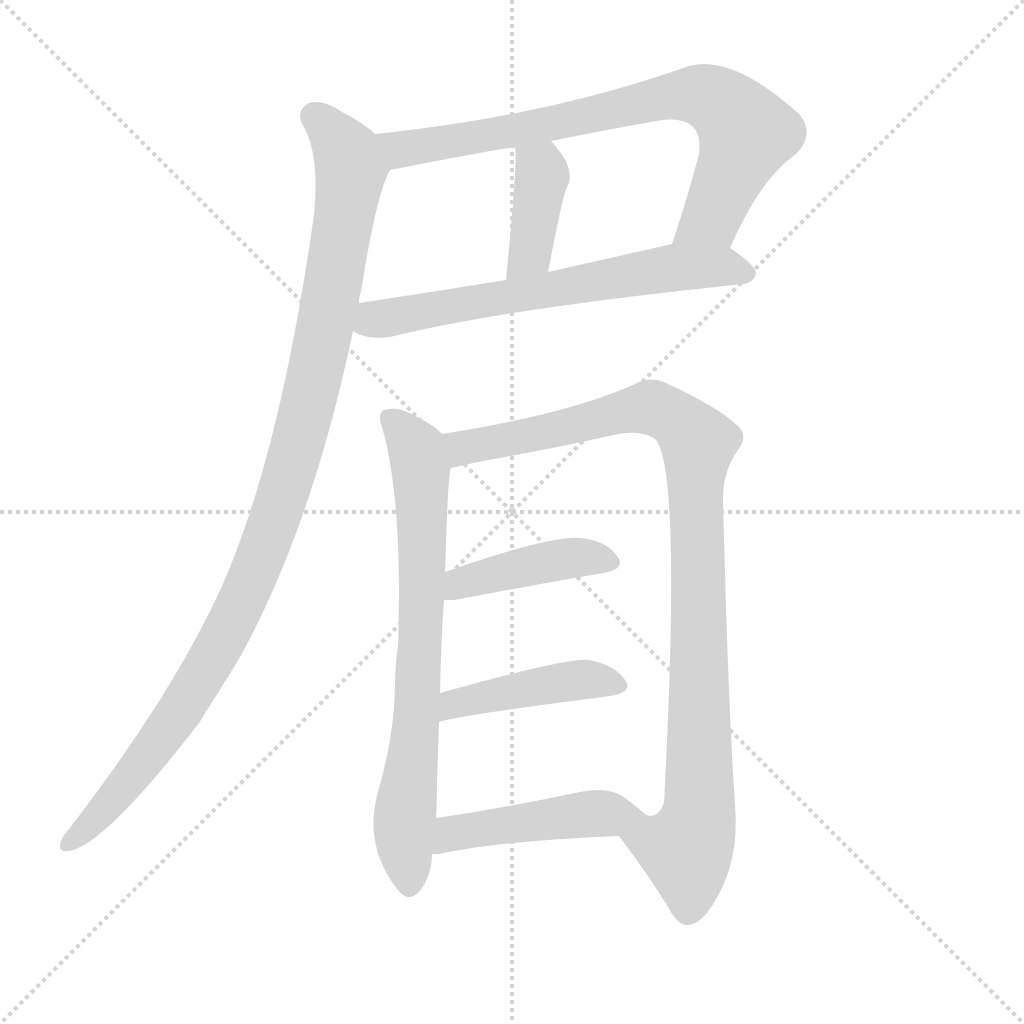
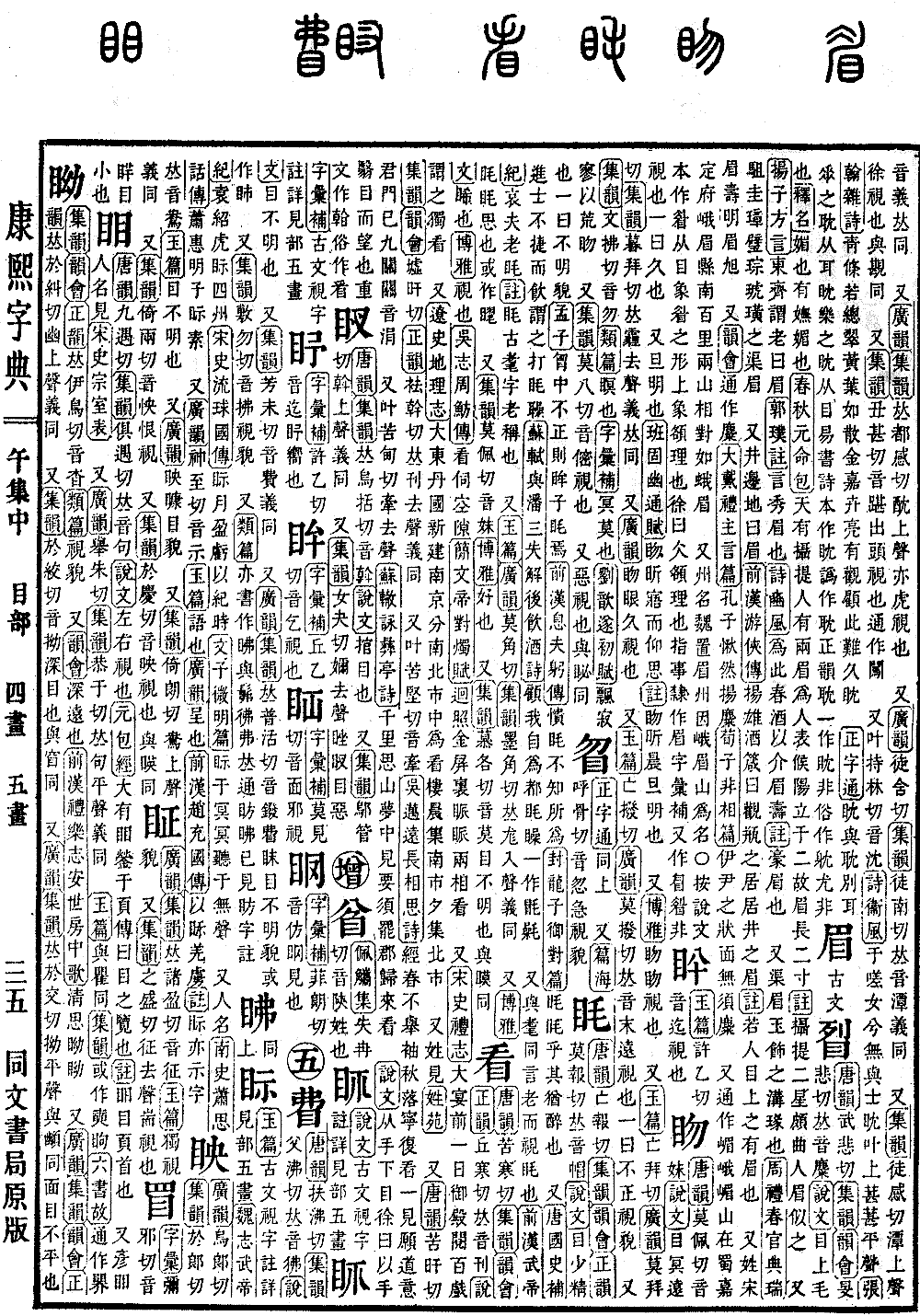
Wu Collection, Middle Volume. Radical: Eye (mù). Kangxi stroke count: 9. Page 803, Entry 01. Ancient form. Pronounced mei. According to the Shuowen Jiezi, it refers to the hair above the eyes. According to the Shiming, it signifies charm, indicating a graceful appearance. According to the Chunqiu Yuanmingbao, in the heavens there is the Sheti star; human beings possess two eyebrows which serve as the standard of appearance. The masculine principle is established in the number two, hence the eyebrows are two inches long. Note: The two Sheti stars are slightly curved, and human eyebrows resemble them. Also, according to the Fangyan by Yang Xiong, in the eastern Qi region, elders are called mei. Guo Pu notes that this refers to beautiful eyebrows. According to the Book of Odes (Shijing), in the Binfeng section, it mentions brewing spring wine to pray for longevity, with a note referring to magnificent eyebrows. Also, qumei refers to the grooved patterns carved onto jade artifacts. According to the Rites of Zhou (Zhouli), specifically the Spring Officials section regarding the code for jade insignias, it describes using silk ribbons to string the qumei of jades such as the gui, zhang, bi, cong, hu, and huang. Also, the area at the edge of a well is called mei. According to the History of the Former Han (Qian Han Shu), specifically the Biography of Wandering Knights, Yang Xiong in his Wine Admonition states: observe the situation of the water pitcher, situated at the edge of the well. Note: It is like how a person has eyebrows above their eyes. Also, a surname. In the Song dynasty there was Mei Shou, and in the Ming dynasty there was Mei Xu. Also, according to the Yunhui, it is interchangeably written as mei. According to the Record of Rites by Dai De (Da Dai Liji), in the Zhuyan section, Confucius lifted his eyebrows with a serious expression. According to the Xunzi, in the Feixiang section, it describes the appearance of Yi Yin, who had no beard or eyebrows on his face. Also, it is interchangeably written as mei (嵋). Mount Emei is located one hundred li south of Emei County in Jiading Prefecture, Shu region; the two mountains face each other like the antennae of a moth. Also, a prefecture name. During the Wei state, Meizhou was established, named after Mount Emei. Commentary: In the Shuowen Jiezi, it was originally written as mei (睂), derived from the eye radical, symbolizing the shape of the eyebrows. The upper part symbolizes the lines of the forehead. Xu Xuan states that the top component represents forehead lines, and it is a self-explanatory character. In clerical script, it changed to mei (眉). The Zihui Bu dictionary also records it as a variant form, which is incorrect.