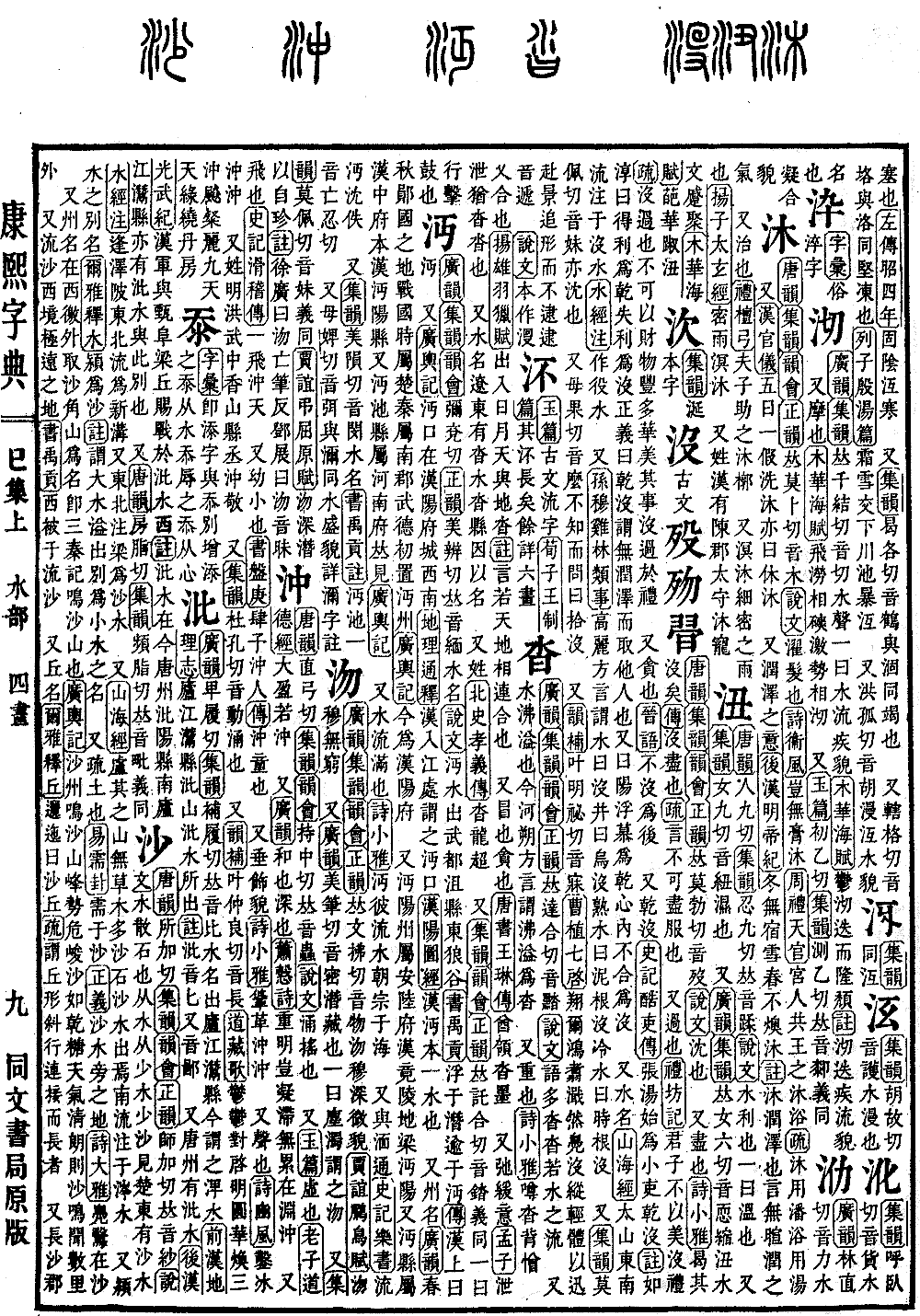
Si Collection, Upper Volume
Radical: Water (shuǐ)
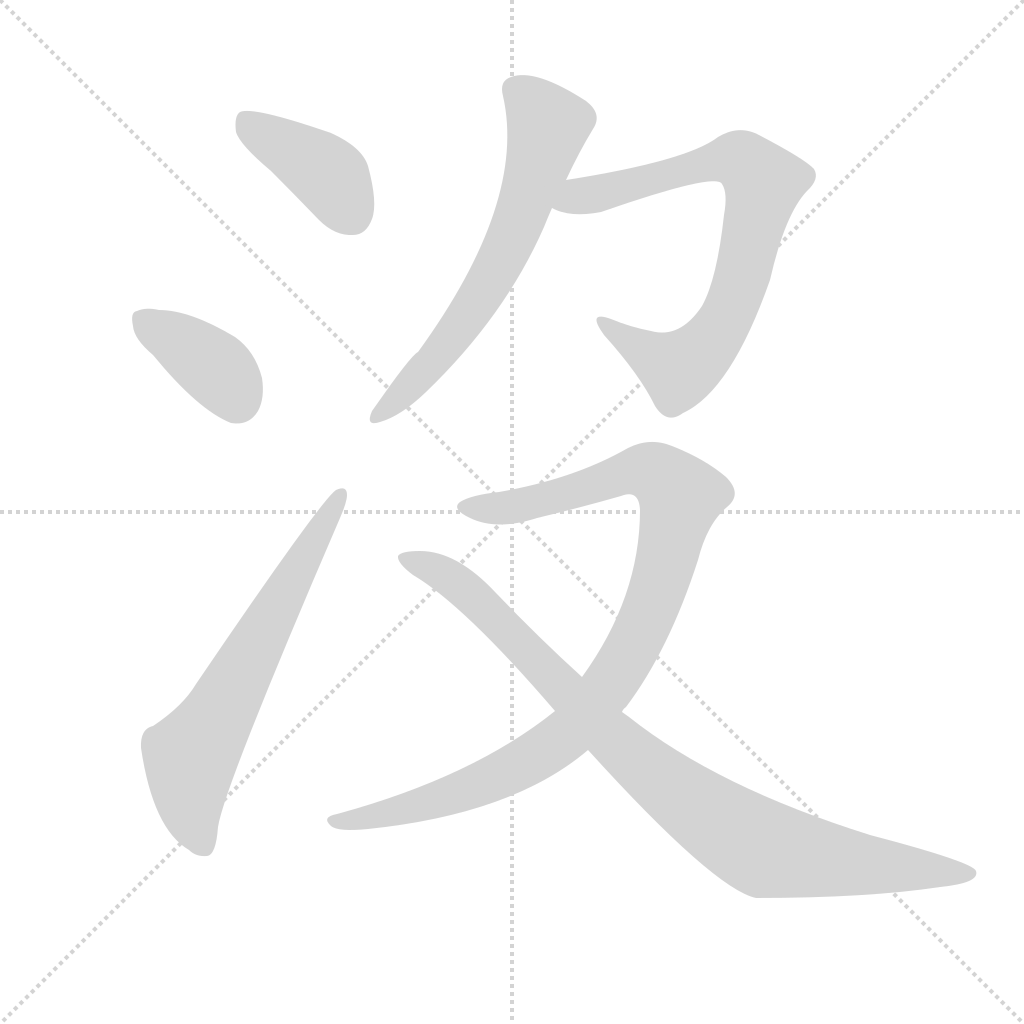
Entry: mo
Kangxi stroke count: 8
Page 611, Entry 10
Ancient characters: mo, mo
Tang Rhymes (Tangyun), Collection Rhymes (Jiyun), Rhyme Compendium (Yunhui), Correct Rhymes (Zhengyun): Pronounced mo.
Shuowen Jiezi (Dictionary of Graphic Components): To sink or drown.
Also, to reach an end.
Book of Odes (Shijing), Lesser Odes (Xiao Ya): When will it be finished?
Commentary: Mo means to reach an end.
Sub-commentary: The meaning is that it cannot be completely subjugated.
Also, to exceed.
Book of Rites (Liji), Record of Manners (Fangji): A gentleman does not exceed ritual regulations because of an abundance of wealth.
Sub-commentary: Mo means to exceed. It means one should not, because of having much wealth, conduct affairs in an overly ornate manner that exceeds the constraints of ritual.
Also, to be greedy.
Discourses of the States (Guoyu), Discourses of Jin (Jinyu): Do not be greedy for the position of heir.
Also, ganmo (a term for illicit gain).
Records of the Grand Historian (Shiji), Biographies of Harsh Officials: When Zhang Tang first served as a minor official, he engaged in ganmo.
Annotation: Ru Chun stated: Obtaining profit is called gan, losing profit is called mo. The Correct Interpretation (Zhengyi) states: Ganmo refers to acquiring the property of others without providing anything in return. Another source states: Admiration on the surface is called gan, lack of internal recognition is called mo.
Also, the name of a river.
Classic of Mountains and Seas (Shanhaijing): The Tai River flows southeast and empties into the Mo River.
Commentary on the Water Classic (Shuijingzhu): Written as the Yi River.
Also, Sun Qilin Leishi (Lexicon of the Sun Qilin): In the dialect of Goryeo, water is called mo, a well is called wumo, hot water is called nigenmo, and cold water is called shigenmo.
Also, Collection Rhymes (Jiyun): Pronounced mei. It also carries the meaning of sinking.
Also, pronounced mo. To not know and ask is called shimo.
Also, Rhyme Supplement (Yunbu): Rhyming with the sound mei.
Cao Zhi, Seven Exhortations (Qi Qi): Like a swan flying high, or like a wild duck diving into the water. It releases its nimble body and rushes rapidly, as if light chasing a form, yet unable to catch up. Dai is pronounced di.
Shuowen Jiezi: Originally written as the character variant.
Textual Research: In the Classic of Mountains and Seas, the Tai Mountain flows southeast, emptying into the Mo River. According to the original text, Tai Mountain has been corrected to Tai River.