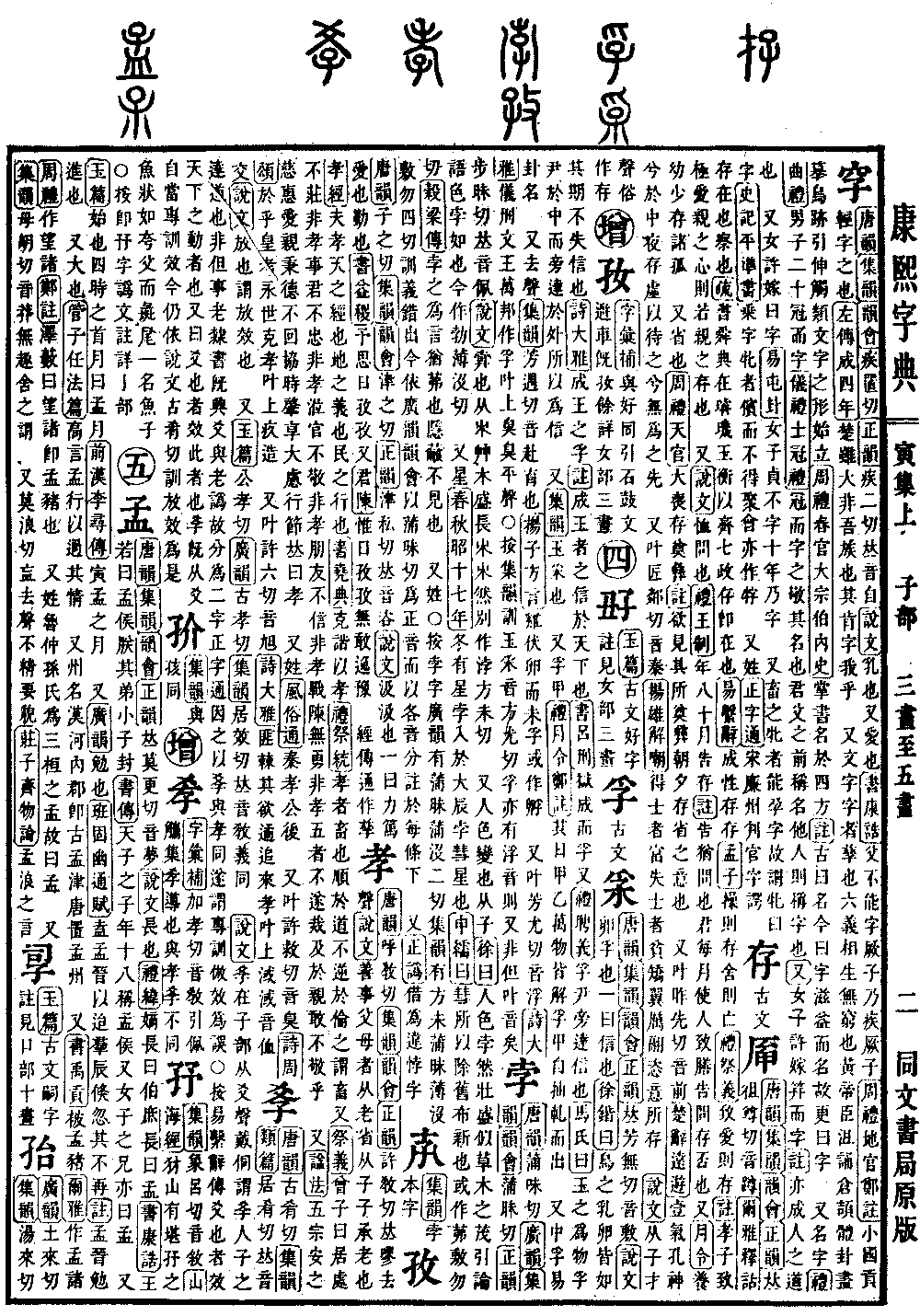
Yin Collection, Upper Volume
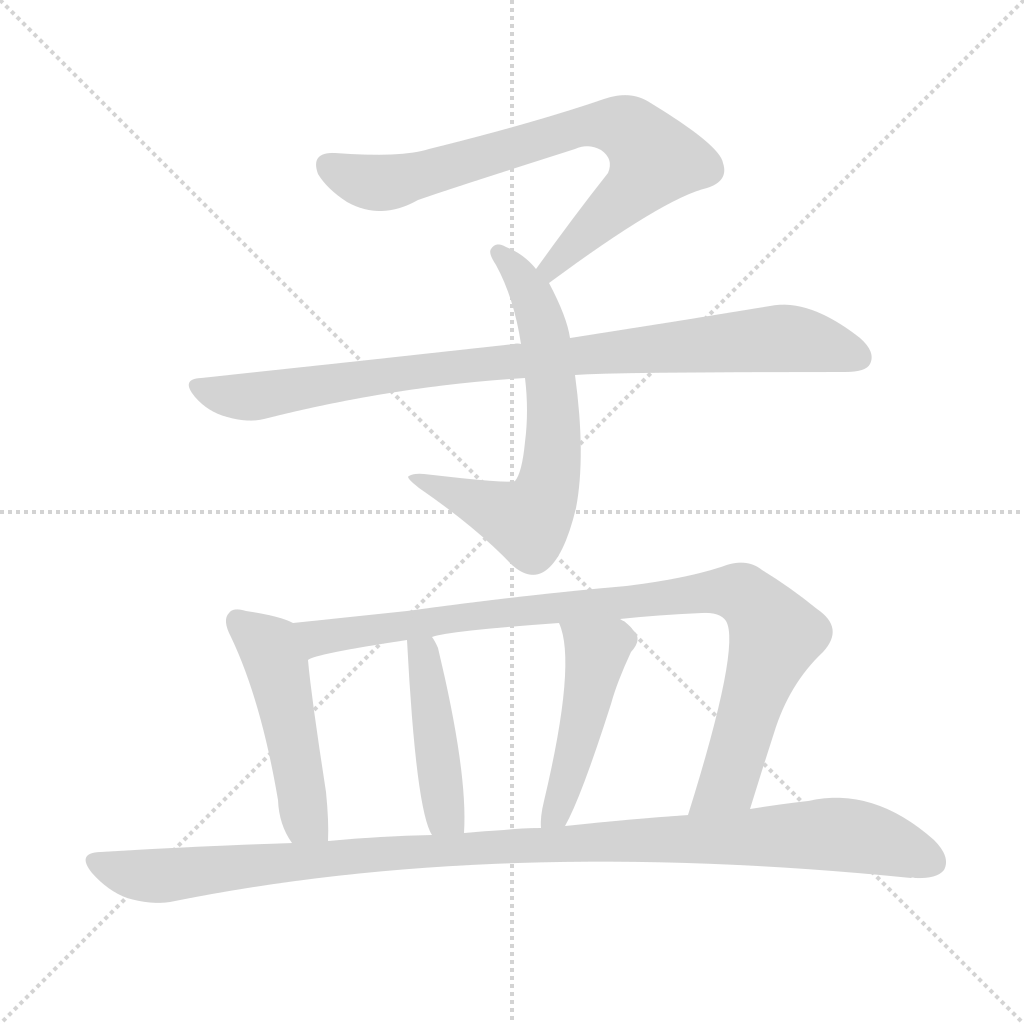
Radical: Child (zǐ)
Kangxi stroke count: 8
Page 278, Entry 16
Pronounced meng (falling tone). Same pronunciation as dream.
Shuowen (Explaining Graphs and Analyzing Characters): Refers to being senior in age.
Book of Rites Weft (Liwei): The eldest son born to the principal wife is called bo; the eldest son born to a concubine is called meng.
Classic of History (Shujing), Announcement to Kang: The King spoke thus: Meng Hou, my younger brother, little Feng.
Commentary on the Classic of History (Shuchuan): The sons of the Son of Heaven, upon reaching the age of eighteen, are called Meng Hou. Also, a woman's elder brother is called meng.
Yupian (Jade Chapters): Refers to the beginning; the first month of any of the four seasons is called the meng month.
History of the Former Han (Qianhan), Biography of Li Xun: Refers to the first month of the year (the lunar first month), which is the first month of spring.
Guangyun (Broad Rhymes): Refers to exerting effort.
Ban Gu, Rhapsody on Dark Communication (Youtong fu): Why not exert effort and forge ahead to catch up with others, for time flies and will not return.
Annotation: Mengjin means to exert effort and forge ahead.
Also refers to being great.
Guanzi, On Appointing Officials (Renfa): To talk boastfully and act with exaggeration, exceeding the reality of the situation.
Also the name of a prefecture; in the Han dynasty, it was Henei Commandery, the location of ancient Mengjin, and in the Tang dynasty, it was established as Meng Prefecture.
Classic of History (Shujing), Tribute of Yu (Yugong): Covering Mengzhu Marsh.
Erya (Approaching Elegance): Written as Mengzhu.
Rites of Zhou (Zhouli): Written as Wangzhu.
Zheng Annotation: A great marsh is called Wangzhu, which is Mengzhu.
Also a surname; the Zhongsun family of the Lu state held the eldest rank among the Three Huan, and thus were called Meng.
Pronounced mang (rising tone). Refers to having no standard for selection.
Pronounced lang (falling tone). Refers to being imprecise or unimportant.
Zhuangzi, Discussion on Making All Things Equal (Qiwulun): Refers to rash or inappropriate speech.