Wu Collection, Middle Volume
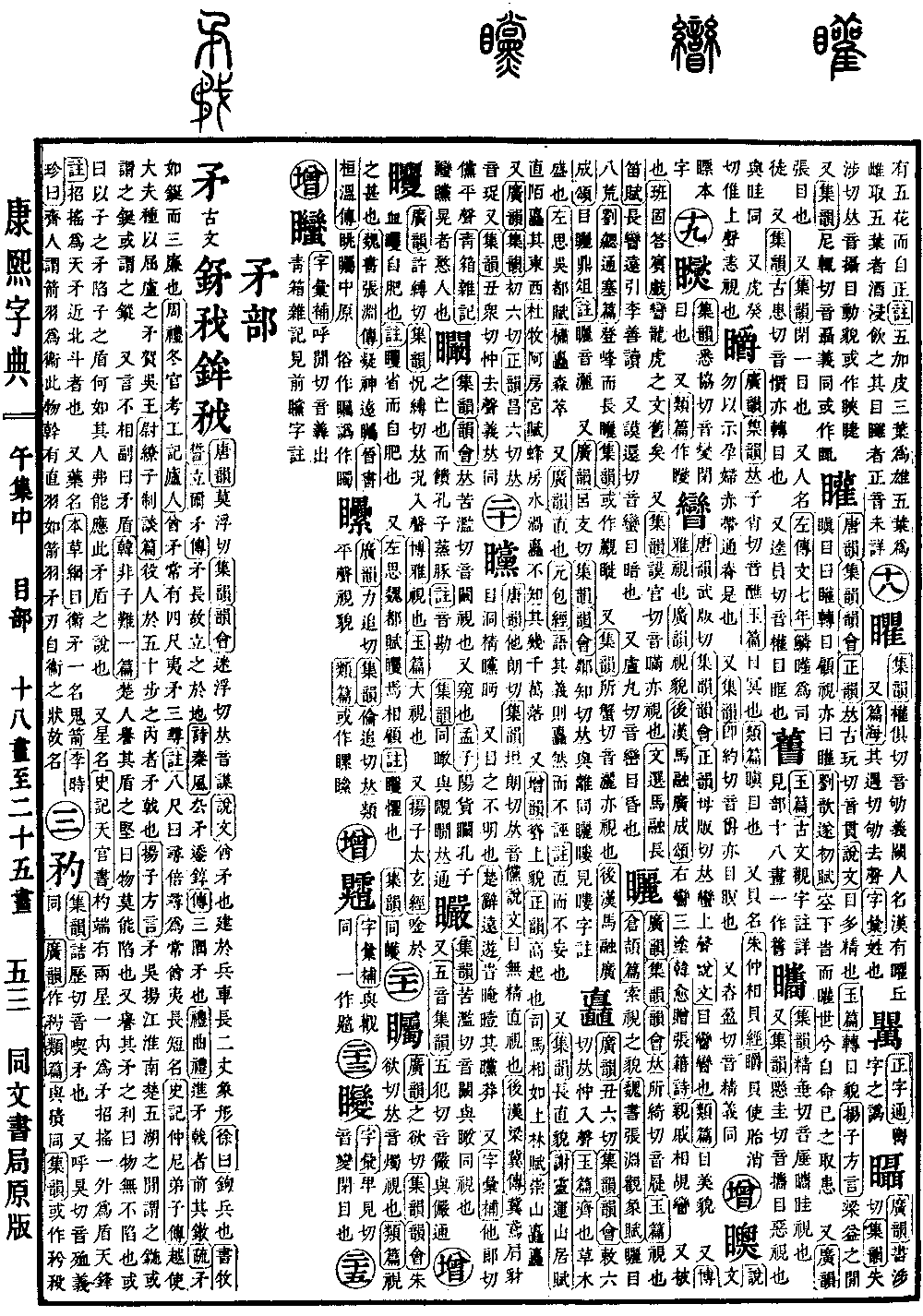
Radical: Spear (máo)
Page 821, Entry 22
The ancient written form is rendered as a variant form (móu). Pronounced mou. According to the Tang Rhyme (Tangyun), Collection of Rhymes (Jiyun), and Rhyme Meeting (Yunhui), the pronunciation is similar to mou. The Explaining Graphs and Analyzing Characters (Shuowen Jiezi) defines it as a long spear. It was mounted on military chariots and measured two zhang in length; the character form is pictographic. Xu Kai explains that it is a type of hooking weapon. The Book of Documents (Shangshu), Pastoral Vow (Mushi) states: Stand your spears. Commentary: Because spears were very long, they were stood upon the ground. The Book of Odes (Shijing), Qin Wind (Qin Feng) mentions the metal-tipped spears with reinforced ferrules. Commentary: This refers to a three-edged spear. The Book of Rites (Liji), Summary of the Rules of Propriety (Quli) states that when presenting spears or halberds, the handle end should be pointed forward. Commentary: It explains that a spear is like a short pike but possesses three cutting edges. The Rites of Zhou (Zhouli), Winter Office, Records of the Artificers (Kaogongji) records that the long spear (qiumao) was one chang and four chi long, and the Yi spear was three xun long. Commentary: Eight chi make one xun, and two xun make one chang. The qiumao and the Yi spear are designations for different lengths. The Records of the Grand Historian (Shiji), Biographies of Confucius's Disciples (Zhongni Dizi Zhuan) records that the state of Yue sent the grand master Wen Zhong to congratulate the King of Wu with a spear produced in Qulu. The Weiliaozi, Discourse on Strategy (Zhitan Pian) states that within a distance of fifty paces, one kills using spears and halberds. The Yangzi Dialect Dictionary (Fangyan) states that the spear is known as shi, or as jian, or as cong, in the regions of Wu, Yang, Jiang, Huai, Southern Chu, and the Five Lakes.
Furthermore, when words or actions contradict each other, it is called contradiction. The Han Feizi, Difficulties (Nan Yipian) records: A man of Chu boasted of his shield's strength, saying: Nothing can pierce it. He also boasted of his spear's sharpness, saying: There is nothing it cannot pierce. Someone asked: If one uses your spear to pierce your shield, what will happen? The man could not answer. This is the origin of the term contradiction.
It is also the name of a star. The Records of the Grand Historian (Shiji), Treatise on the Celestial Offices (Tianguan Shu) records: At the end of the Dipper handle are two stars; the one closer to the inside is the spear, called the Zhaoyao star, and the one on the outside is the shield, called the Tianfeng star. Commentary: The Zhaoyao star is the celestial spear, a star close to the Big Dipper.
It is also the name of a medicinal herb. The Compendium of Materia Medica (Bencao Gangmu) records: Weimao, another name for which is ghost arrow. Li Shizhen says: People in the region of Qi call arrow feathers wei. The stems of this plant have straight appendages that look like arrow feathers, resembling the shape of a spear blade protecting itself, hence the name.