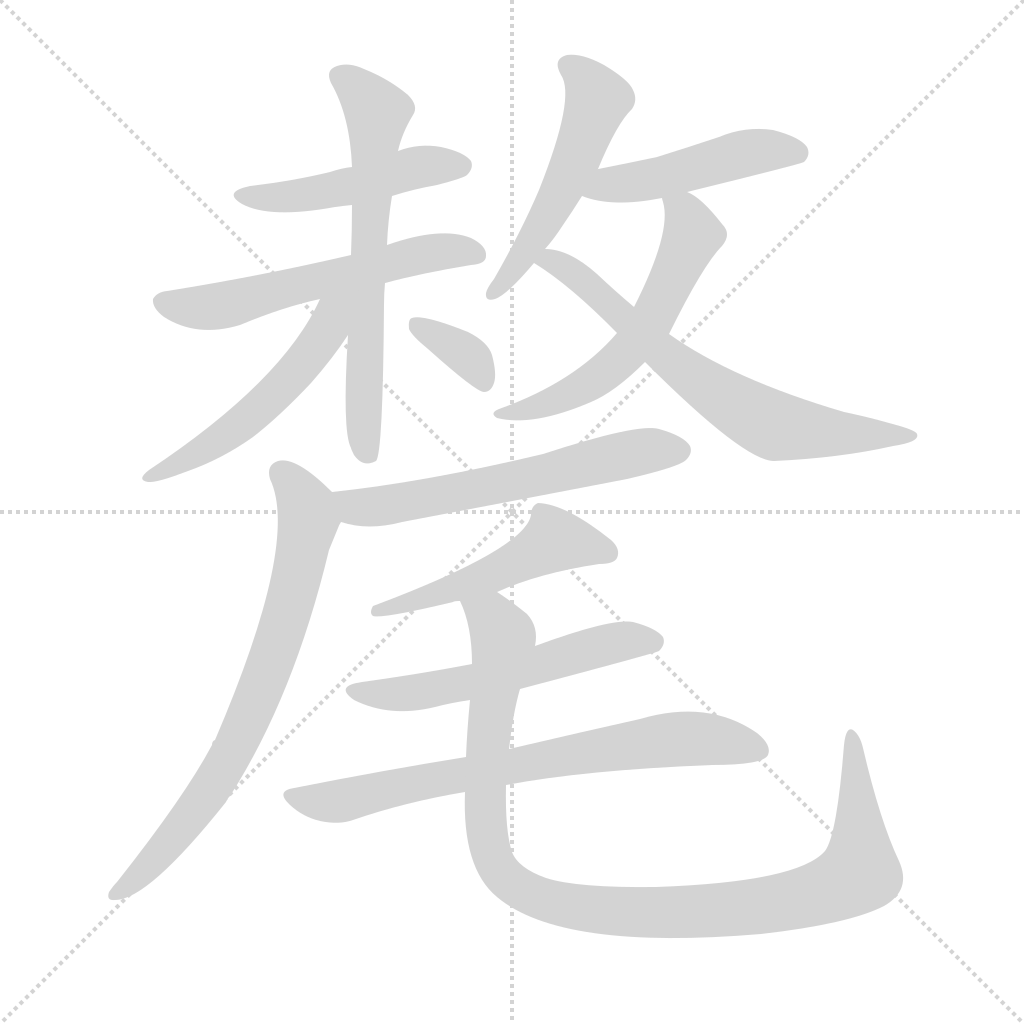
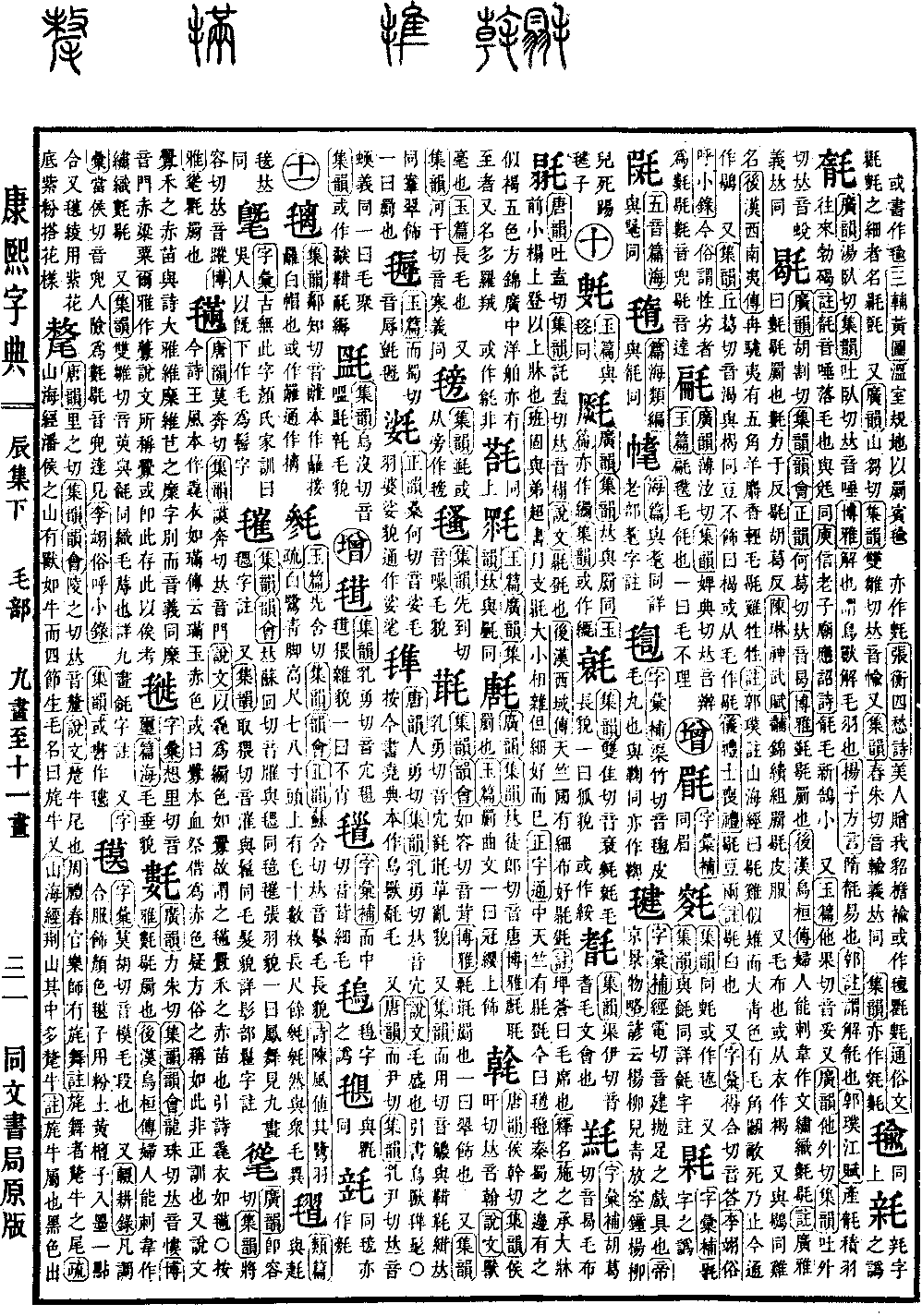
Chen Collection, Lower Volume
Radical: Fur (máo)
Kangxi Strokes: 15
Page 595, Entry 46
Pronounced li. According to the Shuowen Jiezi (Explanation of Words and Phrases), this refers to the tail of a yak. In the Rites of Zhou (Zhouli), Spring Offices, Master of Music section, the commentary on the Mao-dance notes that it is a dance performed using a yak tail. The commentary states that the Classic of Mountains and Seas (Shanhaijing) records a beast on Panhou Mountain resembling a cow but with long hair on its joints, known as a yak.
Also, the Classic of Mountains and Seas notes that Jingshan is home to many yaks. The commentary states that the yak is a type of cow, black in color, found beyond the southwestern borders. Du Fu's poetry mentions a heavenly horse following a yak with its hooves.
Also, a horse's tail is called li. The Huainanzi (Book of the Prince of Huainan), Instructions on Explaining Mountains, mentions using horsehair to cut jade. The commentary states that li refers to horsehair.
Also refers to stiff and curled hair. The History of the Former Han (Hanshu), Biography of Wang Mang, mentions using stiff hair to stuff clothing. The commentary by Yan Shigu states that stiff and curly hair is called li, used to fill paper garments to make them fluffy and expand.
Also, the History of the Former Han, Treatise on the Five Elements, records that in the third year of the Tianhan era, in the eighth month, white hair fell from the sky.
Also, according to the Xiao Erya (Little Book of Refined Terms), variegated hair is called li.
Also refers to long hair. The History of the Later Han (Houhanshu), Biography of Cen Peng, records that when Cen Xi was appointed governor of Weijun, the people sang his praises, saying that even the dogs did not bark in alarm, and they grew long hair on their feet. The commentary notes that li means long hair; since the dogs did not chase or bark at people, they could leisurely grow long hair on their feet.
Also refers to wool textiles. The Erya (Approaching Elegance), Interpretation of Words, states that li is ji (a type of wool fabric). The commentary by Guo Pu states that wool is used to make ji. The sub-commentary by Xing Bing explains that it is made by weaving wool, similar to a modern wool blanket, or used for horse-harness straps.
Also used to describe anything minute or fine. The Liezi, Yin Tang section, describes hanging a louse by a single fine hair from a window. Cao Zhi's Rhapsody on the Nine-Flower Fan mentions bamboo splints being split into distinct fine threads.
Also interchangeable with the character li. The Records of the Grand Historian (Shiji), Biography of Su Qin, states that if a fine hair is not removed, one will eventually need an axe to deal with the resulting large tree. The History of the Former Han, Treatise on Music and Calendars, mentions not missing by even a hair or a li. The commentary by Meng Kang states that the width of ten hairs equals one li.
Pronounced mao. The meaning is the same. Sometimes also written in a variant form (ta), (mao), or (li).
Also pronounced lai. The meaning is the same.
Note: The commentary on the Rites of Zhou, Spring Offices, states that li is pronounced mao. Liu Changzong reads it as lai; Shen Chong reads it as li; some read it as mao; others write it as (li) or (ta). Examining the mention of the (li) ox in the Zhuangzi, Chapter on Wandering at Ease, it is said to be as large as a cloud on the horizon. The commentary by Guo Xiang reads it as li; Xu Miao and Li Gui read it as lai; it is also read as li. Sima Biao states it is the yak. From this, it is understood that although the phonetic readings of various commentators differ, the meanings are synonymous.