Shen Collection, Upper Volume
Radical: Grass (cǎo)
Kangxi Strokes: 11
Page 1025, Entry 20
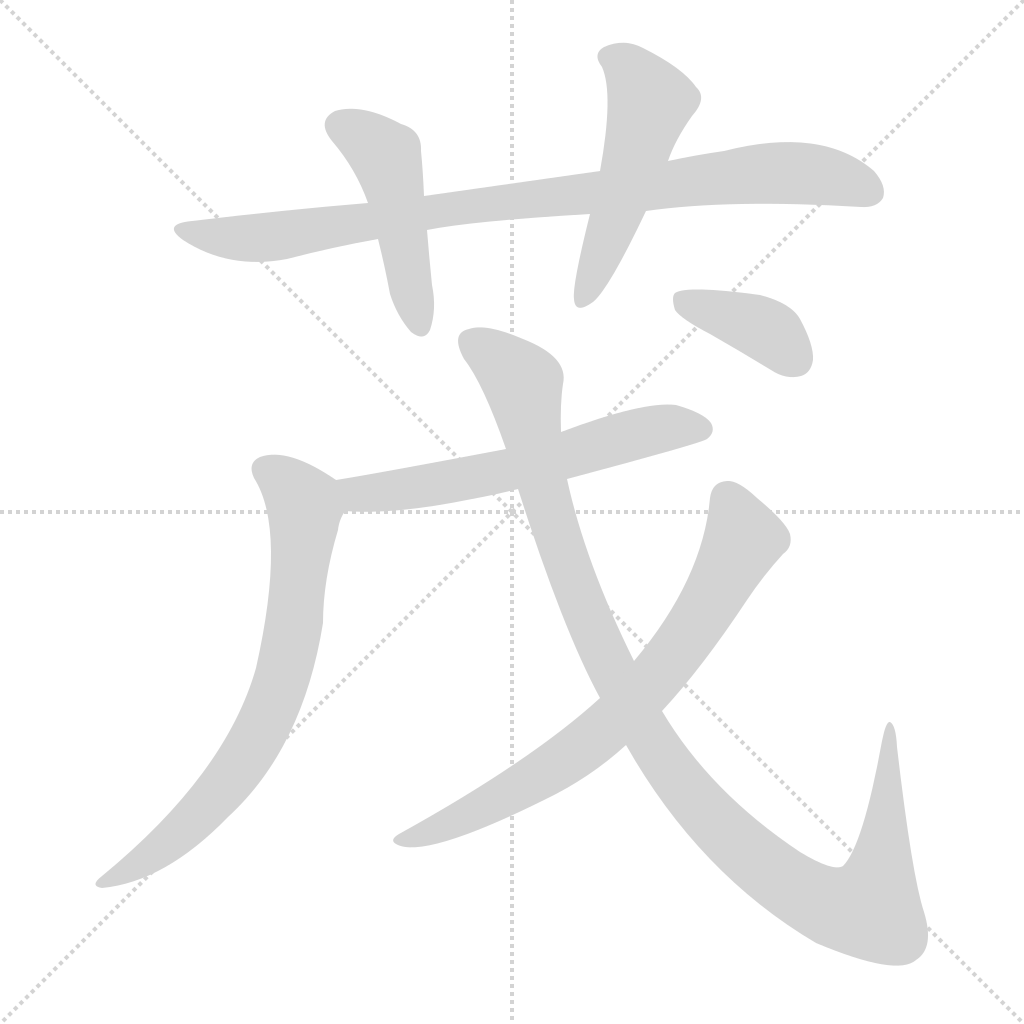
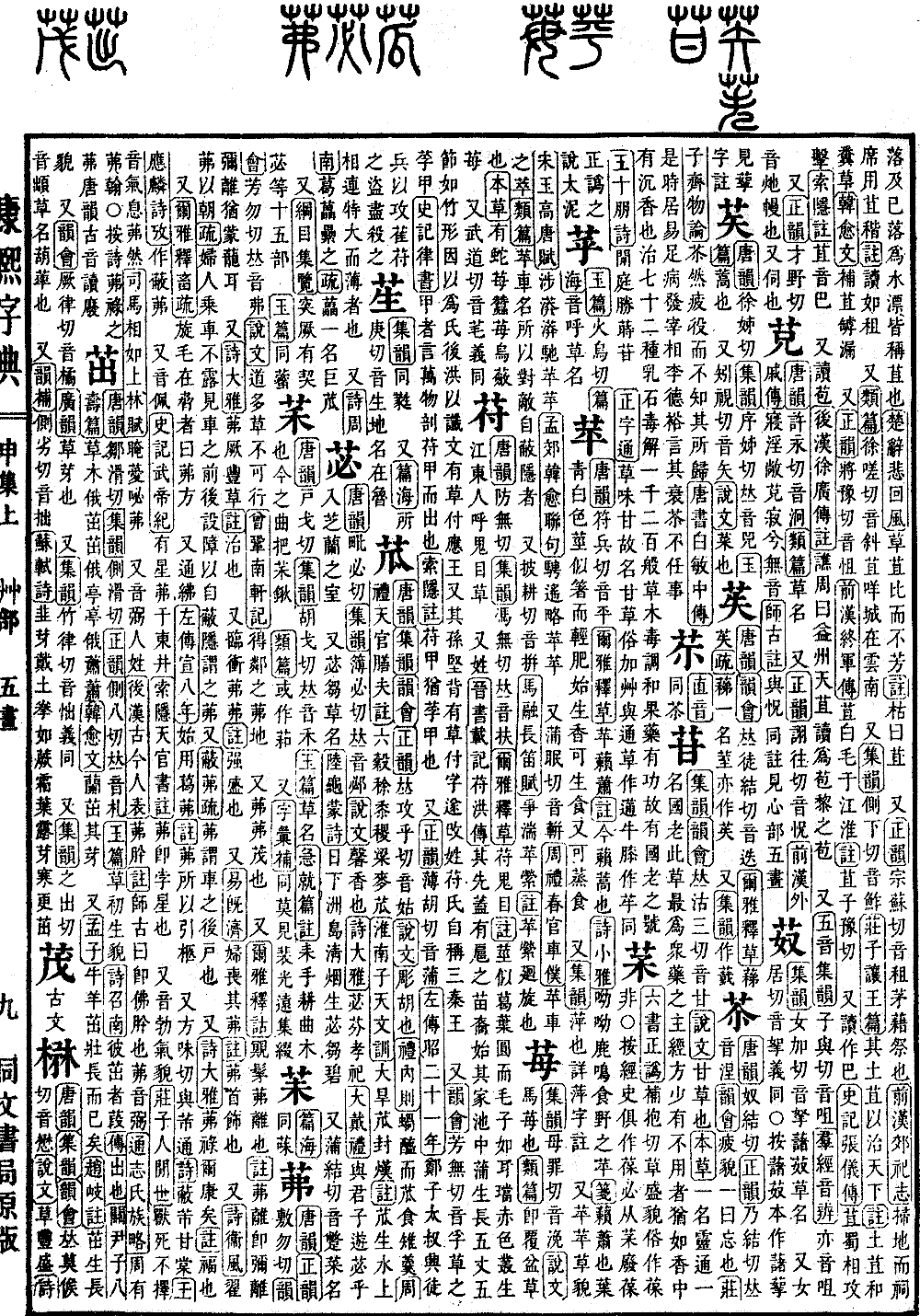
In archaic script, it is written as (mào). According to Tang Rhymes (Tangyun), Collection of Rhymes (Jiyun), and Collection of Phonology (Yunhui), the pronunciation is mao. It is pronounced the same as (mào). Explained in Analytical Dictionary of Chinese Characters (Shuowen Jiezi) as grass growing in abundance and density. In Book of Odes (Shijing), Xiao Ya section, it states, Like the flourishing of the pine and cypress. Book of Changes (Yijing), Hexagram Wuwang, states, The former kings used flourishing virtue to correspond with the seasons and nourish the myriad things. The annotation states that flourishing means prosperous.
Also, in Book of Odes (Shijing), Da Ya section, it says, Planting the yellow and flourishing grain. The annotation states that flourishing refers to something beautiful. In History of the Former Han (Qian Hanshu), Biography of Liu Bi, Prince of Wu, it says, Every year offering greetings to men of flourishing talent. The annotation refers to people with beautiful talents.
Also, in Er Ya, Explanation of Ancient Terms (Shi Gu), flourishing means to be diligent and industrious. In Discourses of the States (Guoyu), Zhou Yu section, it says, In relation to the people, the former kings diligently rectified their virtue and made their natures generous.
Also, in White Tiger Hall Discussions (Baihu Tong), it is recorded that a group of five people is called flourishing.
Also, in Er Ya, Explanation of the Heavens (Shi Tian), when the planet Jupiter is in the Xu year, it is called (yān mào).
It is also a place name. History of the Former Han (Qian Hanshu), Treatise on Geography, mentions Maoling in Youfufeng. The annotation states it was originally Maoxiang in Huaili.
It is also a surname. Zhengzitong records that in the Han dynasty there was a Prefect of Juyang named Mao Zhen.
It is also used interchangeably with (mào). History of the Former Han (Qian Hanshu), Biography of Dong Zhongshu, quotes the Book of Documents (Shujing): Flourish, flourish.
Also, according to Orthodox Rhymes (Zhengyun), it is pronounced mu. History of the Former Han (Qian Hanshu), Narrative Biography by Ban Gu, says, Its branches and leaves are large and flourishing. Yan Shigu’s annotation says that flourishing is pronounced mu.
Also, in Investigation of Ancient Pronunciation of the Mao Odes (Mao Shi Guyin Kao), it is pronounced mei. In Cao Cao's poem Walking Out of the East Gate, it says, Trees and woods grow in clusters, a hundred grasses are lush and flourishing. The autumn wind is soughing, the great waves surge.
Also, in Supplement to Rhymes (Yunbu), it is pronounced mu. In Forest of Changes (Yilin), it says, When it is the sixth month of summer, the branches and leaves are lush and flourishing. The Luan bird provides shade, and the Duke of Zhao avoids the heat.
Also, it is pronounced mu. In the poetry of Bai Juyi, it says, There is a tree called cherry, gaining ground it flourishes early. The leaves are dense as it catches the sun alone, the flowers are abundant as it receives the dew.
Also, Zhengzitong classifies it under the he rhyme, pronounced mo. In the Inscription on the Brush of King Wu of Zhou, it says, Fine hair is thick and dense, water can be removed, but the script cannot be brought to life.
In Direct Pronunciation, it is written as (mào). The character belongs to the Radical: Grass (cǎo).