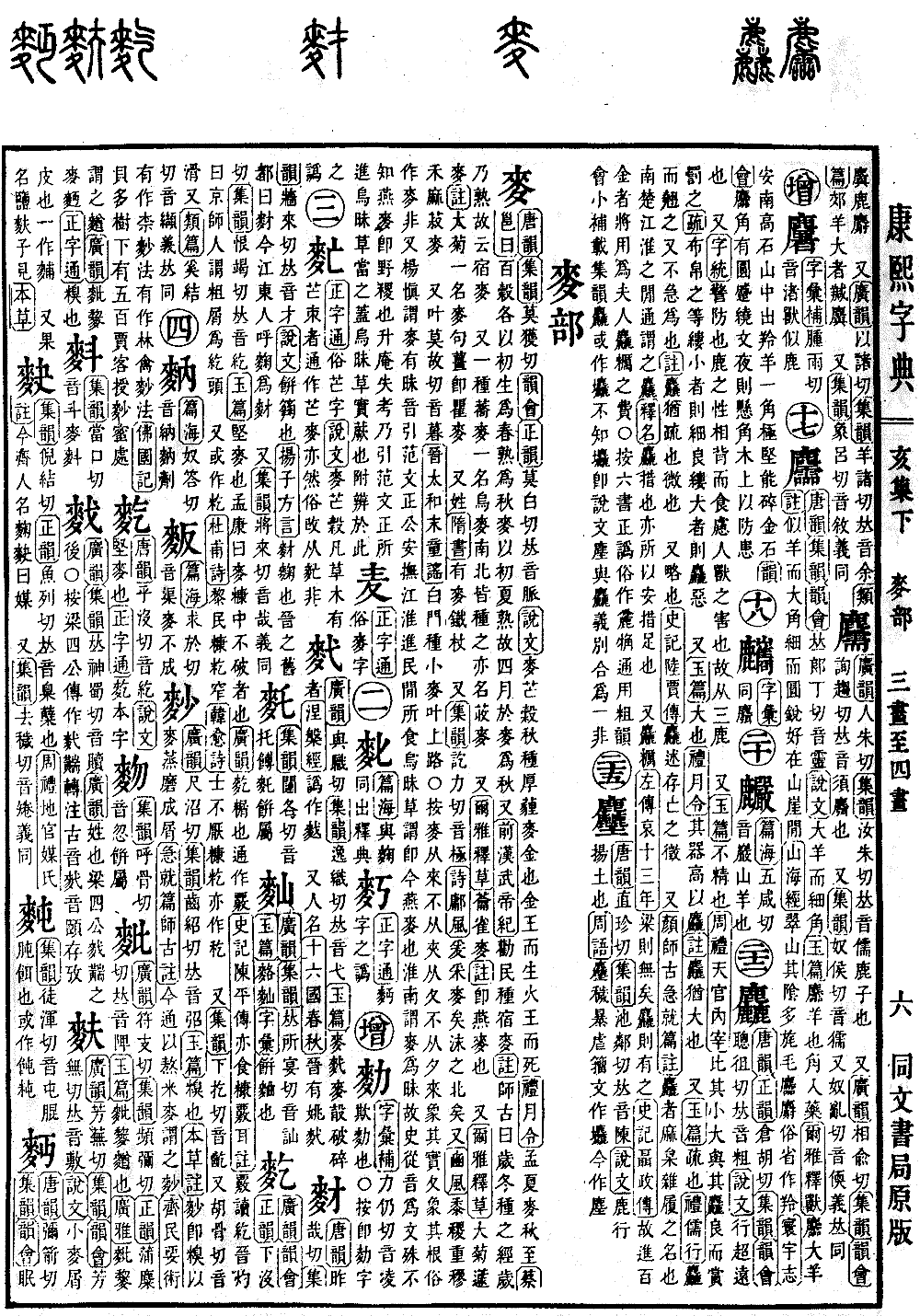
Hai Collection, Lower Volume
Radical: Wheat (mài)
Kangxi Strokes: 11
Page 1512, Entry 09
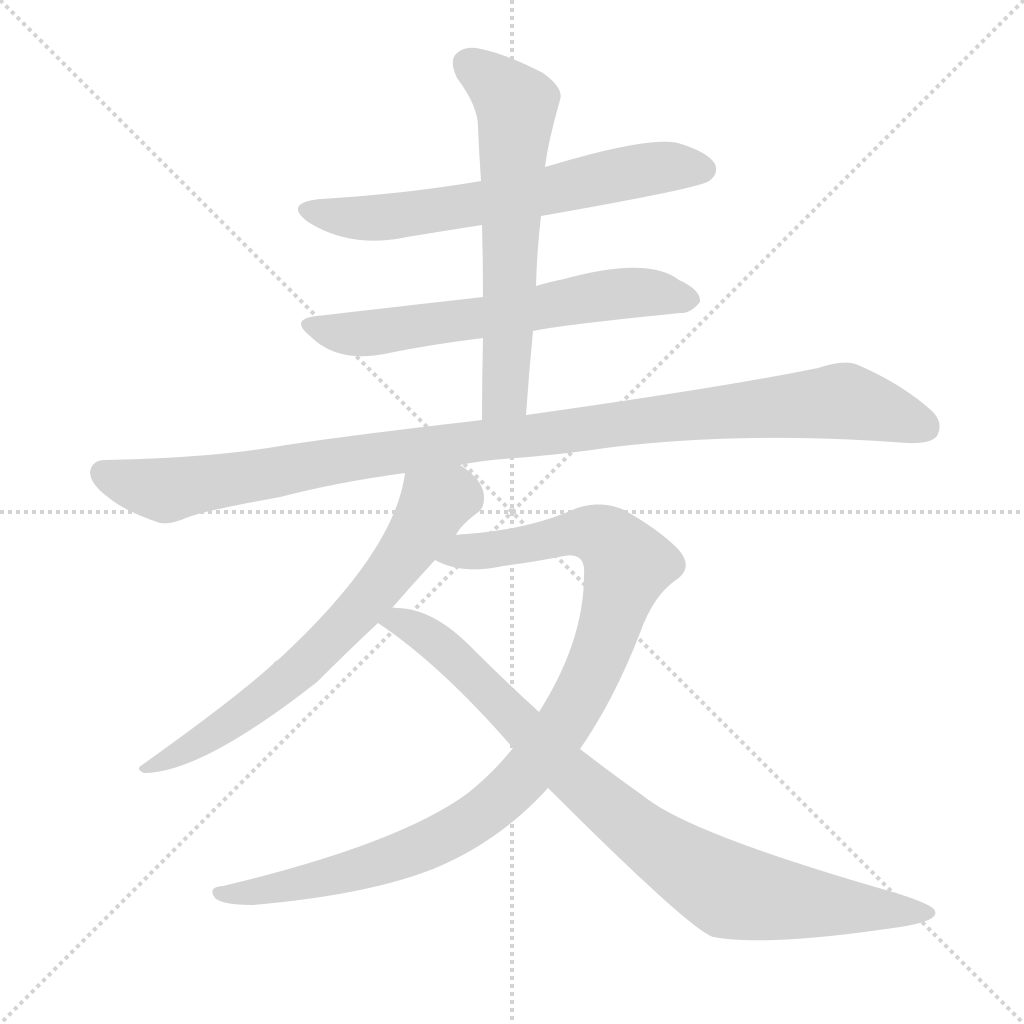
Zhengzitong: This is the vulgar form of the character for wheat.
Mai
Tangyun, Jiyun: Pronounced mo (glottal stop).
Yunhui, Zhengyun: Pronounced mo (glottal stop).
The pronunciation is the same as the character for pulse.
Shuowen: Wheat is a grain with awns; it is sown in autumn and deeply buried in the earth. Wheat belongs to the element of metal. It grows when the energy of metal is prosperous and dies when the energy of fire is prosperous.
Book of Rites (Liji), Monthly Ordinances (Yueling): In the early summer season, wheat matures (the wheat autumn arrives).
Cai Yong states: All grains consider their birth as spring and their maturity as autumn. Wheat matures in early summer, so the fourth month is the autumn of wheat.
Also, from the History of the Former Han (Qianhan Shu), Biography of Emperor Wu: Encouraging the people to plant winter wheat (su mai). Note: Yan Shigu says it is sown in winter and matures after a year, hence it is called su mai.
Also, there is a variety called buckwheat, also known as black wheat. It is grown both north and south, and is also called qiao wheat.
Erya, Explanations of Plants (Shicao): Yue is sparrow wheat. Note: This is oats.
Erya, Explanations of Plants (Shicao): Daju is qu wheat. Note: Daju, also called maijuqiang, is maiden pink (qu mai).
Also a surname. The Book of Sui (Suishu) mentions a person named Mai Tiezhang.
Also, Jiyun: Pronounced ji.
Book of Odes (Shijing), Odes of Yong (Yongfeng): Where shall we go to gather wheat? It is to the north of the Mo city.
Also, Odes of Bin (Binfeng): Broomcorn millet, panicled millet, early and late ripening grains, hemp, beans, and wheat.
Also, rhyming with the sound mu. A nursery rhyme from the end of the Taihe period of the Jin dynasty: Planting wheat at White Gate (rhyming with the sound lu).
Note: The character for wheat never includes the component for press; it is composed of the radical for go slow and not the character for evening. The central part symbolizes its fruit, and the lower part symbolizes its roots. Writing it as the vulgar form is incorrect.
Also, Yang Shen states that wheat has the pronunciation mei. He cites Fan Zhongyan (Wenzheng Gong), who, while pacifying the Jianghuai region, presented the black mei grass eaten by the common people, claiming it was modern-day oats. Huainan region calls wheat mei, so history books recorded the character based on the pronunciation, not knowing that oats are wild millet. Yang Shen's research is erroneous; he mistakenly cited the black mei grass, which is actually a type of fern. Included here for clarification. Wheat is written with the component for press on top and the character for go slow below.