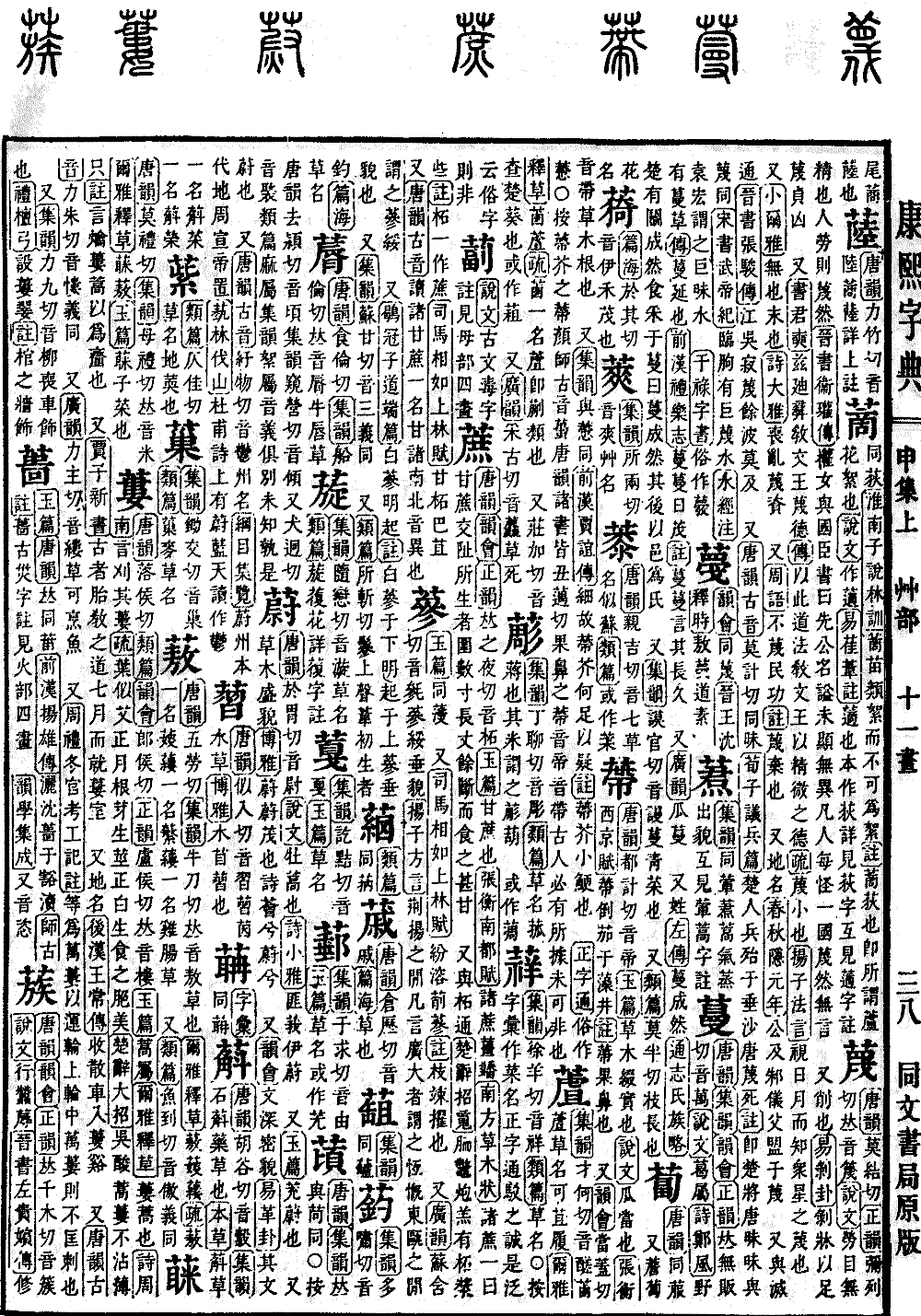
Shen Collection, Upper Volume
Radical: Grass (cǎo)
Kangxi Strokes: 17
Page 1054, Entry 03
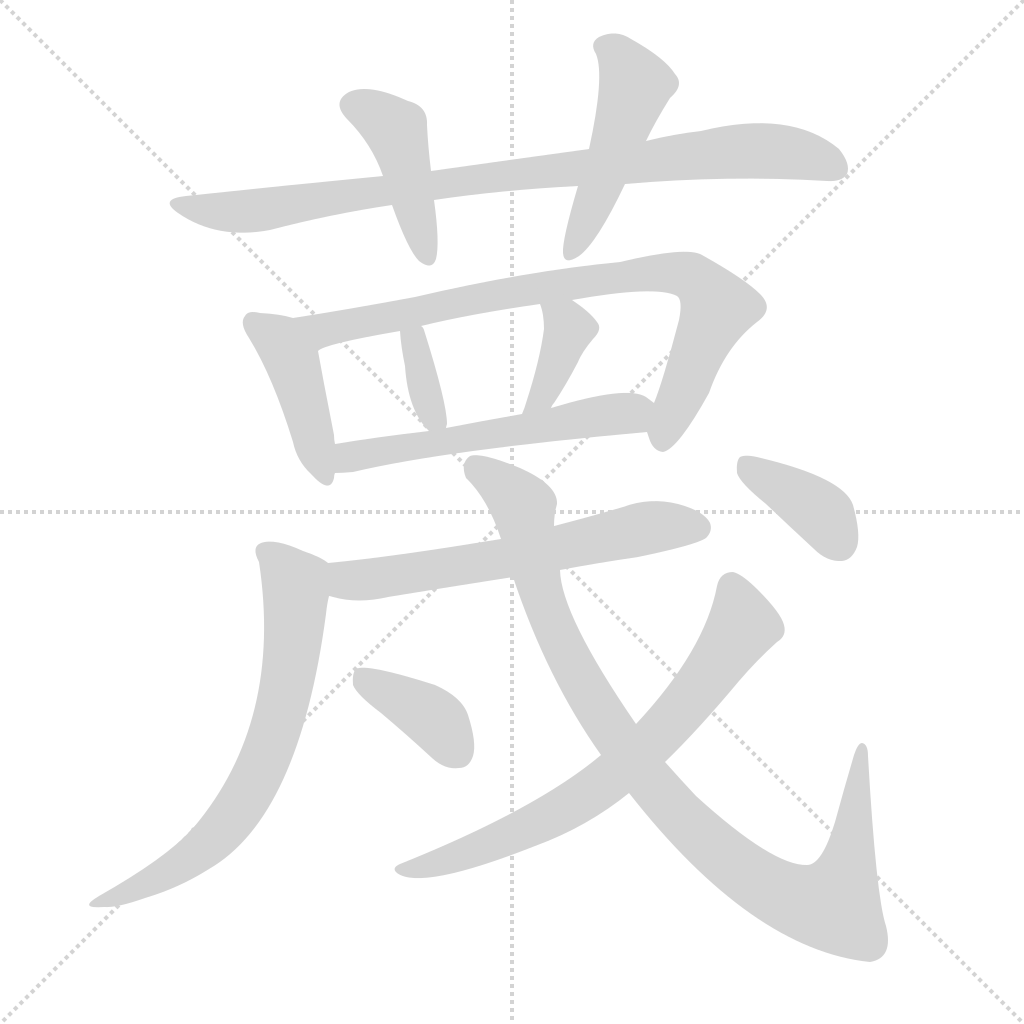
Pronounced mie.
According to the Shuowen Jiezi, the term describes eyes that are tired and lacking luster; when a person is exhausted, their gaze appears vacant.
The Book of Jin (Jinshu), Biography of Wei Guan, records: In a letter from the daughter of Quan to the court officials, she stated that the titles and posthumous names of her ancestors remained unrecognized, indistinguishable from those of commoners, and she found it strange that the entire nation remained silent and indifferent.
It also carries the meaning of to erode or to diminish. The Book of Changes (Yijing), Hexagram Bo, states: To erode the legs of the bed, damaging the righteous path, is ominous.
The Book of Documents (Shangshu), Jun Shi, states: By following this constant path of instruction, the subtle virtues of King Wen are manifested. The Commentary explains: By using this method to instruct, the subtle virtues of King Wen are manifested. The Sub-commentary explains: Mie means small or subtle.
Yangzi’s Model Sayings (Fayan) states: Upon seeing the sun and moon, one recognizes the insignificance of the stars.
The Little Erya (Xiao Erya) defines it as none, without, or as the tip or something infinitesimal.
The Book of Odes (Shijing), Daya, states: With death, mourning, and chaos, there are no resources left.
The Discourses of the States (Guoyu), Zhouyu, states: Do not discard the merits of the common people. The Annotation explains: Mie means to discard or abandon.
It is also a place name. The Spring and Autumn Annals (Chunqiu), First Year of Duke Yin, records: Duke Yin of Lu and Yifu, the ruler of the Zhu state, held a covenant at the place called Mie.
It is also interchangeable with the character meaning to extinguish or destroy (mie). The Book of Jin (Jinshu), Biography of Zhang Jun, states: The regions of Jiang and Wu were silent and extinguished, and the remaining influence could not reach there.
According to the Tangyun Guyin, it is pronounced mei, the same as the character for obscured (mei).
Xunzi, Essay on Military Affairs, states: The Chu army was nearly annihilated at Chuisha, and Tang Mie was killed in battle. The Annotation explains: This refers to the Chu general Tang Mei. Mei and Mie are identical.
The Book of Song (Songshu), Annals of Emperor Wu, records: Linqu has the Jumei River. The Commentary on the Water Classic (Shuijing Zhu) records: Yuan Hong refers to it as the Jumei River.
The Ganlu Zishu states: The common variant form is written as mie. The original form of the character mie is derived from the component representing grass, not from the component meaning to strike.