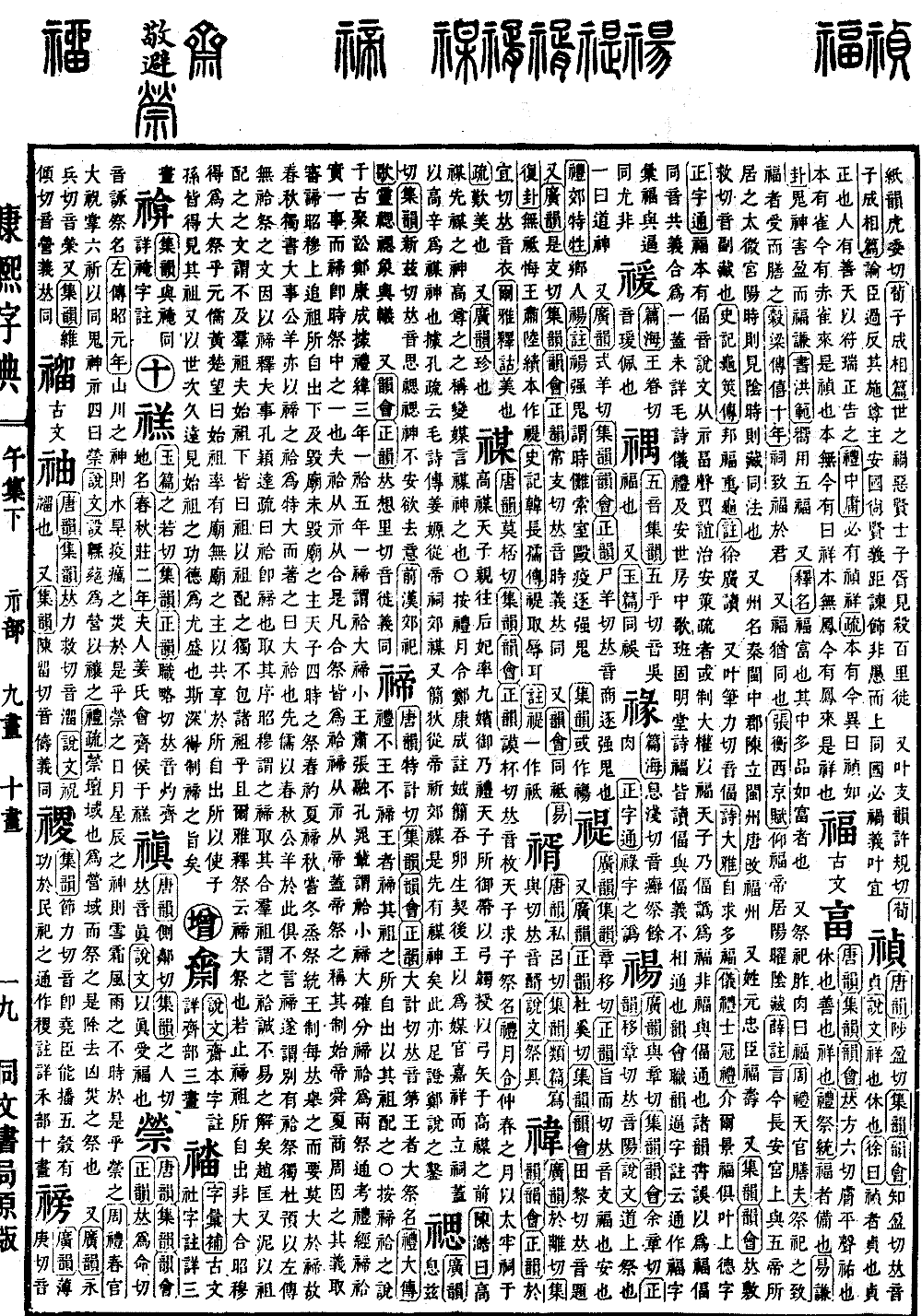
Wu Collection, Lower Volume
Radical: Spirit (shì)
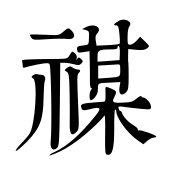
Mei
Kangxi stroke count: 14
Page 845, Entry 11
Pronounced mei. The name of a sacrifice performed by the Son of Heaven to pray for offspring.
Recordings in the Book of Rites (Liji), section Monthly Ordinances (Yueling), state: In the second month of spring, the grand sacrificial ritual (tailao) is performed at the High Matchmaker (Gaomei) shrine. The Son of Heaven proceeds in person, with the empress and nine consorts in attendance, to pay respects to the concubines favored by the Emperor; they are presented with bow cases and bows, and brought before the altar of the High Matchmaker.
Explanation: High Matchmaker (Gaomei) refers to the ancestral deity of matchmaking. The term High is an honorific. Changing the character mei (matchmaker) to mei (divine matchmaker) signifies the deification of the spirit.
According to the commentary by Zheng Kangcheng on the Book of Rites (Liji), section Monthly Ordinances (Yueling): The Yousong clan swallowed a bird egg and gave birth to Xie; subsequent monarchs established the office of the matchmaker in commemoration of this auspicious sign, likely venerating Emperor Gaoxin as the divine matchmaker.
According to the sub-commentary by Kong Yingda: The commentaries on the Book of Odes (Shijing) mention that Jiang Yuan followed the emperor to sacrifice at the suburban altar of the matchmaker, and that the Di people also followed the emperor to pray there, which indicates that the deity existed in ancient times and confirms the accuracy of Zheng Xuan’s interpretation.