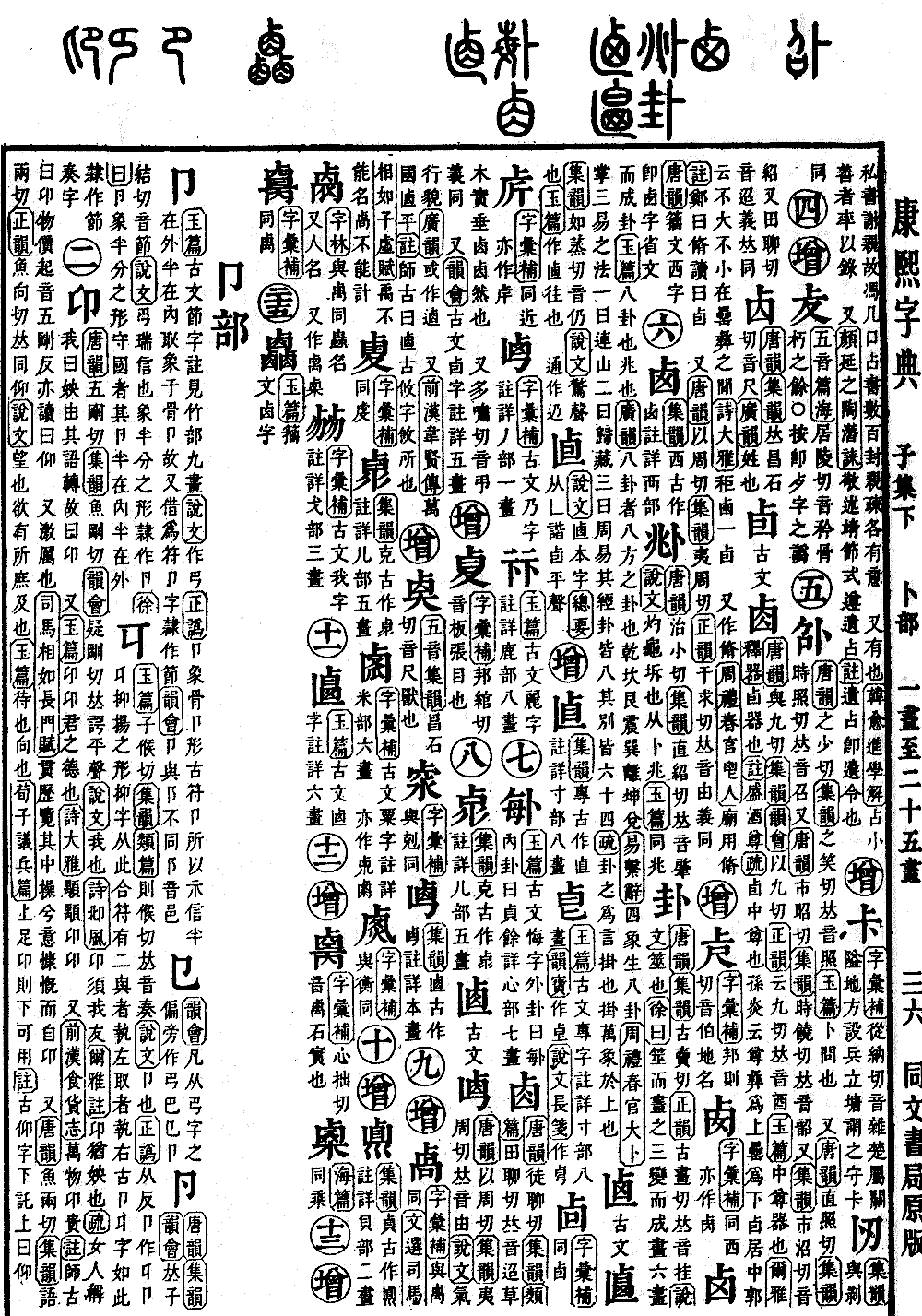
Hai Collection, Lower Volume
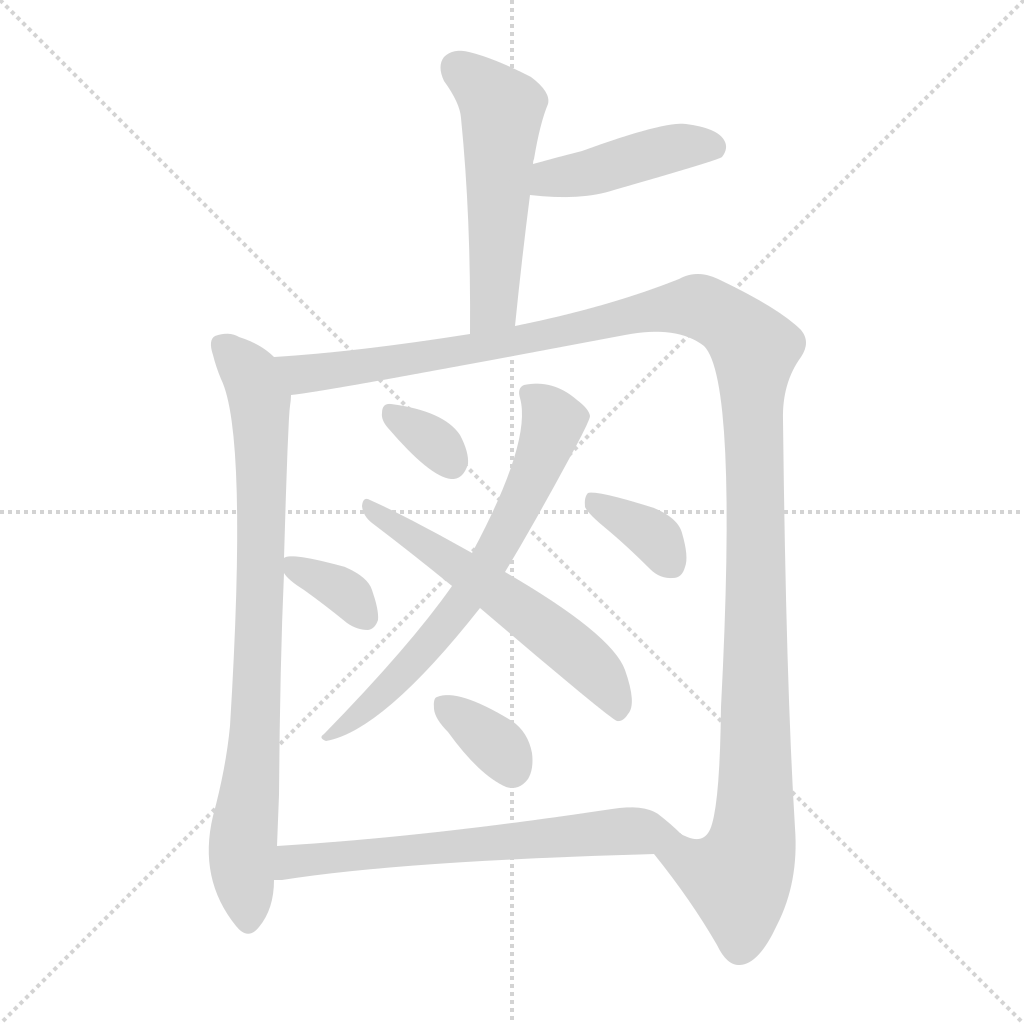
Radical: Salt (lǔ)
Kangxi Strokes: 11
Page 158, Entry 01
Pronounced lu.
According to the Explaining Graphs and Analyzing Characters (Shuowen Jiezi), it refers to salty earth in the west. In the east, it is called [omitted], while in the west, it is called lu. According to the Wide Rhymes (Guangyun), it is a salt marsh. What is produced by heaven is called lu, and what is produced by humans is called salt.
According to the Commentary on the Great Plan (Hongfan Shu) of the Book of Documents (Shangshu), the nature of water is originally sweet; when it soaks the land for a long time, it changes into lu.
According to the Book of Changes (Yijing), in the Treatise on the Hexagrams, the hexagram Dui represents hard and salty land.
Also, it refers to pure and salty land. In the Zuo Tradition (Zuo Zhuan), in the twenty-fifth year of Duke Xiang, the Viscount of Chu sent Zimu to mark out pure and salty land. The commentary notes that pure and salty land refers to land that is barren and thin, where markings are placed to distinguish it so as to reduce the tax burden.
Also, a place name. In the Spring and Autumn Annals (Chunqiu), in the first year of Duke Zhao, Xun Wu of Jin led an army to defeat the Di people at Dalu. The commentary notes that Dalu is Jinyang County in Taiyuan.
Also, in the Book of Han (Hanshu) in the Treatise on Geography, there is Lu County in Anding Commandery. Also, there is Lucheng County in Dai Commandery.
Also, a royal procession (lǔbù). According to the Rituals of Han Officials (Hanguanyi), the order of the Son of Heaven’s carriage procession is called lubu. The guards armed with shields and armor are positioned on the outside as an escort, all recorded in a register, which is why it is called lubu.
Also, careless or sloppy; referring to being hasty or unrefined. In the Zhuangzi, in the chapter on Ze Yang, it is said: Formerly, when I planted crops, I treated them with carelessness during cultivation, so the harvest repaid me with carelessness.
Also, the name of a fragrant herb. According to the Erya, in the Explanation of Plants, it states that tu-lu is the du-heng herb. It resembles mallow and is fragrant. The commentary notes that du has another name, tu-lu.
Also, according to the Guangya, lu means to scent or perfume.
Also, interchangeable with the character for a large shield (lǔ). In the Book of Han, in the Biography of Xiang Ji, it is said that flowing blood caused shields to float. The commentary notes that lu means shield. In Zuo Si's Rhapsody on the Capital of Wu (Wu Du Fu), it mentions shields and spears.
Also, interchangeable with the character for capture or plunder. According to the Fangyan, lu means to seize. In the Book of Han, in the Annals of Emperor Gao, it states: Do not plunder or seize. In the Biography of Wei Qing, it states that vehicles and livestock were all taken as spoils of war.
Also, a surname. According to the Records of the Grand Historian (Shiji), in the Biography of Wandering Knights, there is Lu Gongru of Taiyuan.
Also, pronounced lu. Identical to the character for stove (lú). In the Daoshu, it states: The tripod is the image of heaven and earth. The commentary notes that lu means stove.
In the Explanation of Names (Shimingshi), it says: Land that does not grow things is called lu. Lu means stove, like the place where a stove fire is located.