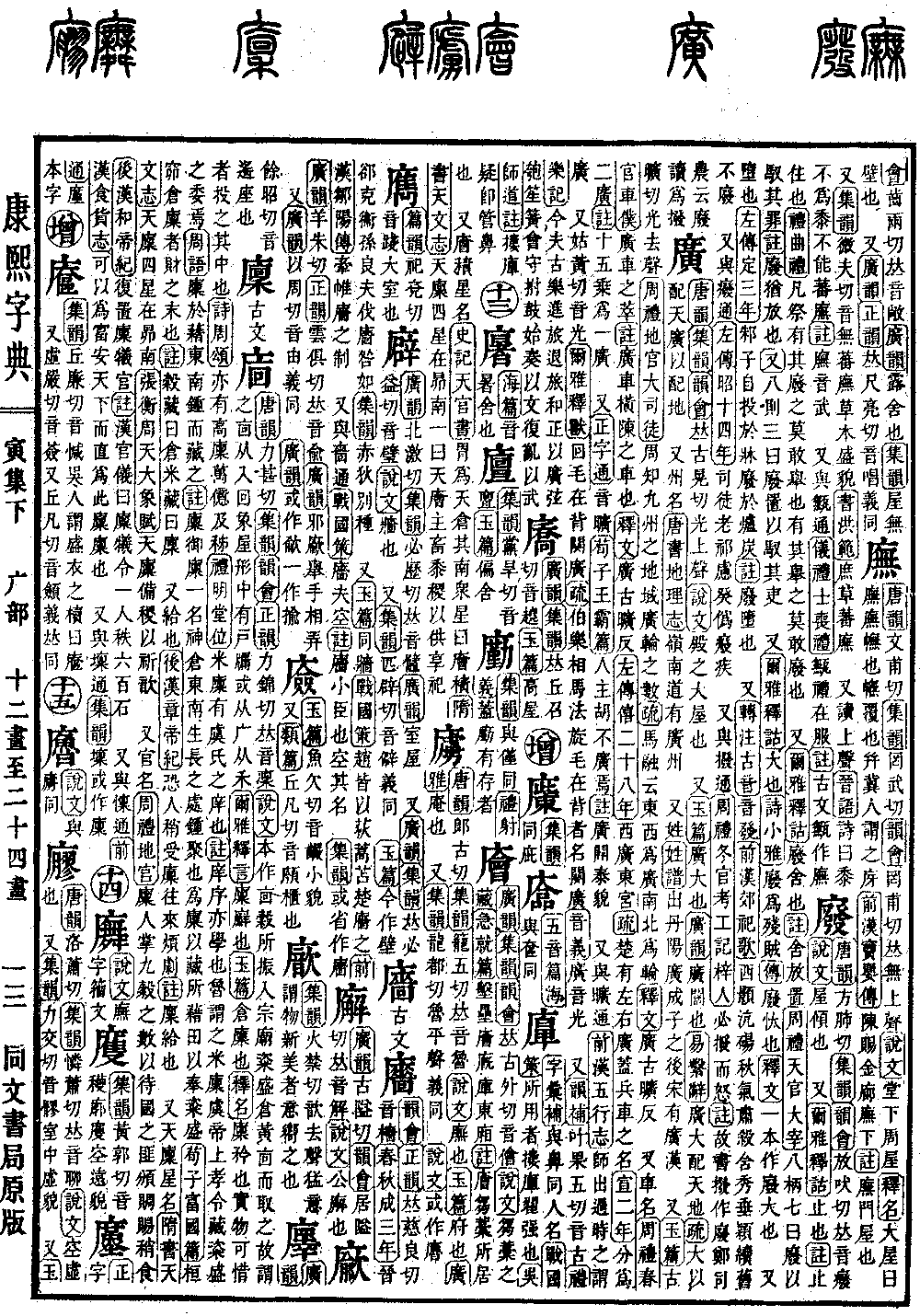
Yin Collection, Lower Volume
Radical: Broad (guǎng)
Kangxi Strokes: 16
Page 351, Entry 23
Ancient script.
Tang Rhymes (Tangyun): Pronounced lǐn.
Collected Rhymes (Jiyun), Rhyme Compendium (Yunhui), Correct Rhymes (Zhengyun): Pronounced lǐn.
Explaining Graphs and Analyzing Characters (Shuowen Jiezi): Originally written as a different form. When grain is harvested and brought inside, grain intended for ancestral temple sacrifices is gathered hurriedly, hence the name. Composed of entering and returning, resembling the shape of a house with doors and windows in the center. Some versions are written with the components for measure and grain.
Glossary of Names (Erya, Shiyan): Lin means a storehouse.
Comprehensive Collection (Yupian): A granary.
Explanation of Names (Shiming): Lin implies to cherish or preserve. It refers to valuable items being placed inside for safekeeping.
Book of Odes (Shijing), Zhou Praises (Zhousong): There are tall granaries, storing ten thousand billion and zǐ units of grain.
Book of Rites (Liji), Hall of Distinction (Mingtang Wei): The Rice Granary (Mǐlǐn) was the school of the Yu dynasty.
Commentary: The xiáng and xù were also types of schools. The state of Lu referred to them as the Rice Granary. Emperor Yu prioritized filial piety and ordered that grain for sacrifices be stored there.
Discourses of the States (Guoyu): Build a granary to the southeast of the royal fields to gather and store grain.
Commentary: Lin refers to the imperial granary. It is also called the Divine Granary, located in the southeast, the direction where all things grow. Zhōng implies gathering. Granaries were built to store the harvest from the royal fields to provide for sacrifices.
Xunzi, On Enriching the State (Fuguo): Walls, cellars, storehouses, and granaries are the secondary aspects of wealth.
Commentary: A place storing grain is called a cāng; a place storing rice is called a lǐn.
Also refers to provisions.
History of the Later Han (Hou Hanshu), Annals of Emperor Zhang: Fearing that people might gradually accept the provisions and cause disturbances by traveling back and forth.
Commentary: Lin means provisions.
Also refers to the Celestial Granary (Tiānlǐn), a constellation name.
Book of Sui (Suishu), Treatise on Astronomy: The Celestial Granary consists of four stars located south of the Pleiades (Mǎoxiù).
Zhang Heng, Rhapsody on the Vast Appearances of the Celestial Sphere (Zhoutian Daxiang Fu): The Celestial Granary star prepares millet to request that the spirits partake of it.
Also refers to an official title.
Rites of Zhou (Zhouli), Earthly Officials: The Granary Official (Lǐnrén) manages the quantities of the nine grains to provide for state distributions, rewards, relief, and salaries.
History of the Later Han (Hou Hanshu), Annals of Emperor He: Re-established the Linxi official.
Commentary: The Records of Han Officials (Hanguanyi) states: There is one Linxi Prefect, with a salary of six hundred shi.
Also interchangeable with lǐn (trembling).
History of the Former Han (Qian Hanshu), Treatise on Food and Money (Shihuozhi): It could have made the world prosperous and stable, yet it resulted in such a fearful situation.
Also interchangeable with a variant form.
Collected Rhymes (Jiyun): Sometimes written as a variant form.
Textual Verification: In Xunzi, On Enriching the State, the text reads Walls, cellars, storehouses, and granaries are the secondary aspects of wealth. According to the original text, the character huan has been corrected to yuan (wall).