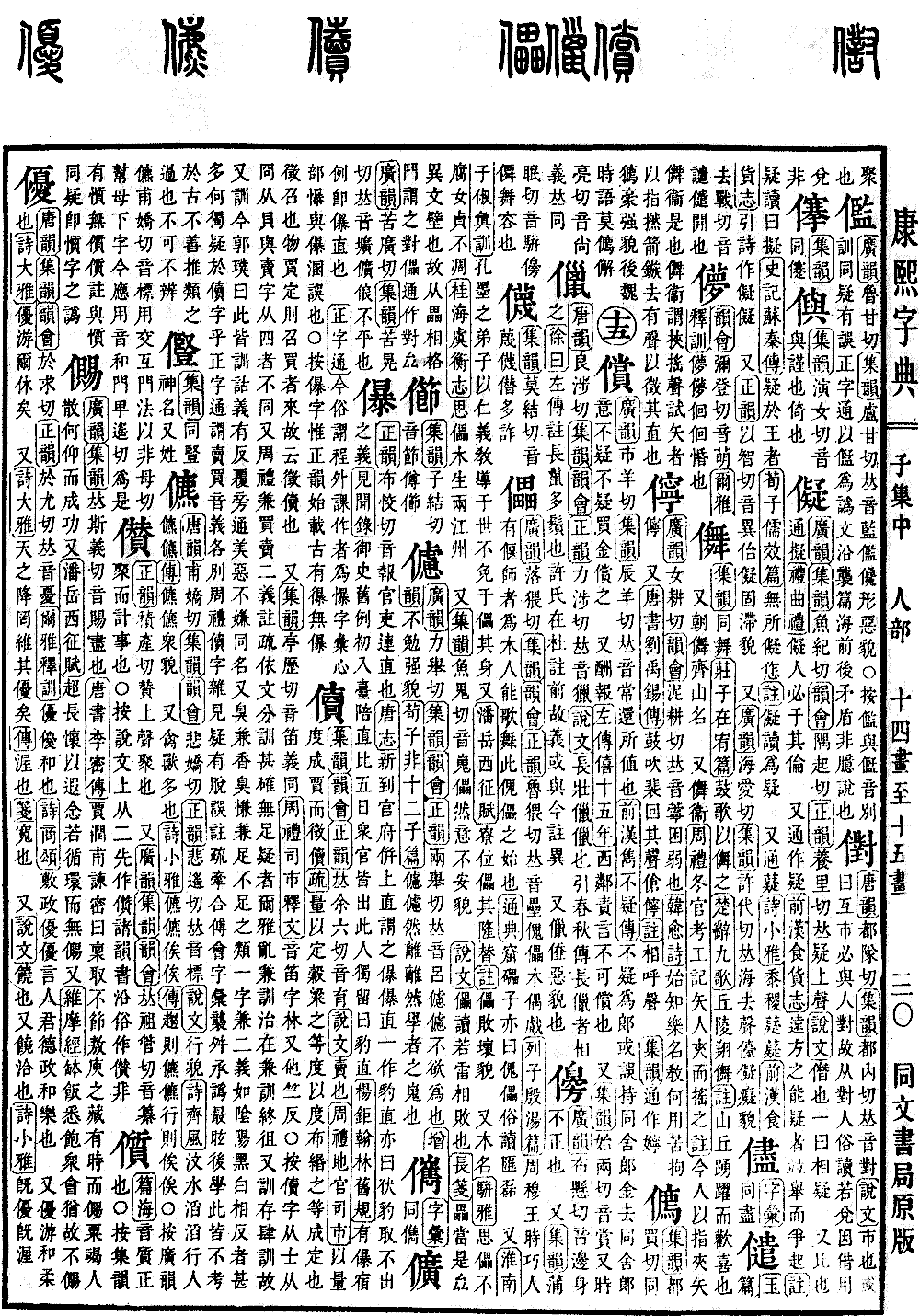
Zi Collection, Middle Volume
Radical: Person (rén)
儡
Kangxi strokes: 17
Page 120, Entry 16
Pronounced lěi.
Kuilei, a puppet show.
Liezi (Liezi), Yin Tang Chapter: During the time of King Mu of Zhou, there was a clever man named Yanshi who made a wooden figure capable of singing and dancing; this was the beginning of the puppet show.
Comprehensive Institutions (Tongdian): Kuléizǐ, also known as kuilei. Commonly read as huìlěi.
Also, Huainanzi (Huainanzi), Shuzhen Xun: The disciples of Confucius and Mozi, by teaching benevolence and righteousness to the world, could not avoid ruining (lěi) themselves.
Also, Pan Yue, Western Expedition Rhapsody (Xizheng Fu): Official positions ruining (lěi) their rise and fall.
Annotation: Lěi, appearance of decay.
Also, a type of tree.
Pian Ya (Pian Ya): The silěi tree does not rot, the glossy privet does not wither.
Guihai Yuheng Zhi (Guihai Yuheng Zhi): The silěi tree grows in Liangjiang Prefecture.
Also, pronounced wěi. Lěirán, the appearance of a restless mind.
Shuowen (Shuowen): Lěi, read like léi. To defeat one another.
Chang Jian (Chang Jian): Lěi should be a variant form of lěi (mounds), meaning a wall, therefore it is derived from lěi. Fighting against one another is called duìlěi. Commonly written as duìlěi (using the variant character).