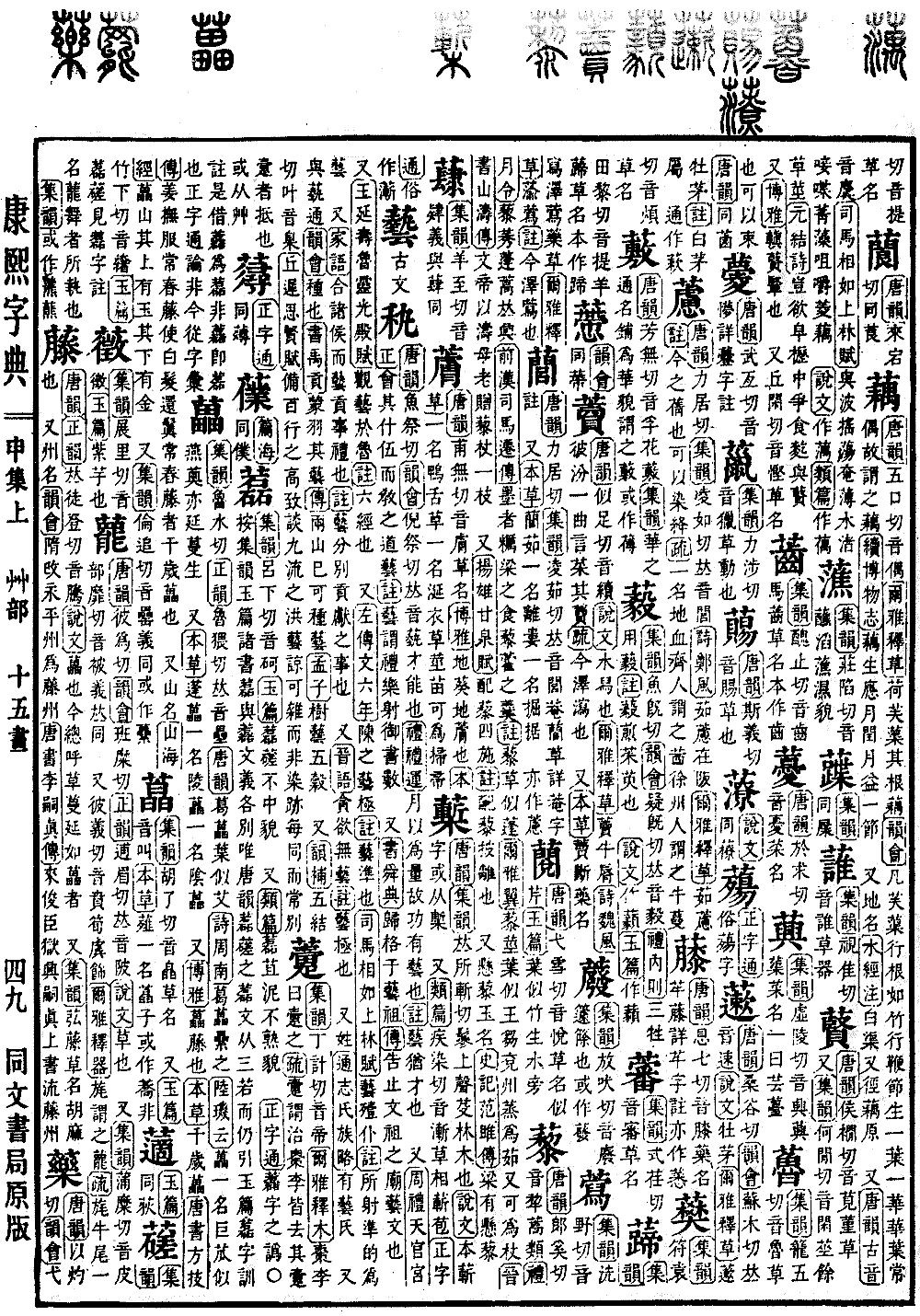
Shen Collection, Upper Volume
Radical: Grass (cǎo)
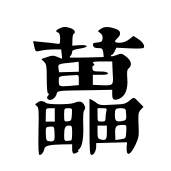
Lui
Kangxi Strokes: 21
Page 1065, Entry 40
According to the Compilation of Rhymes (Jiyun), pronounced lei (rising tone). According to the Standard Rhymes (Zhengyun), pronounced lei (rising tone). According to the Tang Rhymes (Tangyun), the wild vine (ge lui) has leaves resembling mugwort. In the Book of Odes (Shijing), it is said that the wild vines intertwine. Lu Ji states that the lui is also known as the giant gourd, resembling wild grapes and growing as a spreading vine. According to the Materia Medica (Bencao), the peng-lui is also known as ling-lui or yin-lui. According to the Extensive Refinements (Boya), lui is a vine. According to the Materia Medica (Bencao), it is the thousand-year vine. In the History of the Tang Dynasty (Tangshu), Biographical Section on Specialists, it is noted that Jiang Fu consumed evergreen ivy, which turned his white hair black again. The evergreen ivy is what is known as the thousand-year vine. It also refers to a mountain name. In the Classic of Mountains and Seas (Shanhaijing), Mount Lui contains jade on its summit and gold at its base. According to the Compilation of Rhymes (Jiyun), pronounced lei (level tone). The meaning is the same. Sometimes written in a variant form (lui).