Wei Collection, Lower Volume
Radical: Jar (fǒu)
Kangxi Strokes: 21
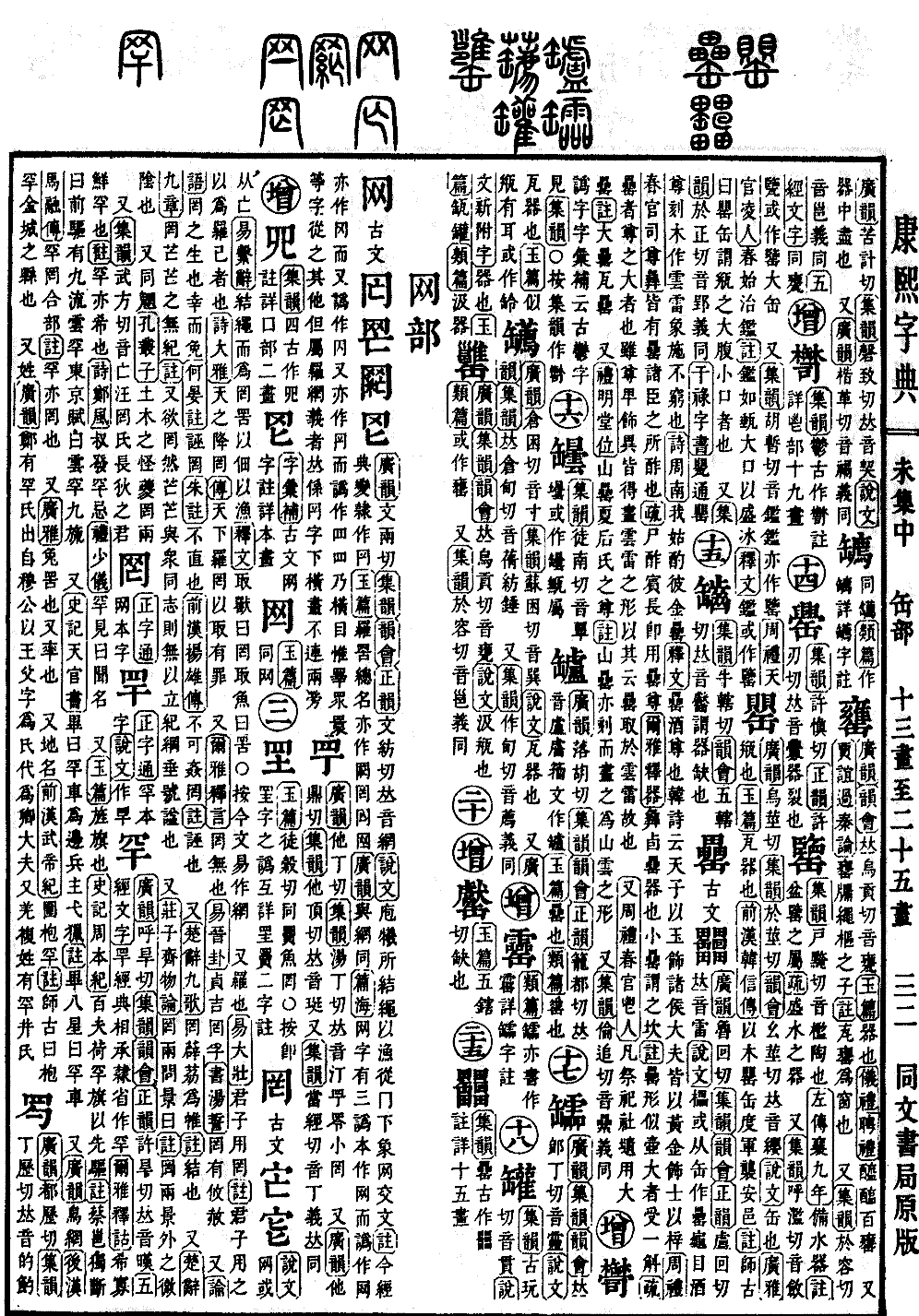
Page 946, Entry 08
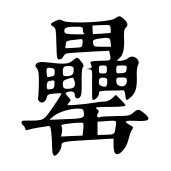
Ancient form. According to the Expanded Dictionary of Sounds and Meanings (Guangyun), it is pronounced lei (level tone). According to the Collection of Dictionary Sounds (Jiyun), the Dictionary of Rhymes (Yunhui), and the Correct Dictionary of Rhymes (Zhengyun), it is pronounced lei (level tone). According to the Analytical Dictionary of Characters (Shuowen), it is a variant of the character lei, which is written with the jar radical. It refers to a wine vessel with turtle-eye shaped decorations; it is carved with cloud and thunder patterns to symbolize the endless nature of these phenomena. In the Book of Odes (Shijing), it is written: I will pour from that golden lei. The Exegesis (Shiwen) states that the lei is a wine vessel. The Han version of the Book of Odes (Han Shi) says: The Son of Heaven decorates it with jade, feudal lords and high officials decorate it with gold, and scholars use catalpa wood. In the Rites of Zhou (Zhouli), section on the Ministry of Spring, it is noted that they all possess the lei, which is what the ministers use to offer wine back to the host. The Commentary (Shu) explains that when the representative of the deceased offers a return toast to the senior guest, the lei vessel is used. In the Erya (Er Ya), section on Explaining Vessels, it is noted that the yi, you, and lei are all vessels, and a small lei is called a kan. The Commentary (Zhu) notes that the lei is shaped like a pot, and a large one holds one hu measure. The Commentary (Shu) explains that the lei is the largest of the wine vessels. Although the decorations on these vessels vary, they all feature cloud and thunder patterns because the name lei is derived from the concepts of clouds and thunder. Furthermore, in the Rites of Zhou (Zhouli), section on the Ministry of Spring, it states that for all sacrifices at the altar of the soil, the great lei is used. The Commentary (Zhu) notes that the great lei is an earthen vessel. Furthermore, in the Record of the Hall of Distinction (Mingtang Wei), it mentions the mountain lei, the vessel used by the Xia dynasty. The Commentary (Zhu) notes that the mountain lei is also carved and painted with images of mountains and clouds. Furthermore, according to the Collection of Dictionary Sounds (Jiyun), it is also pronounced lei (level tone). The meaning is the same.
Textual research: According to the Analytical Dictionary of Characters (Shuowen), it is carved with cloud and thunder patterns to symbolize the endless nature of these phenomena. Note: The original text uses the phrase carved with cloud and thunder, and there is an additional character meaning to symbolize before the phrase endless nature; this has been added here accordingly.