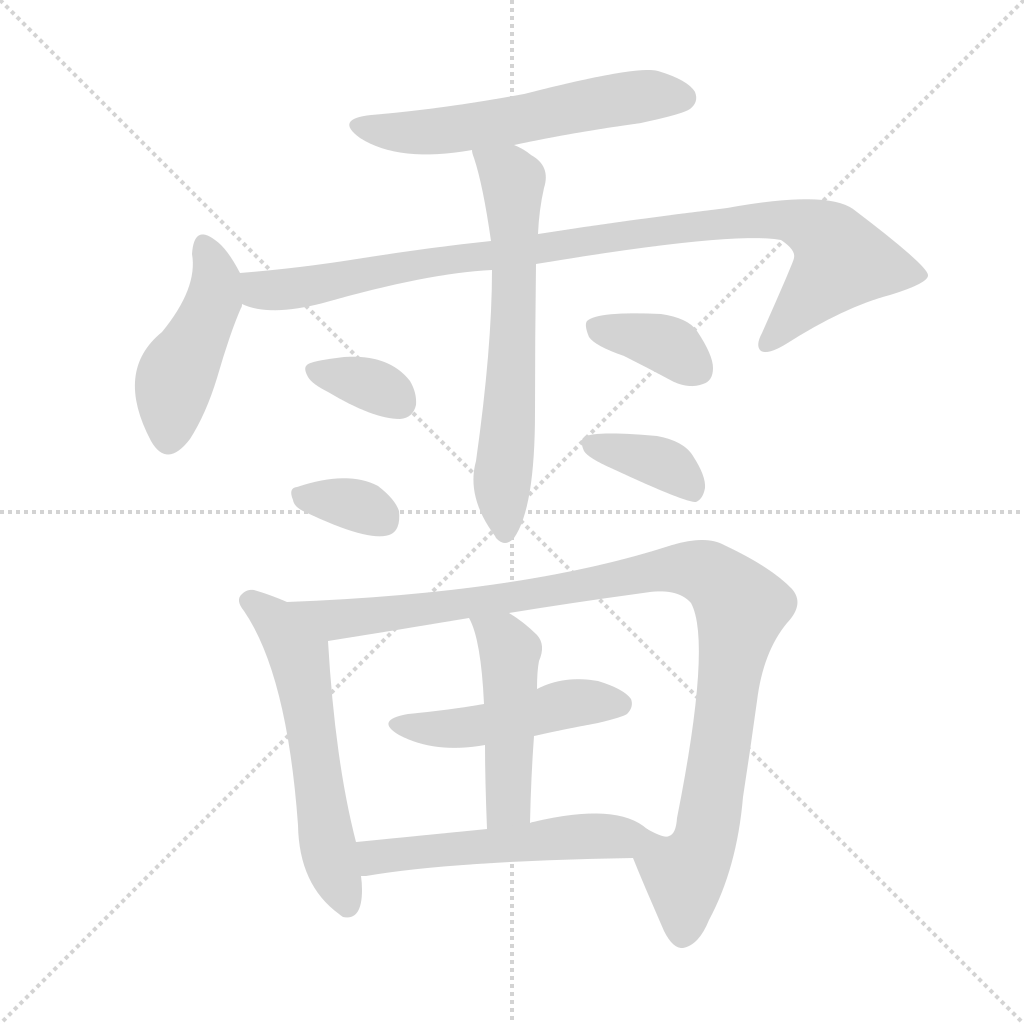
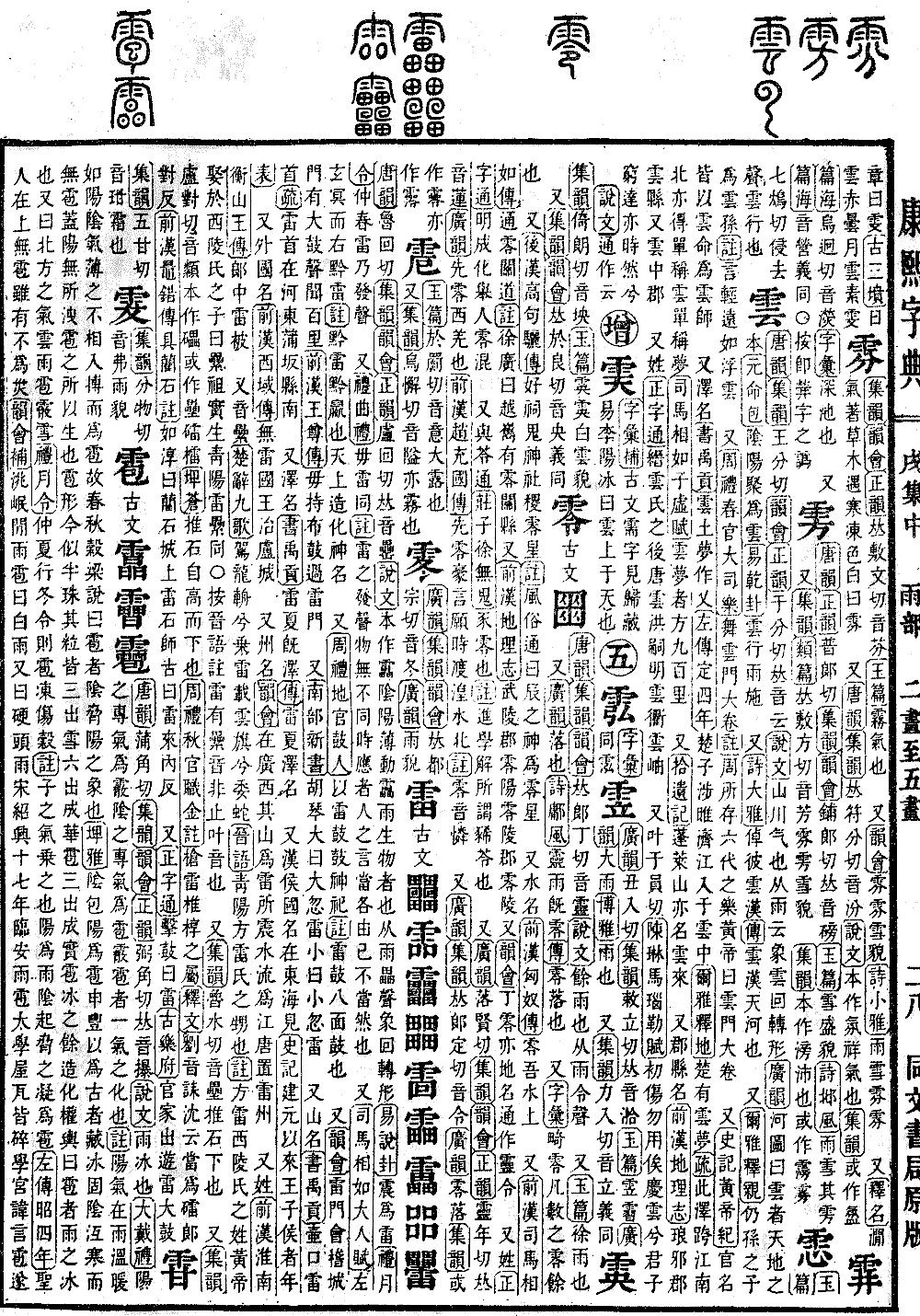
Xu Collection, Middle Volume
Radical: Rain (yǔ)
Kangxi Strokes: 13
Page 1372, Entry 14
The ancient written form is leí.
According to the Tang Dynasty Rhyme Dictionary (Tangyun), pronounced léi. According to the Collected Rhymes (Jiyun), the Rhyme Collection (Yunhui), and the Correct Rhymes (Zhengyun), pronounced léi, and is read the same as léi (a type of wine vessel).
According to the Explanation of Graphs and Analysis of Characters (Shuowen Jiezi), the original form is written as léi. It refers to the substance produced by the collision and oscillation of the yin and yang qi, which brings forth thunderstorms and causes all things to grow. The character is formed with the radical for Rain (yǔ) and the phonetic component léi (thunder-like). The shape represents a swirling or rotating motion.
Book of Changes (Yijing), Commentary on the Trigrams (Shuoguazhuan): The trigram Zhen symbolizes thunder.
Book of Rites (Liji), Monthly Ordinances (Yueling): In the second month of mid-spring, thunder begins to sound.
Also, Book of Rites (Liji), Record of Rites (Quli): Do not blindly echo the opinions of others (leítóng). Commentary: When thunder sounds, there is nothing that does not respond to it. A person's speech should originate from their own insights and should not be like this (blindly echoing others).
Also, Master Sima Xiangru, Rhapsody on the Great Man (Daren Fu): On the left is Xuanming, and on the right is Qianlei. Commentary: Qianlei is also known as Qianying. This is the name of a deity in heaven who creates and nurtures all things.
Also, Rites of Zhou (Zhouli), Earth Officer, Drum Master: Use the thunder drum to offer sacrifices to the heavenly spirits. Commentary: The thunder drum is a type of drum with eight sides.
Also, Rhyme Collection (Yunhui): Thunder Gate (Leimen) is the city gate of Kuaiji; there is a large drum there, and the sound of the drum can reach over a hundred li away. Former Book of Han (Qian Hanshu), Biography of Wang Zun: Do not pass through Thunder Gate carrying a drum made of cloth (an idiom for displaying one's meager skills in front of an expert).
Also, New Records from the South (Nanbu Xinshu): Among the huqin instruments, the large ones are called Great Hulei, and the small ones are called Small Hulei.
Also, a mountain name. Book of Documents (Shangshu), Tribute of Yu (Yugong): Hukou Mountain and Leishou Mountain. Commentary: Leishou Mountain is located to the south of Puban County in Hedong.
Also, a marsh name. Book of Documents (Shangshu), Tribute of Yu (Yugong): Leixia has become a marsh. Commentary: Leixia is the name of a marsh.
Also, the name of a marquisate in the Han Dynasty. Located in Donghai Commandery. See the Records of the Grand Historian (Shiji), Table of the Princes and Marquises since the Jianyuan Period.
Also, the name of a foreign country. Former Book of Han (Qian Hanshu), Treatise on the Western Regions: The capital of the Wulei Kingdom was located in Lucheng.
Also, the name of a prefecture. Rhyme Collection (Yunhui): Located in Guangxi; the mountains there were once split by thunder, and the water flowed to form rivers. During the Tang Dynasty, Leizhou was established.
Also, a surname. Former Book of Han (Qian Hanshu), Biography of Huainan King An: There was a court gentleman named Lei Bei.
Also read as léi. Songs of Chu (Chucheng), Nine Songs (Jiuge): Riding a dragon carriage while riding the sound of thunder, bearing cloud banners and winding forward. Discourses of the States (Guoyu), Discourses of Jin (Jinyu): (Qingyang is) the nephew of the Fanglei clan. Commentary: Fanglei is a surname of the Xiling clan. The Yellow Emperor married a woman of the Xiling clan, named Leizu, who actually gave birth to Qingyang. Lei and Lei are pronounced the same. According to the commentary on the Discourses of Jin (Jinyu), Lei has the pronunciation of léi, and it is not just for the purpose of rhyming.
Also, according to the Collected Rhymes (Jiyun), pronounced léi, and is read the same as léi (pile/mound). It means to push down a stone.
Also, according to the Collected Rhymes (Jiyun), pronounced léi, and is read the same as léi (class/category). The original character is léi. Sometimes written as léi, léi, or léi. Pi Cang: To push a stone down from a high place.
Rites of Zhou (Zhouli), Autumn Officer, Office of Metals (Zhijin), Commentary: Qiang and lei belong to the category of weapons such as hammers and wooden shields. Explanation of Sounds (Shiven): Liu Changzong reads it with the sound of leì. Shen Zhong says: It should be written as léi, pronounced léi.
Former Book of Han (Qian Hanshu), Biography of Chao Cuo, Commentary on Lin Stones: Ru Chun says: Lin stones are the thunder stones used for defense on city walls. Yan Shigu says: Lei is pronounced léi.
Also, Correct Dictionary (Zhengzitong): To beat a drum is called thunder. Ancient Music Bureau (Gu Yuefu): The government officials go out on an excursion and the thunderous drums sound.
Textual research: Also a surname. Former Book of Han (Qian Hanshu), Biography of the King of Huainan. Note: The History of the Han Dynasty (Hanshu) combines the biographies of the King of Huainan, the King of Hengshan, and the King of Jibei into one volume. The quote here is from the Biography of the King of Huainan, so the word Hengshan should be omitted. Changed to: Also a surname, see the Former Book of Han (Qian Hanshu), Biography of Huainan King An.