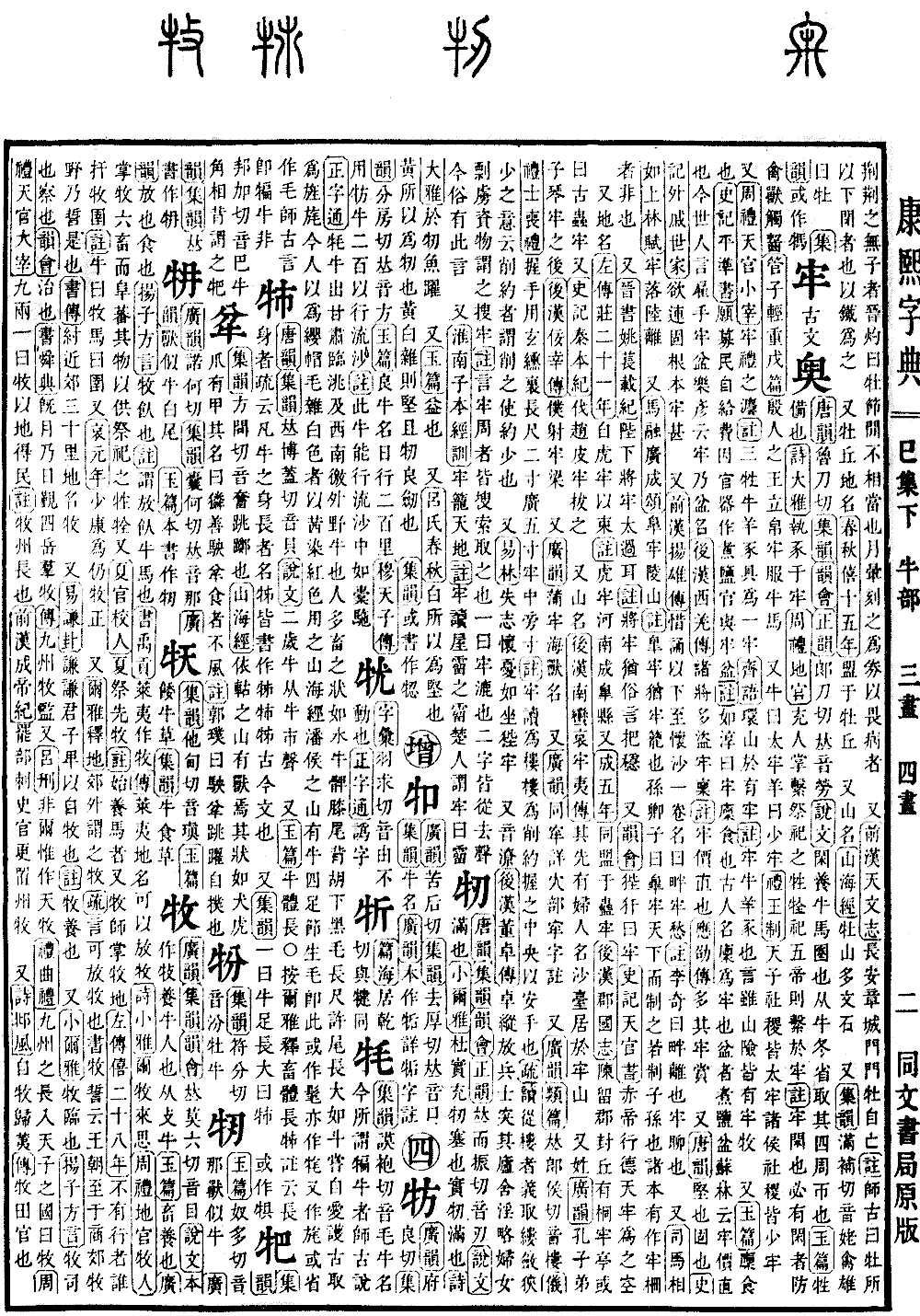
Si Collection, Lower Volume
Radical: Cow (niú)
Page 698, Entry 01
Ancient script. Pronounced lao (rising tone).
Explaining the Script: A pen for confining cattle and horses. The character is formed from the radical for cow, with a reduced element for winter, implying the sense of being surrounded on all sides.
Jade Encyclopedia (Yupian): Livestock used for sacrificial rites.
Book of Odes (Shijing): Seizing a pig in the pigsty.
Rites of Zhou (Zhouli): The officer in charge of sacrificial animals manages those tethered for ritual use; when sacrificing to the Five Emperors, the animals are secured in a pen. Commentary: A pen is an enclosure. It must be enclosed to prevent beasts from touching or gnawing at the animals.
Master Guan (Guanzi): The kings of the Yin dynasty established enclosures to tame cattle and horses. Cattle are referred to as Great Enclosure (tai lao), while sheep are referred to as Lesser Enclosure (shao lao).
Book of Rites (Liji): The Son of Heaven uses the Great Enclosure when sacrificing to the gods of soil and grain, while the feudal lords use the Lesser Enclosure.
Rites of Zhou (Zhouli): The law of the enclosure rite. Commentary: The three sacrificial animals—cattle, sheep, and pigs—collectively form one enclosure.
Discourses of the States (Guoyu): The surrounding mountainous lands also have livestock. Commentary: Enclosure refers to cattle, sheep, and pigs. It means that even in steep, rugged terrain, there is livestock grazing.
Jade Encyclopedia (Yupian): Rations provided by the government.
Records of the Grand Historian (Shiji): Hoping to recruit commoners to bear their own expenses and use government equipment to boil salt, with the government providing the rations and salt pans. Commentary: Ru Chun states: The enclosure is the rations provided by the government. The ancients called granaries enclosures. The pan refers to the boiling pan. Su Lin states: The enclosure refers to the value or wages. This is what people today call laborers' wages and salt pans. Le Yan states: The enclosure is a name for a pan.
History of the Later Han (Hou Hanshu): The various generals often embezzled the government's grain and funds. Commentary: The enclosure refers to value, money, and grain.
History of the Later Han (Hou Hanshu): Bestowing generous rewards.
Pronounced lao (rising tone). Solid, firm, or secure.
Records of the Grand Historian (Shiji): Wishing to firmly connect the foundation, it is very secure.
Book of Han (Hanshu): From the poem Lamenting My Fate (Xi song) down to the Poem of Sand (Huai sha), the scroll is named Sorrow of the Shore and Enclosure (Pan lao). Commentary: Li Qi states: Pan means to part. Lao means to be solitary or lacking support.
Sima Xiangru (Shanglin fu): Sparse and scattered, varied and numerous.
Ma Rong (Guangcheng song): To enclose and cover the mountain ranges. Commentary: To enclose (gao lao) is to cage or contain. Xunzi says: To enclose the world and control it, as one controls one's descendants. Some versions write this as a palisade, which is incorrect.
Book of Jin (Jinshu): Your Majesty is overly cautious and steady. Commentary: To be secure is like the colloquial expression for being steady.
Rhyme Collection (Yunhui): A prison is called an enclosure.
Records of the Grand Historian (Shiji): When the Red Emperor carries out virtuous governance, the Heavenly Prison (tian lao) is empty.
Geographical name.
Zuo Commentary (Zuo zhuan): From east of Hulao. Commentary: Hulao is in Chenggao County, Henan.
Zuo Commentary (Zuo zhuan): Formed an alliance at Chonglao.
History of the Later Han (Hou Hanshu): There is a Tonglao Pavilion in Fengqiu County, Chenliu Prefecture. Some say this is the ancient Chonglao.
Records of the Grand Historian (Shiji): Attacked and captured the Pilao of the Zhao state.
Mountain name.
History of the Later Han (Hou Hanshu): Their ancestors included a woman named Shatai who lived at Mount Lao.
Surname.
Extensive Rhymes (Guangyun): Descendant of Qin Lao, a disciple of Confucius.
History of the Later Han (Hou Hanshu): Servant Lao Liang.
Extensive Rhymes (Guangyun): Pulao, name of a sea creature.
Extensive Rhymes (Guangyun): Identical to the character (qióng). See details under the Cave (xué) radical entry for (qióng).
Extensive Rhymes (Guangyun), Categorized Compendium (Lei pian): Pronounced lou.
Book of Etiquette and Ceremonial (Yili): In the mortuary rites for a gentleman, when holding hands, use light-red silk, twelve inches long and five inches wide, with both sides of the center narrowed by one inch. Commentary: Lao is read as lou. Lou means to trim, decrease, or narrow. It refers to the center part of the hand-wrapping, to facilitate placing the hands. Commentary (Shu): It is read as lou, signifying the gathering or narrowing of the material. Trimming and binding means reducing the size to make it narrower.
Forest of Changes (Yilin): Losing one's resolve and feeling deep sorrow, as if sitting in a prison.
Also pronounced lao (falling tone).
History of the Later Han (Hou Hanshu): Dong Zhuo allowed his soldiers to break into commoners' homes, commit rape and looting, and plunder property, which they called sweeping and looting. Commentary: Lao zhou implies searching and seizing. Another interpretation is that lao means to scoop or plunder. Both characters are pronounced in the falling tone. This expression is still used by the common people today.
Master Huainan (Huainanzi): To enclose heaven and earth. Commentary: Lao is read like the liu in the word for eaves (wu liu). People in the Chu region call an enclosure a liu.
Research Notes: In Zuo Commentary (Zuo zhuan), Duke Cheng, year five, it says alliance at Chonglao. I have corrected the original text from Gu lao to Chonglao.