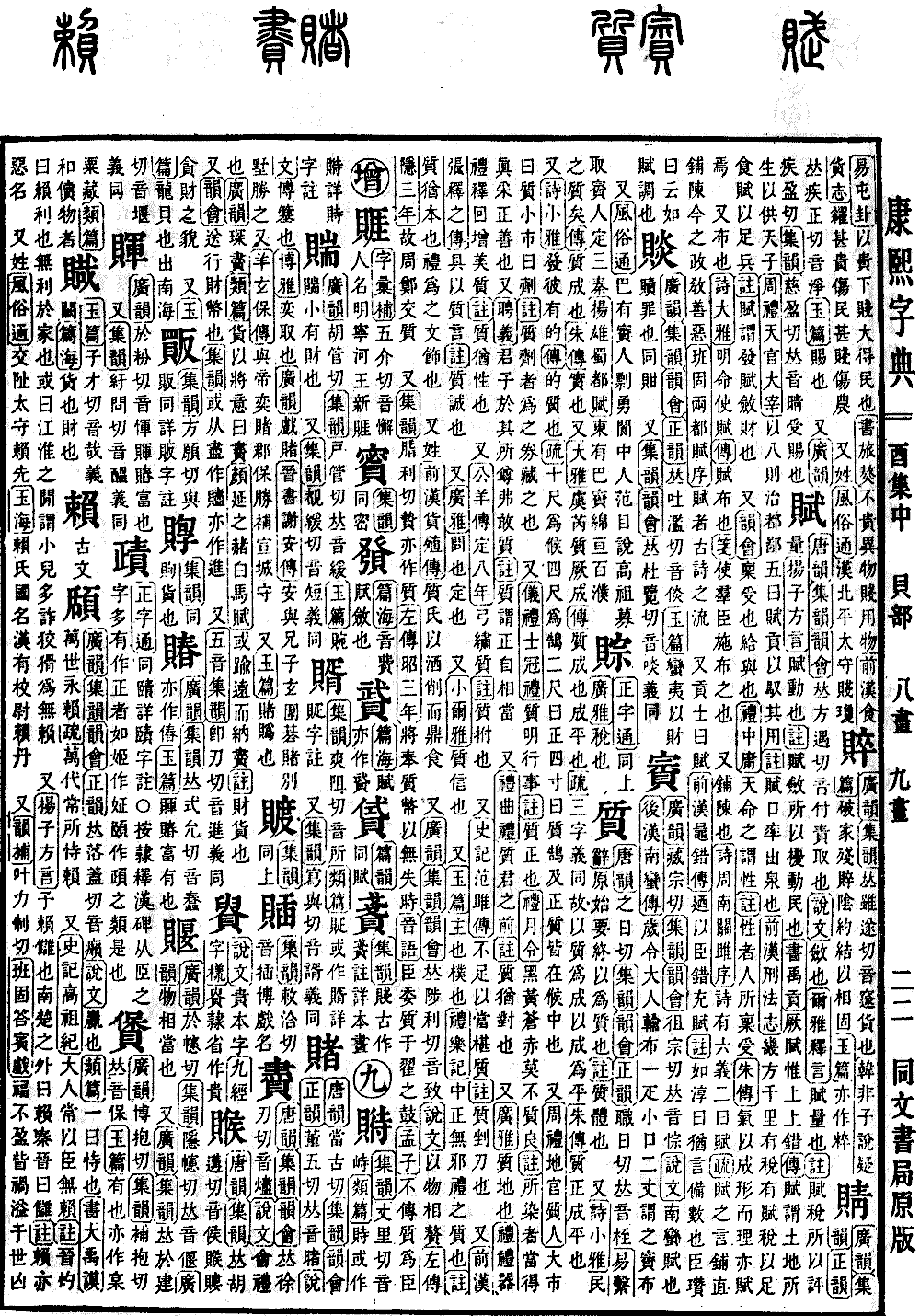
You Collection, Middle Volume
Radical: Shellfish (bèi)
Lai
Kangxi strokes: 16
Page 1210, Entry 16
Ancient documentation: Broad Rhymes (Guangyun), Compilation of Rhymes (Jiyun), Rhyme Compendium (Yunhui), and Correct Rhymes (Zhengyun) all provide the pronunciation as lai. Dictionary of Etymology (Shuowen Jiezi) defines it as profit. Classified Dictionary (Leipian) additionally defines it as to depend on. Book of Documents (Shujing), Counsels of the Great Yu (Dayu Mo) records: may ten thousand generations forever depend on this. The Commentary (Shu) explains: to rely upon for a long duration for ten thousand generations. Also, Records of the Grand Historian (Shiji), Annals of Emperor Gaozu (Gaozu Ji) records: my father always considered me without profit. The Note states: Jin Zhuo explains that lai refers to profit; it means having no benefit to the family. Another interpretation is that in the Jiang and Huai regions, children who are sly and cunning are called wulai (scoundrels). Also, Yang Xiong’s Dialects (Fangyan) records: yu lai means an enemy. Outside of the Southern Chu region, it is called lai, while in the Qin and Jin regions, it is called chou (enemy). The Note states: lai is also a term for evil. Also, it is a surname. Customs and Traditions (Fengsu Tong) records the Governor of Jiaozhi, Lai Xian. Ocean of Jade (Yuhai) records that the Lai clan was a state name. In the Han dynasty, there was a commandant named Lai Dan. Also, in the Supplement to Rhymes (Yunbu), the pronunciation is listed as li. Ban Gu’s Response to the Guest’s Play (Da Bin Xi) writes: blessings do not fill the eye sockets, misfortunes overflow the human world; even an evil person would feel regret because of this, how much more so should a virtuous person depend on it. Note: In the Dictionary of Etymology (Shuowen Jiezi), the character is formed from the Shellfish radical and the sound la. The vulgar form is written as lai. This is incorrect.