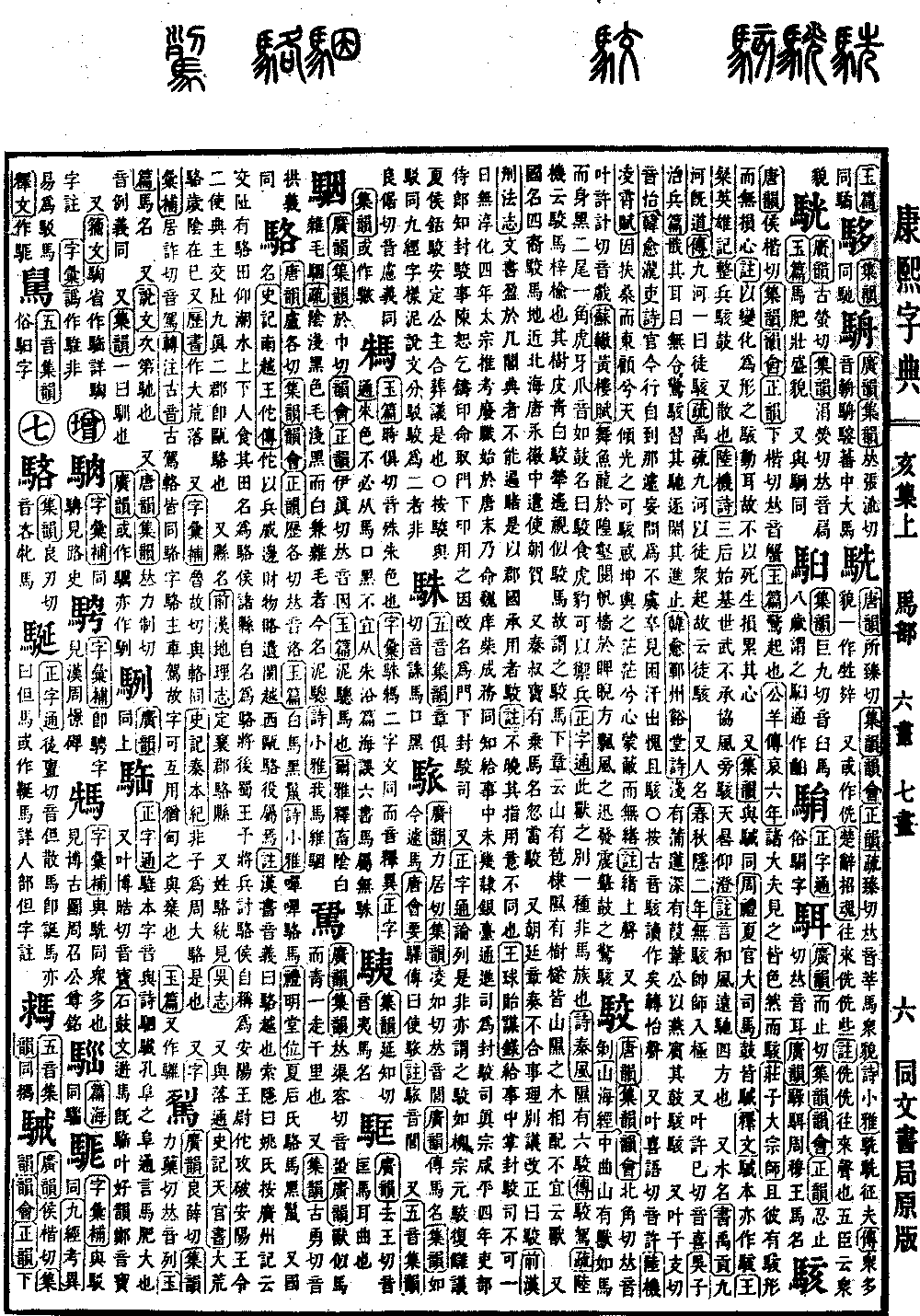
Hai Collection, Upper Volume
Radical: Horse (mǎ)
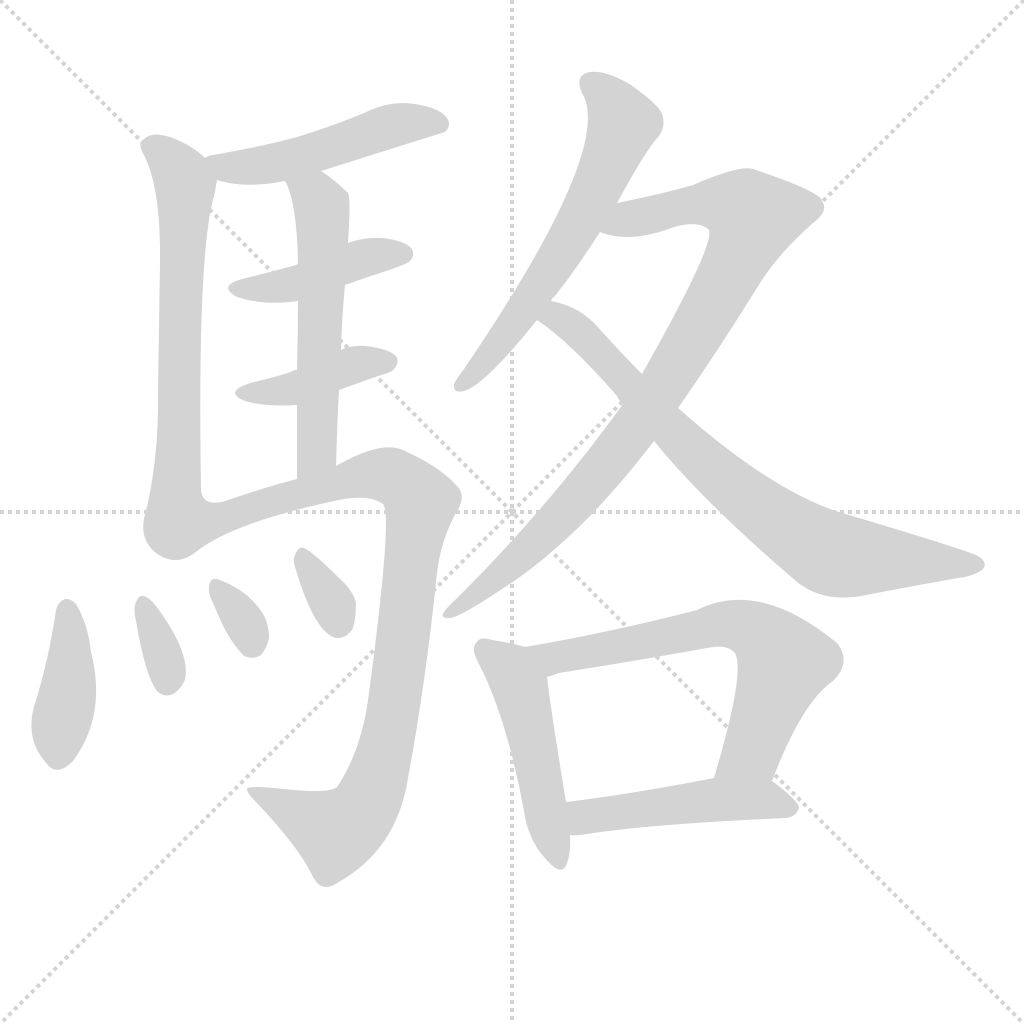
Luo
Kangxi stroke count: 16
Page 1438, Entry 17
Pronounced luo.
In the Jade Chapter (Yupian): A white horse with a black mane.
In the Book of Odes (Shijing), Lesser Odes: The horses with black manes pant and heave.
In the Book of Rites (Liji), Mingtang Wei: The Xia dynasty used horses with black manes.
Also, the name of a country.
In the Records of the Grand Historian (Shiji), Biography of King Tuo of Nanyue: Tuo used military might to intimidate the border regions, and through wealth and gifts, he brought the Minyue, Xi'ou, and Luo under his service.
Commentary: The Han Book (Hanshu) Phonetic Meanings states: Luo refers to the Yue people. The Suoyin commentary notes: The Yao clan refers to the Guangzhou Records, which states: In Jiaozhi there are Luo fields that rise and fall with the tide. The people who eat from these fields are called Luo Lords, and the various districts call themselves Luo Generals. Later, the King of Shu sent troops to suppress the Luo Lords and proclaimed himself King Anyang. Wei Tuo attacked and defeated the King of Anyang, ordering two envoys to oversee the two commanderies of Jiaozhi and Jiuzhen, which are the Ou-Luo.
Also, the name of a county.
In the Former Han Book (Qian Hanshu), Treatise on Geography: Luo County in Dingxiang Commandery.
Also, a surname. Luo Tong appears in the Records of Wu (Wuzhi).
Also, interchangeable with luo (falling).
In the Records of the Grand Historian (Shiji), Treatise on the Celestial Offices: In the year Dahuangluo, the yin energy is in the si position.
In the Treatise on the Calendar (Lishu), it is written as Dahuangluo.
Also, in the Dictionary Supplement (Zihui Bu): Pronounced lu, the same as the character for carriage.
In the Records of the Grand Historian (Shiji), Annals of Qin: This refers to Feizi, who was the Da Luo of the Zhou dynasty.
Also, in the Dictionary Supplement (Zihui Bu): Pronounced jia.
In the Zhuanzhu Guyin (Ancient Phonetic Interpretations): Anciently, the characters for jia (yoke) and lu (carriage) were both the same as the character luo. Since luo represents the carriage and its yoking, the characters can be used interchangeably, similar to the terms for fields and to ride.
In the Jade Chapter (Yupian): Also written in a variant form.