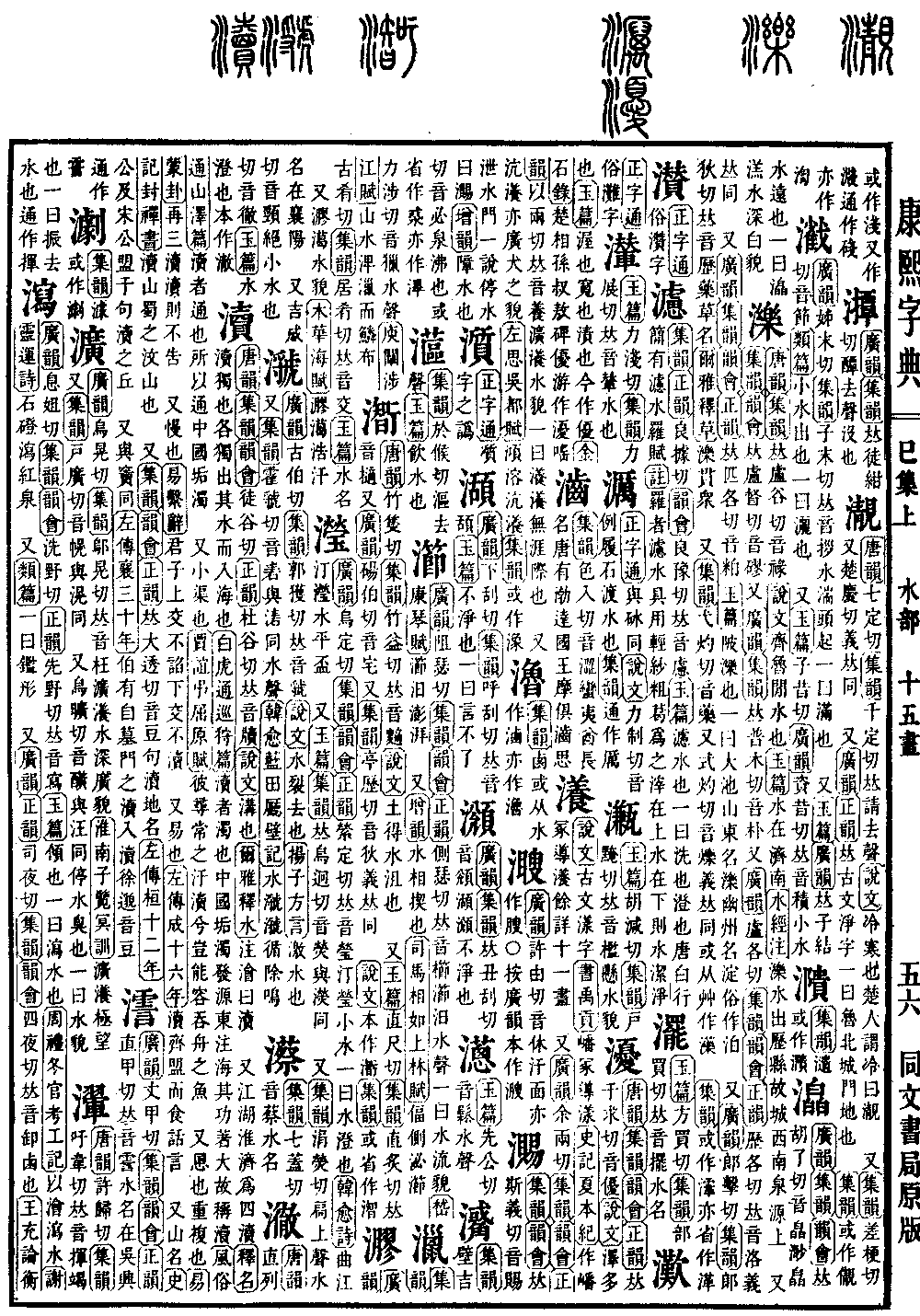
Si Collection, Upper Volume
Radical: Water (shuǐ)
Entry: Luò
Kangxi strokes: 19
Page 658, Entry 01
Tang Rhymes (Tangyun) and Collected Rhymes (Jiyun): Pronounced lu (falling tone).
Explanation of Characters (Shuowen): The name of a body of water located between the states of Qi and Lu.
Comprehensive Collection (Yupian): A body of water located in Jinan.
Commentary on the Water Classic (Shuijingzhu): The Luo River originates from the springs located southwest of the ancient city of Li County.
Also, Collected Rhymes (Jiyun) and Rhyme Anthology (Yunhui): Pronounced lu (entering tone).
Also, Broad Rhymes (Guangyun) and Collected Rhymes (Jiyun): Pronounced pu (entering tone).
Also, Broad Rhymes (Guangyun): Pronounced luo (entering tone). Collected Rhymes (Jiyun), Rhyme Anthology (Yunhui), and Correct Rhymes (Zhengyun): Pronounced luo (entering tone). Same meaning.
Also, Broad Rhymes (Guangyun), Collected Rhymes (Jiyun), Rhyme Anthology (Yunhui), and Correct Rhymes (Zhengyun): Pronounced po (entering tone).
Comprehensive Collection (Yupian): Refers to a pond or lake. One source states it refers to a large pond; in Shandong it is called luo, in Youzhou it is called dian, and it is commonly written with the variant form (bo).
Also, Broad Rhymes (Guangyun): Pronounced li (entering tone). Collected Rhymes (Jiyun): Pronounced li (entering tone). Name of a medicinal herb.
Literary Expositor (Erya), Explanation of Grasses: The luo is known as the guanzhong (a type of fern).
Also, Collected Rhymes (Jiyun): Pronounced yao (entering tone). Also pronounced shuo (entering tone). Same meaning.
Some write this character using the grass radical. Collected Rhymes (Jiyun) notes it is sometimes written in a variant form. It is also abbreviated as a variant form.