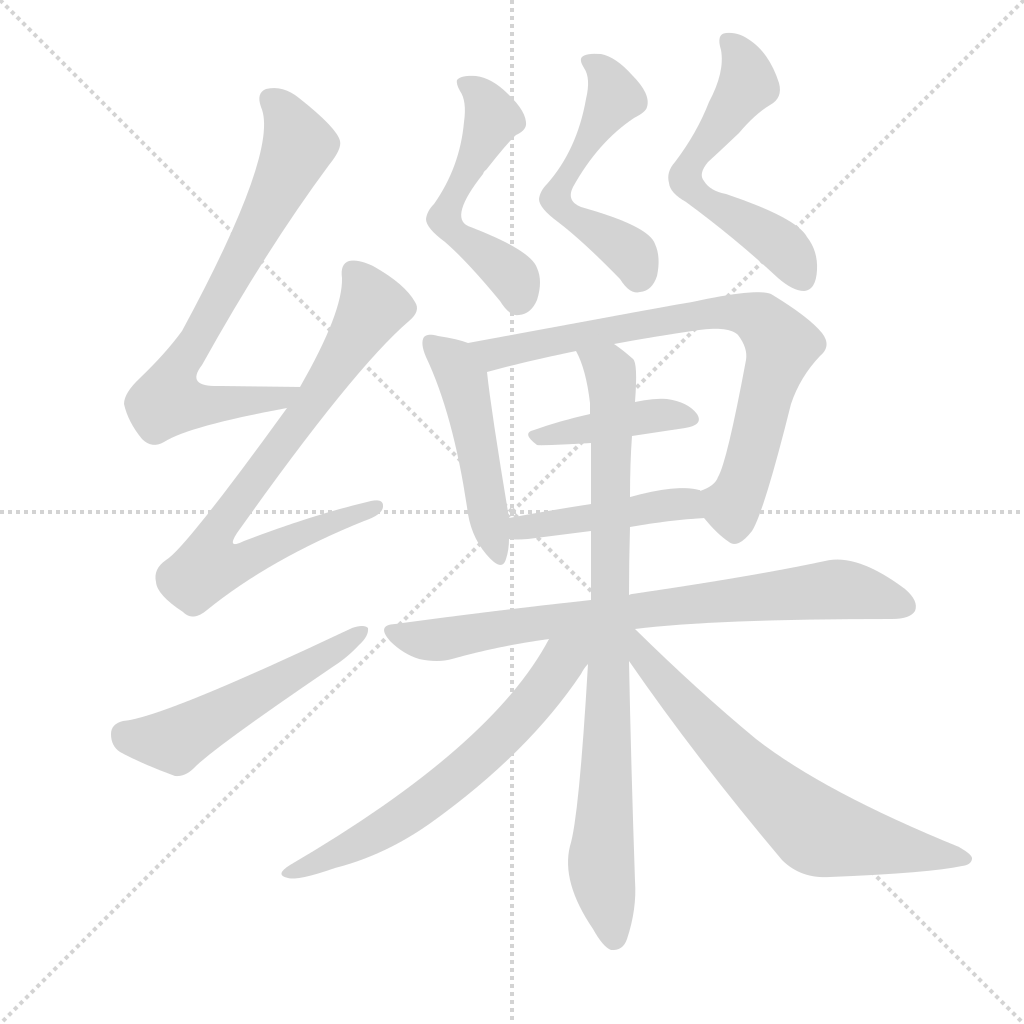
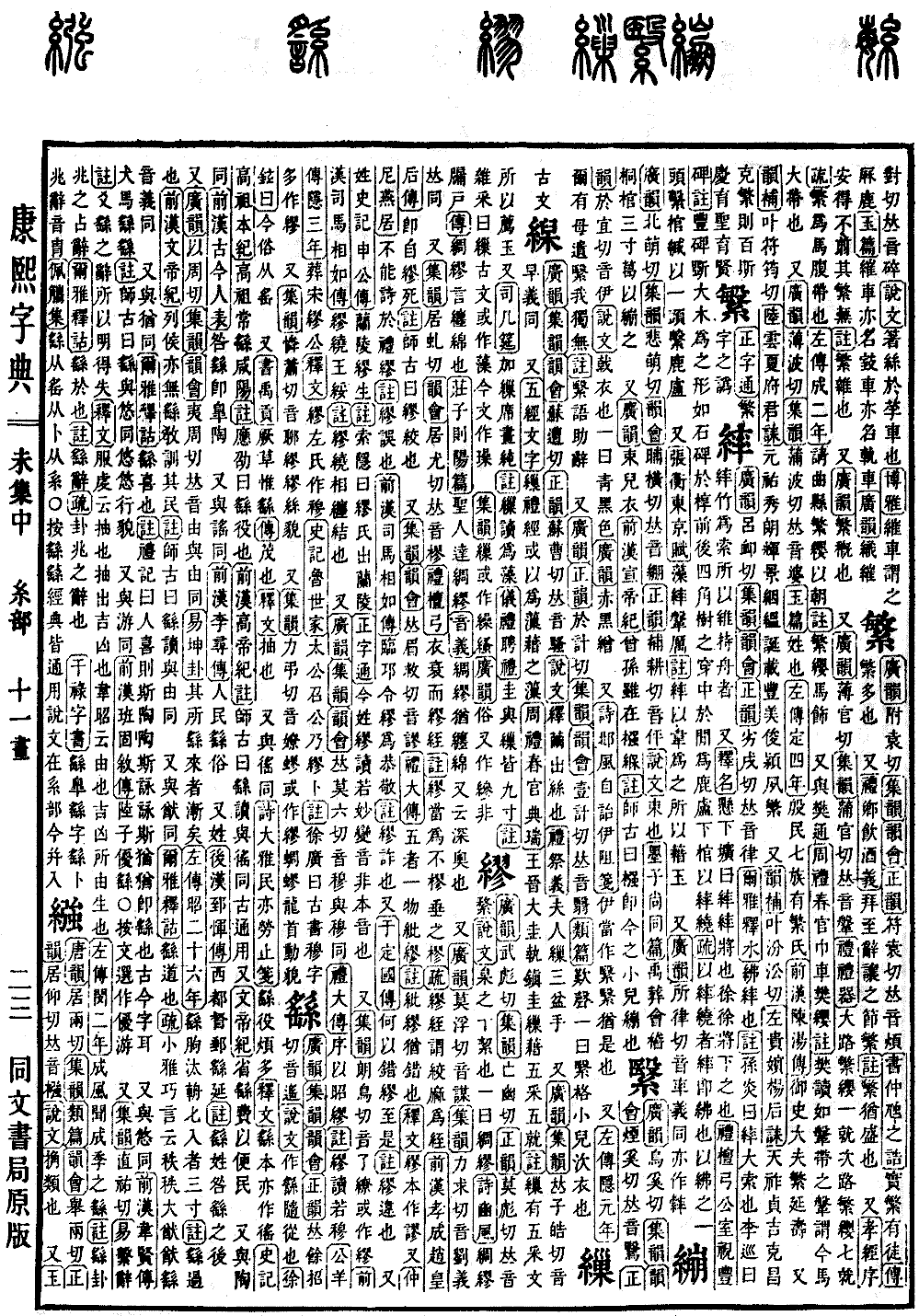
Wei Collection, Lower Volume
Radical: Silk (mì)
Strokes: 17
Page 937, Entry 01
Ancient form.
According to the Expanded Rhymes (Guangyun), Collected Rhymes (Jiyun), and Rhyme Compendium (Yunhui), the pronunciation is sao. According to the Corrected Rhymes (Zhengyun), the sound is sao.
According to the Explaining Graphs and Analyzing Characters (Shuowen), it refers to reeling silk from cocoons.
According to the Book of Rites (Liji), Rites of Sacrifice: The wife performs the ceremony of reeling with three basins.
Also, according to the Expanded Rhymes (Guangyun) and Collected Rhymes (Jiyun), it is pronounced zao. The meaning is the same.
Also, according to the Five Classics Characters (Wujing Wenzi), the character for this term in the Classic of Rites is sometimes written as the character for water plant (zao).
According to the Rites of Zhou (Zhouli), Offices of Spring, Clerk of Insignia: The king holds the great scepter and the town scepter, with silk cords and mats of five colors in five repetitions. The commentary notes that these silk cords have five-colored patterns used to cushion the jade.
Also, in the Offices of the Couch and Mat: Add the silk-corded mat with painted borders. The commentary notes that here the character is read as water plant (zao).
According to the Ceremonial Rites (Yili), Rites of Official Visits: The scepter and the silk cords are both nine inches. The commentary notes that multicolored is called silk cord (sao). Ancient texts sometimes write it as water plant (zao). Modern texts write it as jade accessory (zao).
According to the Collected Rhymes (Jiyun), it is sometimes written in a variant form (cāo).
According to the Expanded Rhymes (Guangyun), it is also commonly written in a variant form (shān), which is incorrect.