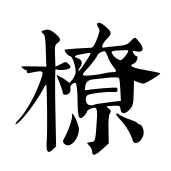
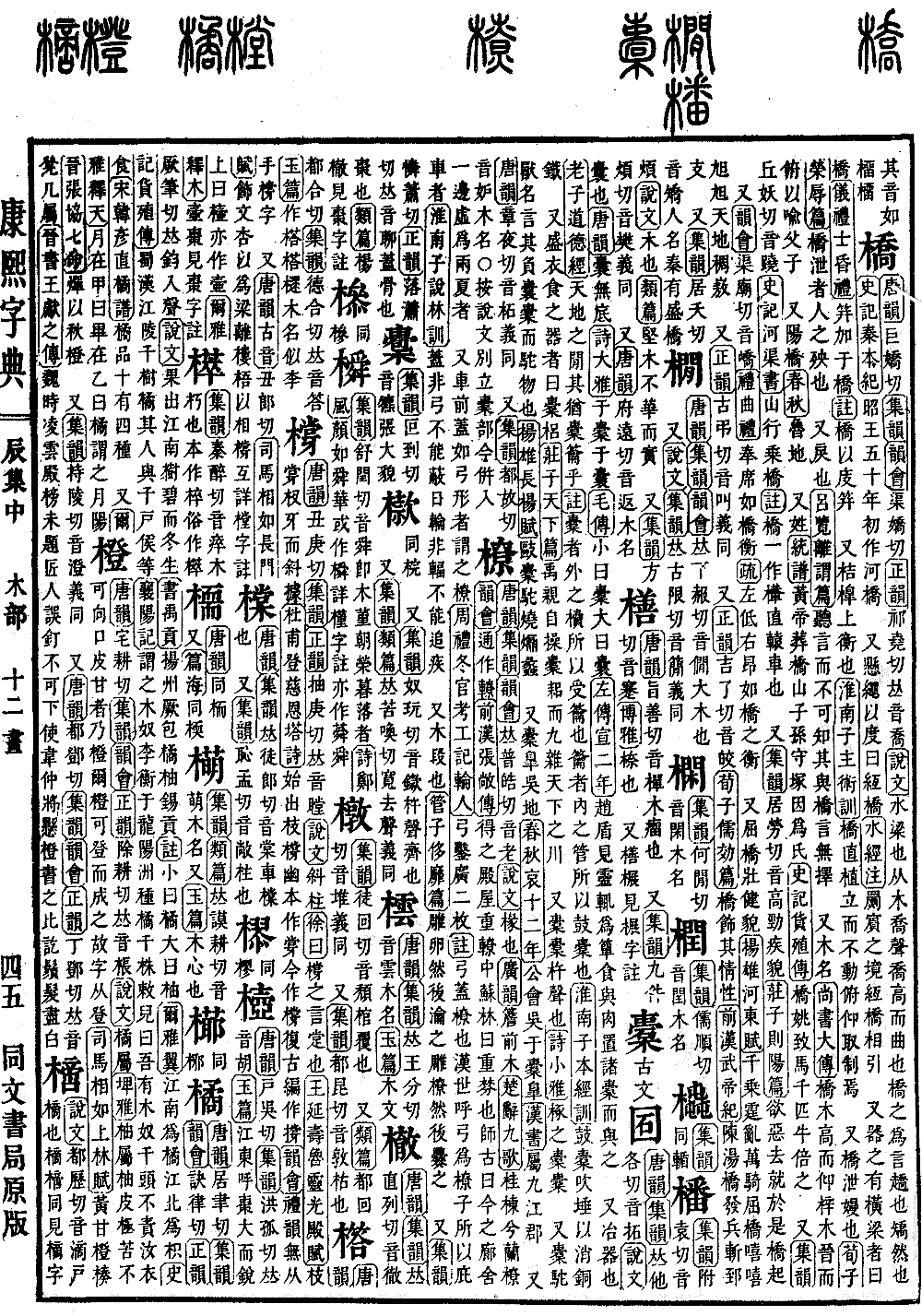
Chen Collection, Middle Volume
Radical: Tree (mù)
Kangxi Strokes: 16
Page 553, Entry 10
Pronounced lao. According to the Shuowen Jiezi (Explanation of Writing and Analysis of Characters), it refers to a rafter. According to the Guangyun (Broad Rhymes), it is the wood at the front of the eaves. In the Chu Ci (Songs of Chu), Nine Songs, it states: Cinnamon pillars and orchid rafters. According to the Yunhui (Collection of Rhymes), it is also written as the variant form lao. In the Book of Han (Hanshu), Biography of Zhang Chang, it mentions being found in the middle of the palace building rafters. Su Lin states: This refers to layered eaves. Shigu states: This refers to modern corridors where one side is open, creating two sections.
It also refers to the bow-shaped support for the front cover of a carriage, called a lao. According to the Rites of Zhou (Zhouli), Winter Officials, Artificers Record, Wheelwrights: The bow-shaped mortise is four units wide. The commentary states: The bow-shaped cover is a lao. During the Han dynasty, the bow was called a laozi, which is what protects the carriage. According to the Huainanzi (Masters of Huainan), Sayings Forest Chapter: A canopy cannot shield the sun without a bow, and a wheel cannot chase speed without spokes.
It also refers to a segment of wood. According to the Guanzi (Master Guan), Extravagance Chapter: Carve the eggs then boil them; carve the wood segments then cook them.
Pronounced liao. Refers to the frame of a canopy.
Textual verification: The Rites of Zhou, Wheelwrights entry states: The bow-shaped mortise is two units wide. Corrected to four units according to the original text.