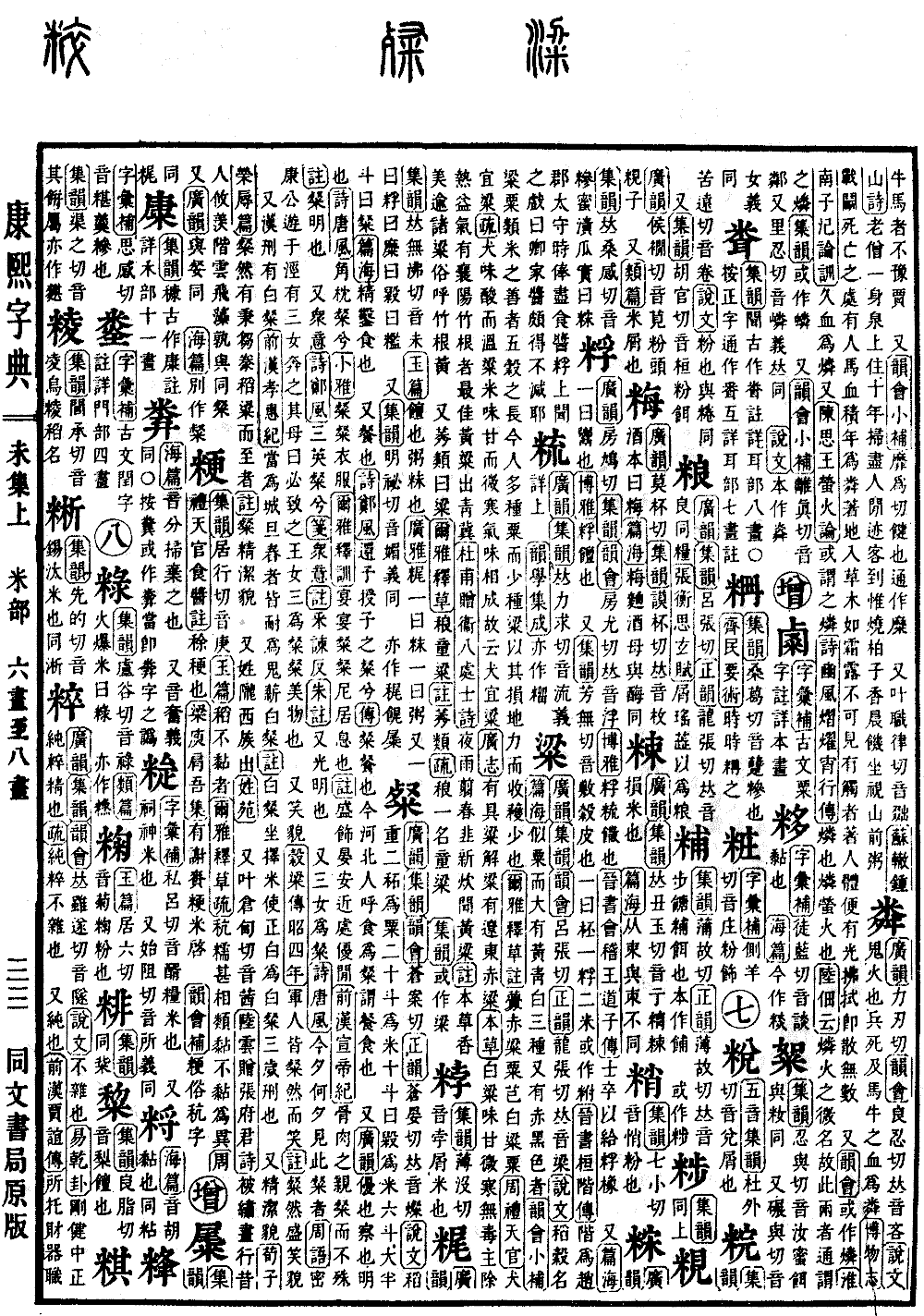
Wei Collection, Upper Volume
Radical: Rice (mǐ)
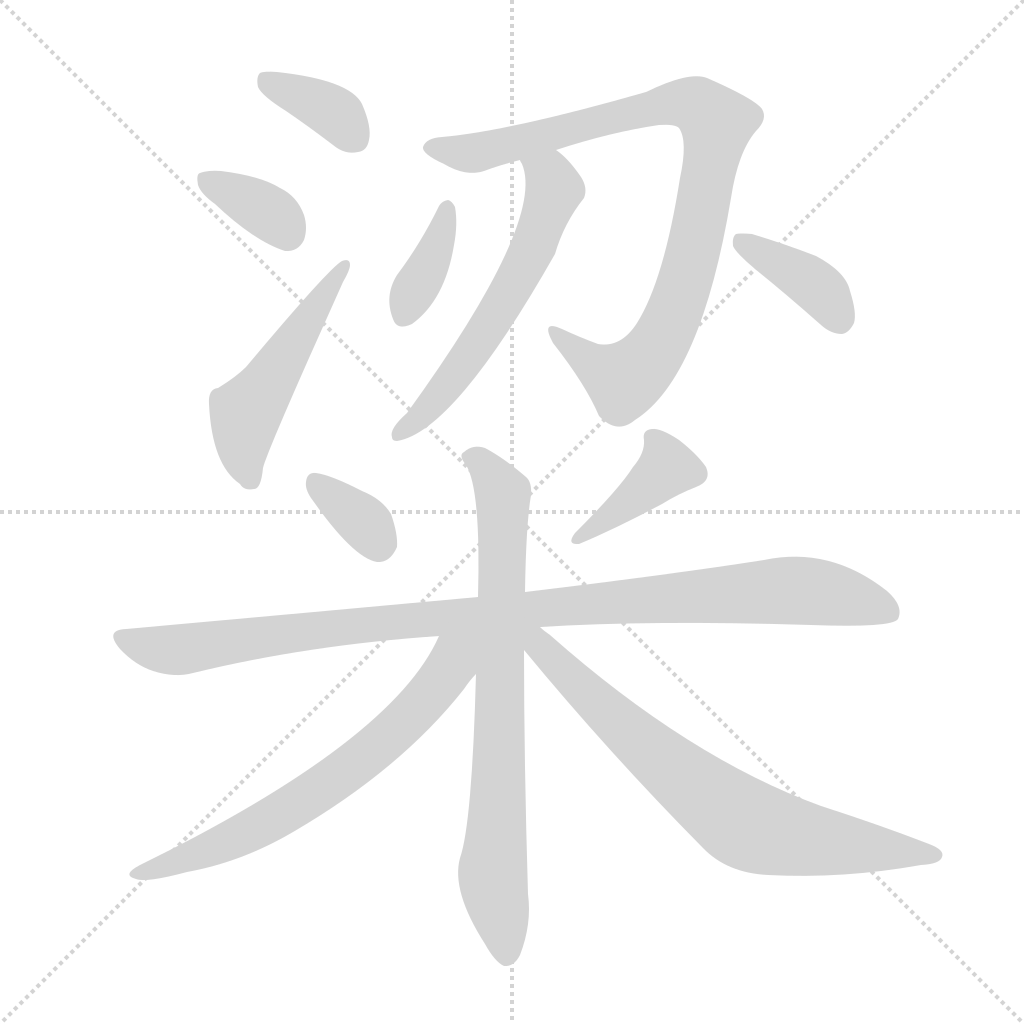
Liáng
Kangxi stroke count: 13
Page 909, Entry 20
Guangyun, Jiyun, and Yunhui all define it as having the pronunciation liáng. Zhengyun defines it as having the same pronunciation. According to the Shuowen Jiezi, it is the name of a type of rice. Pianhai states that it resembles millet but has larger grains, coming in yellow, green, and white varieties, as well as red and black types. Yūnhuì Xiǎobǔ notes that liáng is a type of millet and is considered a superior quality grain, ranking as the foremost among the five cereals; nowadays, people plant more common millet and less liáng because it depletes the soil and yields less.
According to the commentary on the Erya, Shicǎo, fén refers to red liáng millet, and qǐ refers to white liáng millet. The Zhou Rites (Zhouli), Tiānguān section states that dog meat is best accompanied by liáng rice. The commentary explains that dog meat is sour in flavor and warm in nature, while liáng rice is sweet and slightly cold; their flavors and qualities complement one another, hence the recommendation to pair them.
Guǎngzhì lists varieties such as jù liáng and xiè liáng, as well as Liaodong red liáng. The Bencǎo states that white liáng is sweet in flavor, slightly cold in nature, and non-toxic; its primary benefits are clearing internal heat and supplementing vital energy, with the variety produced at the roots of bamboo in Xiangyang being the finest. Yellow liáng is produced in the Qingzhou and Jizhou regions.
Du Fu, in his poem A Gift to Hermit Wei Ba (Zèng Wèi Bā Chǔshì Shī), wrote: Cutting spring leeks in the night rain, freshly steamed yellow liáng mixed in. The commentary notes that the Bencǎo records its fragrance as superior to other types of liáng, commonly referred to as bamboo-root yellow.
Additionally, a type of weed is also called liáng. According to the Erya, Shicǎo, láng is known as tóng liáng. The commentary identifies it as a type of weed, and the sub-commentary states that láng is also known as tóng liáng. Jiyun notes that it is sometimes written in a variant form (liáng).
Textual research: The Shuowen Jiezi identifies it as a type of rice; the original text has been corrected accordingly. In Du Fu's poem, the text has been corrected from the original to read as mixed in rather than smelled.