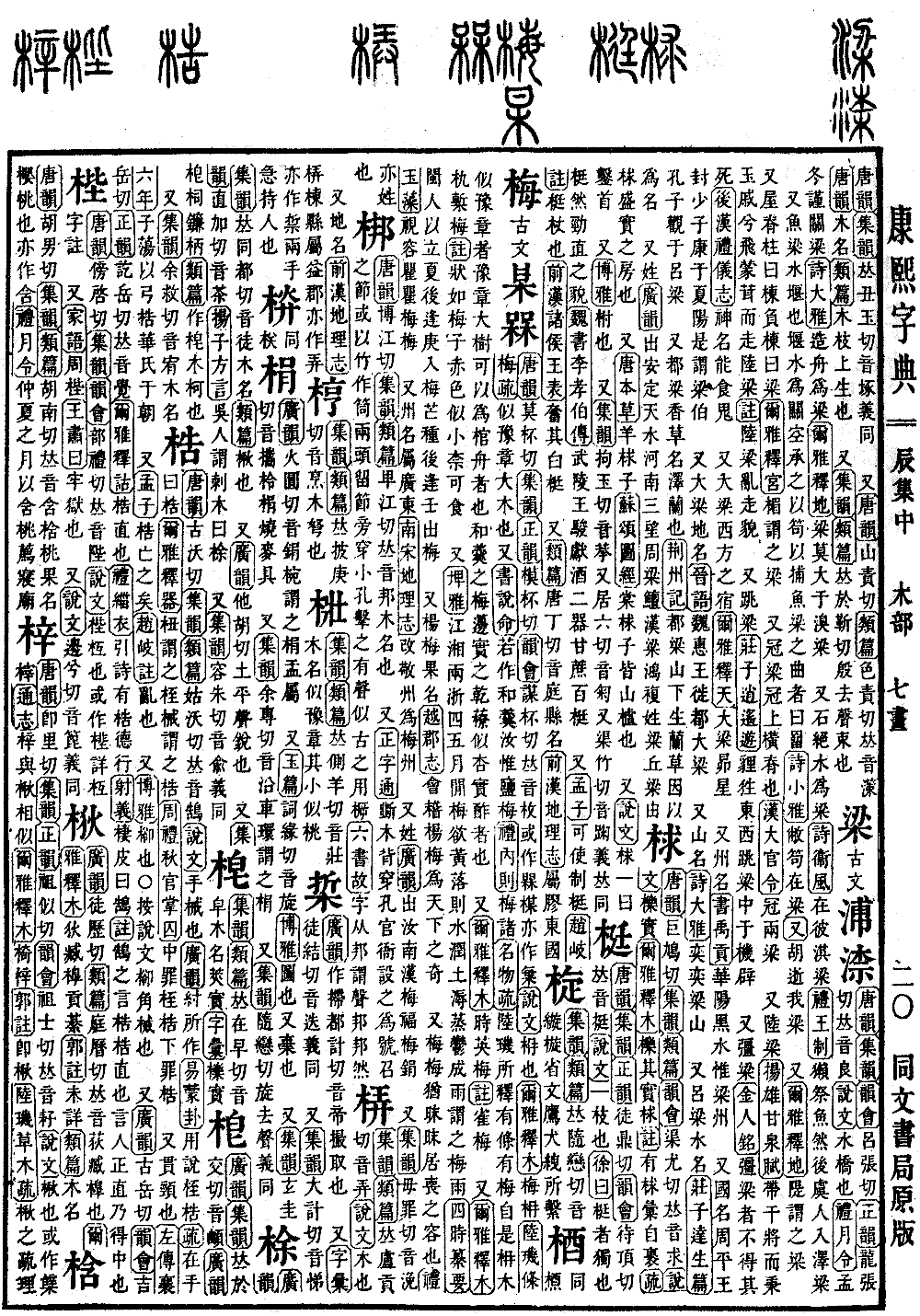
Chen Collection, Middle Volume
Radical: Tree (mù)
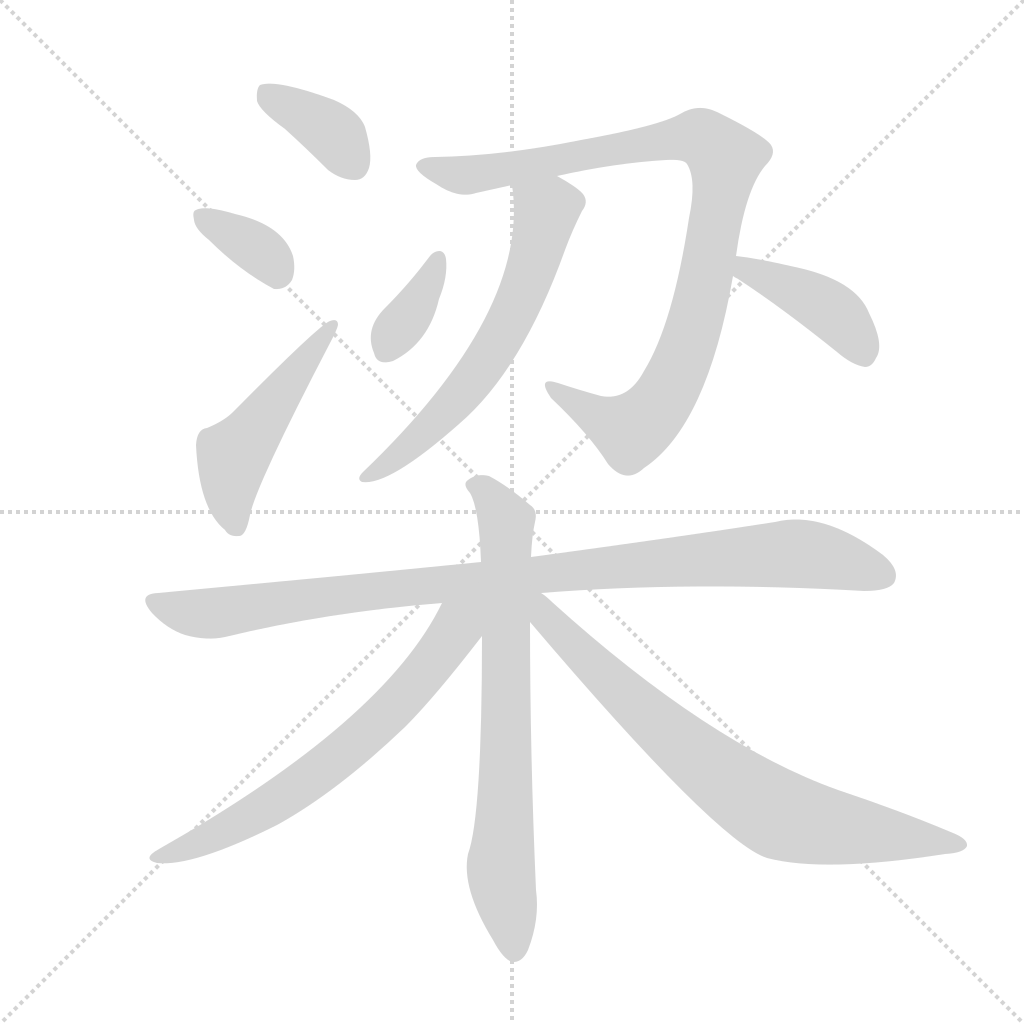
梁
Kangxi stroke count: 11
Page 528, Entry 01
Ancient form: 渿
According to Tang Rhymes (Tangyun), Collected Rhymes (Jiyun), and Rhyme Meeting (Yunhui), pronounced liang; according to Correct Rhymes (Zhengyun), also pronounced liang.
Shuowen Jiezi states: A bridge over water.
Book of Rites (Liji), Monthly Ordinances (Yueling): In the first month of winter, be cautious with mountain passes and bridges.
Book of Odes (Shijing), Greater Odes (Daya): Build boats to serve as a bridge.
Erya, Explanations of Earth (Shidi): Among bridges, none are greater than the Xiu bridge.
Also, stones across water form a bridge.
Book of Odes (Shijing), Odes of Wei (Weifeng): At that Qi bridge.
Book of Rites (Liji), Royal Regulations (Wangzhi): Only after the otter sacrifices fish may the forest warden enter the marshes and fish-dams.
Also, a fish-dam is a weir in the water. A weir is built to obstruct water, leaving gaps supported by bamboo baskets to catch fish. The curved part of a dam is called a liu.
Book of Odes (Shijing), Odes of Qi (Qifeng): The worn-out bamboo basket is at the dam.
Greater Odes (Daya): Why go to my dam?
Erya, Explanations of Earth (Shidi): An embankment is called a beam.
Also, the pillar of a roof ridge is called a dong, and the support beneath the ridge is called a liang.
Erya, Explanations of Palaces (Shigong): The lintel is called a beam.
Also, a crown beam, the horizontal ridge on top of a crown.
Han Dynasty Official Records (Han Daguan Ling): Crowns have two beams.
Also, luliang (unruly behavior).
Yang Xiong, Ganquan Rhapsody (Ganquan Fu): Girded with the Ganjiang sword and grasping a jade battle-axe, rushing about in a chaotic, unruly manner.
Annotation: Luliang is the appearance of running in a disorderly way.
Also, tiaoliang (leaping about).
Zhuangzi, Free and Easy Wandering (Xiaoyao You): The wildcat jumps and leaps east and west, until it is caught in a trap.
Also, qiangliang (tyrannical and unyielding).
Inscription on a Metal Statue (Jinren Ming): Those who are tyrannical and unyielding do not meet a natural death.
Book of the Later Han (Houhan Shu), Records of Rituals (Liyi Zhi): The name of a spirit capable of devouring ghosts.
Also, Daliang, a stellar mansion in the west.
Erya, Explanations of Heaven (Shitian): Daliang corresponds to the Mao constellation.
Also, a prefecture name.
Book of Documents (Shangshu), Tribute of Yu (Yugong): From Huayang to the Black River is the Liang Province.
Also, a state name. King Ping of Zhou enfeoffed his youngest son, Kang, in Xiayang; he was known as the Earl of Liang.
Also, Daliang, a place name.
Records of the Grand Historian (Shiji): King Hui of Wei moved his capital to Daliang.
Also, a mountain name.
Book of Odes (Shijing), Greater Odes (Daya): The grand and majestic Liang Mountain.
Also, Lüliang, a water name.
Zhuangzi, Essentials of Life (Dasheng Pian): Confucius observed the Lüliang waterfall.
Also, Duliang, a fragrant herb, also known as zelan (marsh orchid).
Jingzhou Record (Jingzhou Ji): Orchid grass grows under Duliang Mountain, and it is named after this.
Also, a surname.
Guangyun: Originates from the three prestigious clans of Anding, Tianshui, and Henan. Examples include Zhou's Liang Zhan and the Han Dynasty's Liang Hong.
Compound surnames include Liangqiu and Liangyou.
Textual corrections:
Book of Odes (Shijing), Lesser Odes (Xiaoya): The worn-out bamboo basket is at the dam.
Ibid.: Why go to my dam?
The original text was corrected from Odes of Qi (Qifeng) to Lesser Odes (Xiaoya). The character reference was corrected to Lesser Odes.
Erya, Explanations of Heaven (Shitian): Daliang corresponds to the Mao constellation.
The original text was corrected to specify the Mao star.
Records of the Grand Historian (Shiji): King Hui of Wei moved his government to Daliang.
The original reference to the Discourses of Jin (Jinyu) was inaccurate; the text was corrected to refer to the Annals of Wei in the Records of the Grand Historian, and the word for capital was changed to government.