Si Collection, Lower Volume
Radical: Dog (quǎn)
Kangxi strokes: 16
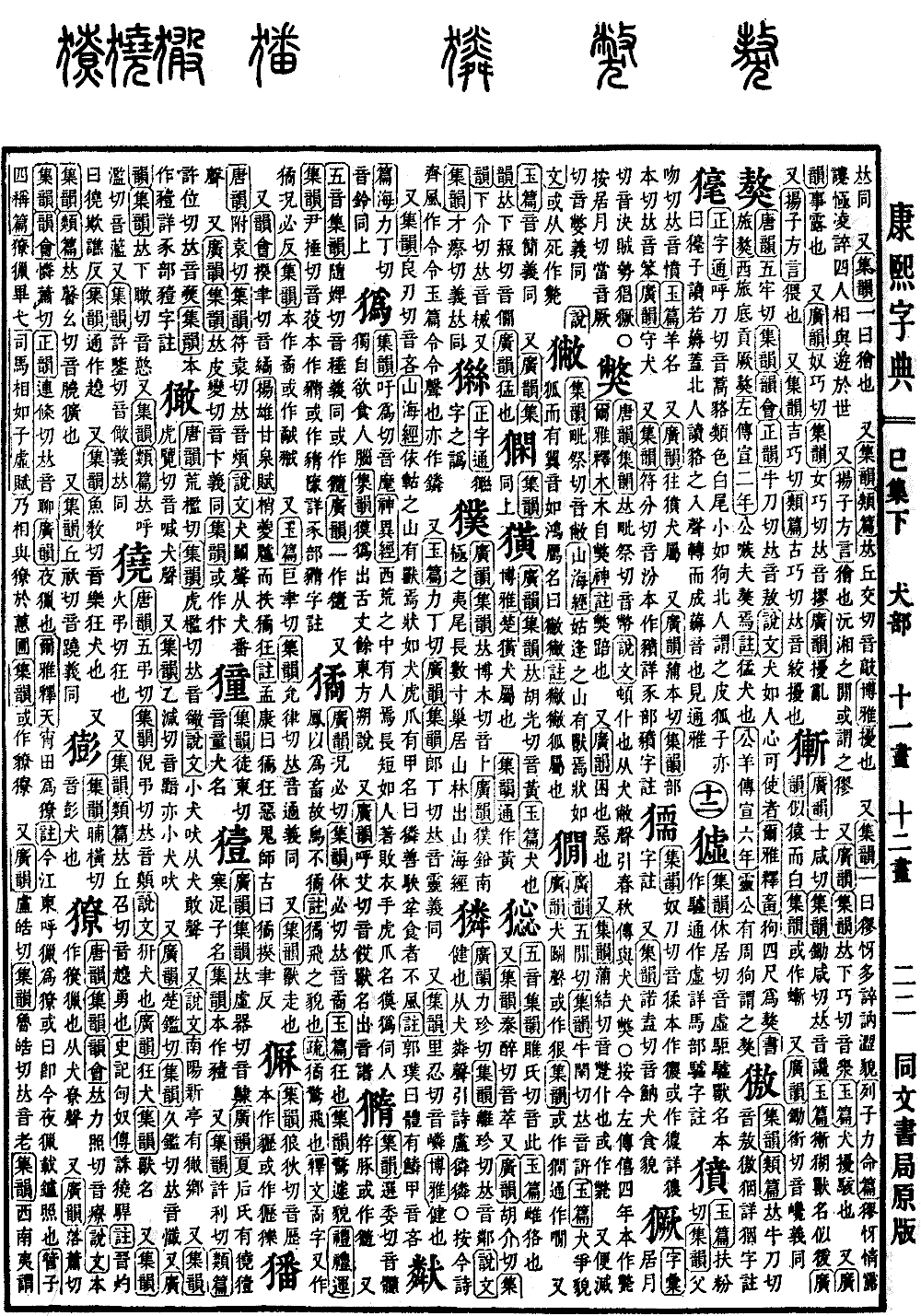
Page 718, Entry 29
Tang Rhymes (Tangyun), Collected Rhymes (Jiyun), and Rhyme Compilation (Yunhui) record the pronunciation as liao (falling tone), identical to the pronunciation of liao (rising tone).
Shuowen Jiezi (Shuowen) states that the original form was written as (variant), meaning to hunt. The character is composed of the radical for dog and the phonetic component liao.
Additionally, Guangyun records the pronunciation as liao (level tone), and Jiyun and Rhyme Compilation (Yunhui) record it as liao (level tone), and Correct Rhymes (Zhengyun) records it as liao (level tone), all identical to the pronunciation of liao (level tone).
Guangyun defines this as hunting at night.
Erya, Explanation of Heaven (Erya) states: Hunting at night is called liao.
Commentary: Currently in the Jiangdong region, hunting is called liao. Some say it refers to the activity of carrying a fire stove for illumination while hunting at night.
Guanzi, Four Qualifications (Guanzi) refers to using various methods to hunt and catch birds.
Sima Xiangru, Rhapsody on Sir Fantasy (Zixu Fu) describes them hunting together in the orchid grass garden.
Collected Rhymes (Jiyun) notes that it is sometimes written as (variant).
Additionally, Guangyun records the pronunciation as lao (rising tone), and Jiyun records it as lao (rising tone), identical to the pronunciation of lao (rising tone).
Collected Rhymes (Jiyun) notes that ethnic minorities in the southwest regions were called liao. Sometimes also written as a variant (liao).
Additionally, Guangyun records the pronunciation as jiao (rising tone), and Jiyun and Classified Chapters (Leipian) record it as jiao (rising tone), identical to the pronunciation of jiao (rising tone).
Guangyun states the original form was written as (variant).
Collected Rhymes (Jiyun) notes that it is sometimes written as (variant).
One may also consult the entries under the Badger (zhì) radical for the character (variant).