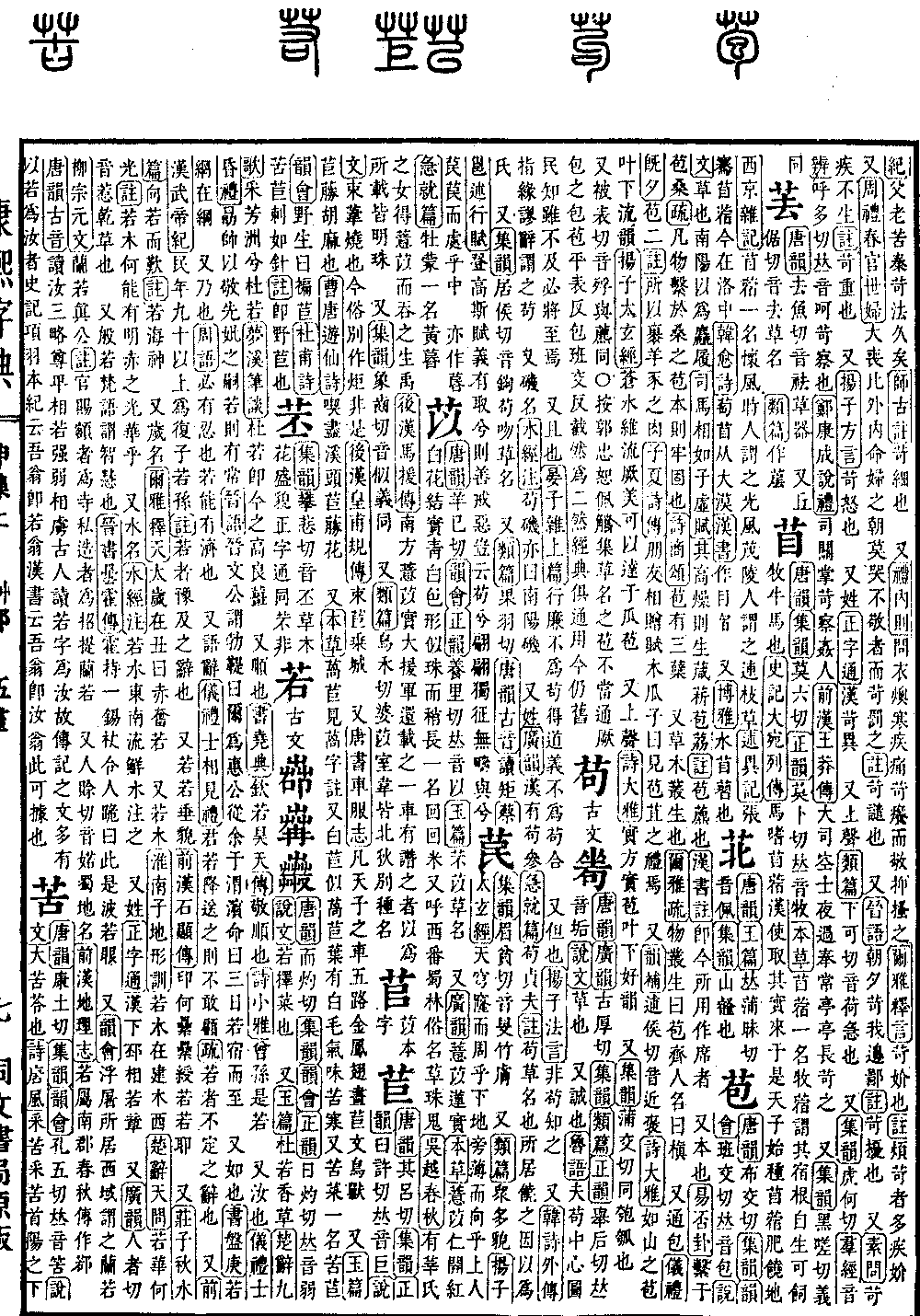
Shen Collection, Upper Volume
Radical: Grass (cǎo)
Ku. Kangxi stroke count: 11. Page 1023, Entry 16.
Tangyun pronunciation: ku (rising tone). Jiyun and Yunhui pronunciations: ku (rising tone).
Shuowen Jiezi says: Greater bitter, a type of ling plant.
Book of Odes (Shijing), Tang Feng section: Gathering the bitter plant, gathering the bitter plant, below Mount Shouyang.
Commentary: Bitter refers to the bitter vegetable. Lu Ji says: It grows in fields and mountains; after the frost, it becomes sweet, crisp, and delicious.
Xie Lingyun, Rhapsody on Mountain Living (Shanju fu): Two types of bamboo, each with unique leaves; four types of bitter greens, all with uniform flavor.
Self-annotation: The four bitter greens are the green bitter, white bitter, purple bitter, and yellow bitter.
Also means flavor.
Book of Documents (Shangshu), Great Plan (Hongfan): Fire flames upward, creating a bitter flavor.
Book of Odes (Shijing), Bei Feng section: Who says the bitter sow thistle is bitter? To me it is as sweet as shepherd's purse.
Also, Jiyun says: To toil.
Mencius: One must first distress (ku) their heart and will.
Also means to suffer from or to be afflicted by.
History of the Former Han (Qianhan shu), Biography of Jia Yi: Not only suffering from swelling, but also afflicted by an ailment of the limbs.
Also, Leipian says: Urgent.
Also, Guangya dictionary: To be disappointed or dissatisfied.
Also, Yang Xiong, Regional Dialects (Fangyan): To be happy or pleased. In the state of Chu it is called ku, in Qin it is called liao.
Guo Pu says: Using ku to mean happy is like calling an odor fragrant, or disorder order; these are terms used in reverse.
Also, falling tone. Zheng Yun dictionary: Pronounced ku (falling tone). To be distressed or trapped.
Xixi Congyu: Modern people who are not skilled at sailing call a ship that is difficult to handle a ku boat; northerners call a poorly constructed cart a ku cart.
Also a surname. The official Kucheng is mentioned in the Discourses of the States (Guoyu).
Also, Tongzhi: Shizu Lue, during the Han dynasty, there was a Governor of Kuaiji named Kuzhuo.
Also pronounced gu (rising tone). Means coarse or bad.
Rites of Zhou (Zhou li), Winter Offices (Dongguan kaogong ji): Distinguish between coarse and fine quality.
Annotation: Refers to distinguishing the coarseness and fineness of silk fabrics.
Discourses of the States (Qi yu): Distinguish between durability and coarseness.
Annotation: Gong means durable; ku means fragile.
Records of the Grand Historian (Shiji), Annals of the Five Emperors: The utensils on the riverbank were neither coarse nor fragile.
Annotation: Ku means coarse.
Also pronounced hu (falling tone). A place name.
Records of the Grand Historian (Shiji), Biographies of Laozi and Zhuangzi: Laozi was a person from Li Township, Quren Village, Ku County, in the state of Chu.
Note: The character ku in the terms ku liang (coarse quality), ku yu (coarse and fragile), and gong ku (durability and coarseness) is sometimes written as ku or gu; it is also interchangeable with gu, all with the same meaning. Zhiyin dictionary writes it as ku. The character ku is formed with the grass radical.