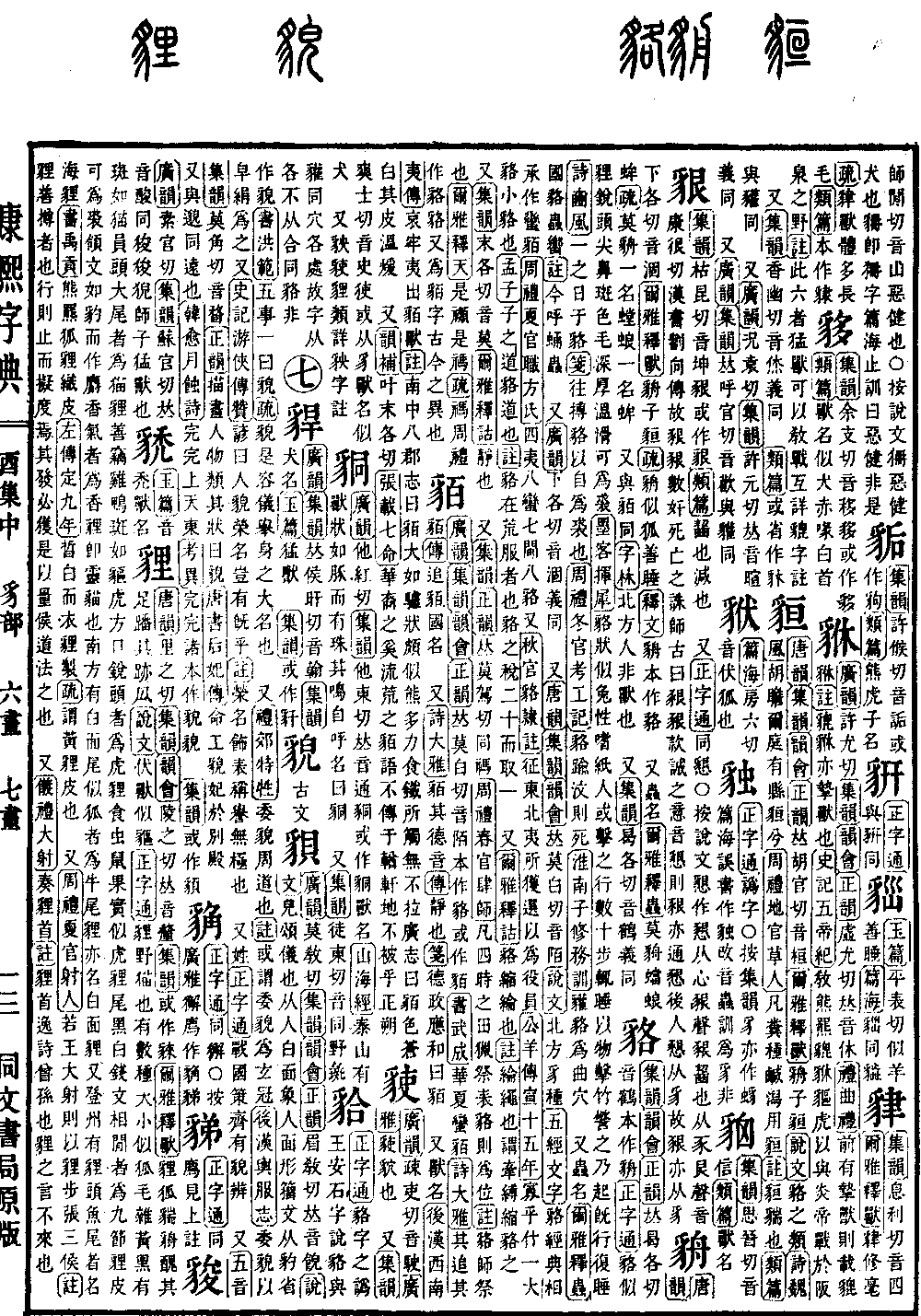
You Collection, Middle Volume
Radical: Badger (zhì)
13 strokes
Page 1201, Entry 11
According to the Sound-Rhyme Dictionary (Jiyun), it is pronounced kun. Sometimes also written in a variant form (kěn). According to the Classified Compendium (Leipian), it means to gnaw or to reduce. Also, according to the Correct Meaning Through (Zhengzitong), it is the same as the character for sincere (kěn). According to the Explanation of Simple and Compound Characters (Shuowen Jiezi), the character for sincere is written with the heart radical and uses the character meaning to gnaw as its phonetic component. The character meaning to gnaw uses the swine radical and uses the character meaning mountain limit as its phonetic component, pronounced kang-hen. In the Biography of Liu Xiang in the History of the Former Han (Hanshu), it states: Therefore, one is earnest and sincere, repeatedly risking the penalty of death. Yan Shigu comments that the term meaning earnest and sincere is pronounced the same as the character for sincere. Thus, the character for gnaw can also be used generally. Later scholars used the badger radical, and therefore the character for gnaw is also written with the badger radical. The character with the badger radical is synonymous with the character for sincere.