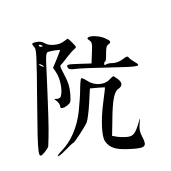
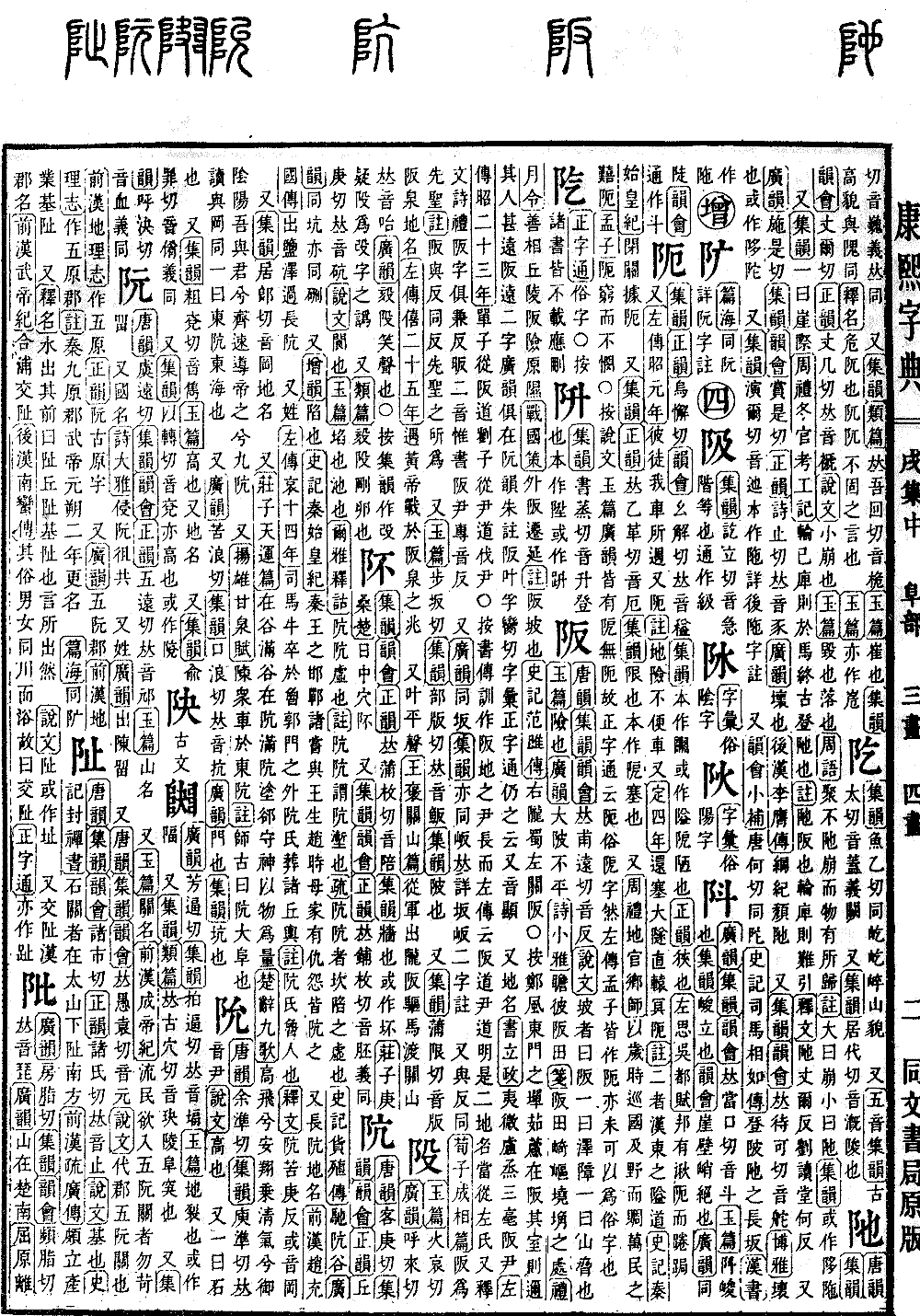
Xu Collection, Middle Volume. Radical: Mound (fù). The character kēng. Kangxi Stroke Count: 12. Page 1346, Number 14.
Tang Rhymes (Tangyun) gives the pronunciation as a combination of the sounds kè and gēng. Collected Rhymes (Jiyun), Rhyme Meeting (Yunhui), and Correct Rhymes (Zhengyun) all give the pronunciation as a combination of qiū and gēng. It is sounded like kàng.
Explaining Simple and Analyzing Compound Characters (Shuowen Jiezi) defines it as a high gate or an empty space. Jade Chapters (Yupian) defines it as a pit or a pond.
In the Explaining Words (Shigu) section of the Erya (Erya), the character refers to a hollow or empty space. The commentary notes that the doubled form kēng kēng refers to a moat or a trench. The sub-commentary explains that the doubled form refers to the emptiness of a sunken pit.
Records of the Grand Historian (Shiji) in the Biographies of Money-makers (Huozhi Zhuan) mentions speeding through pits and valleys. Broad Rhymes (Guangyun) notes it is the same as the character for pit. It is also synonymous with xíng, referring to a valley or a mold.
Additionally, Augmented Rhymes (Zengyun) defines it as to trap or bury alive. The Annals of Qin Shi Huang (Qin Shi Huang Ji) in the Records of the Grand Historian states that when the King of Qin went to Handan, he buried alive all those who had held a grudge against his mother's family during the time the King lived in Zhao.
It is also a place name, Changkeng. History of the Former Han (Qian Han Shu) in the Biography of Zhao Chongguo (Zhao Chongguo Zhuan) mentions setting out from the Salt Marsh and passing through Changkeng.
It is also a surname. Zuo Commentary (Zuozhuan) for the 14th year of Duke Ai notes that when Sima Niu died outside the outer gates of the capital of Lu, the Keng clan buried him in Qiuyu. The commentary identifies the Keng clan as people of the state of Lu. The Explanation of Texts (Shiwen) provides a pronunciation as a combination of kǔ and gēng, or sometimes as gāng.
Also, in Collected Rhymes, it is given the pronunciation of a combination of jū and láng, sounded like gāng, as a place name.
In the Zhuangzi (Zhuangzi) section The Turning of Heaven (Tianyun), it states that in the valleys it fills the valleys, and in the pits it fills the pits; one should block the gaps and guard the spirit, using things as the measure.
In the Nine Songs (Jiuge) of the Songs of Chu (Chu Ci), it says: Flying high and soaring peacefully, riding the pure air and commanding the yin and yang. I and the lord speed together, leading the Emperor to the Nine Pits.
Furthermore, in Yang Xiong's Rhapsody on the Ganquan Palace (Ganquan Fu), it mentions a multitude of chariots at Dongkeng. The commentary by Yan Shigu states that the character means a large mound and should be read the same as gāng. Another interpretation suggests Dongkeng refers to the Eastern Sea.
Additionally, Broad Rhymes and Collected Rhymes provide a pronunciation as a combination of kǔ or kǒu with làng, sounded like kàng. Broad Rhymes defines it as a gate, while Collected Rhymes defines it as a pit.