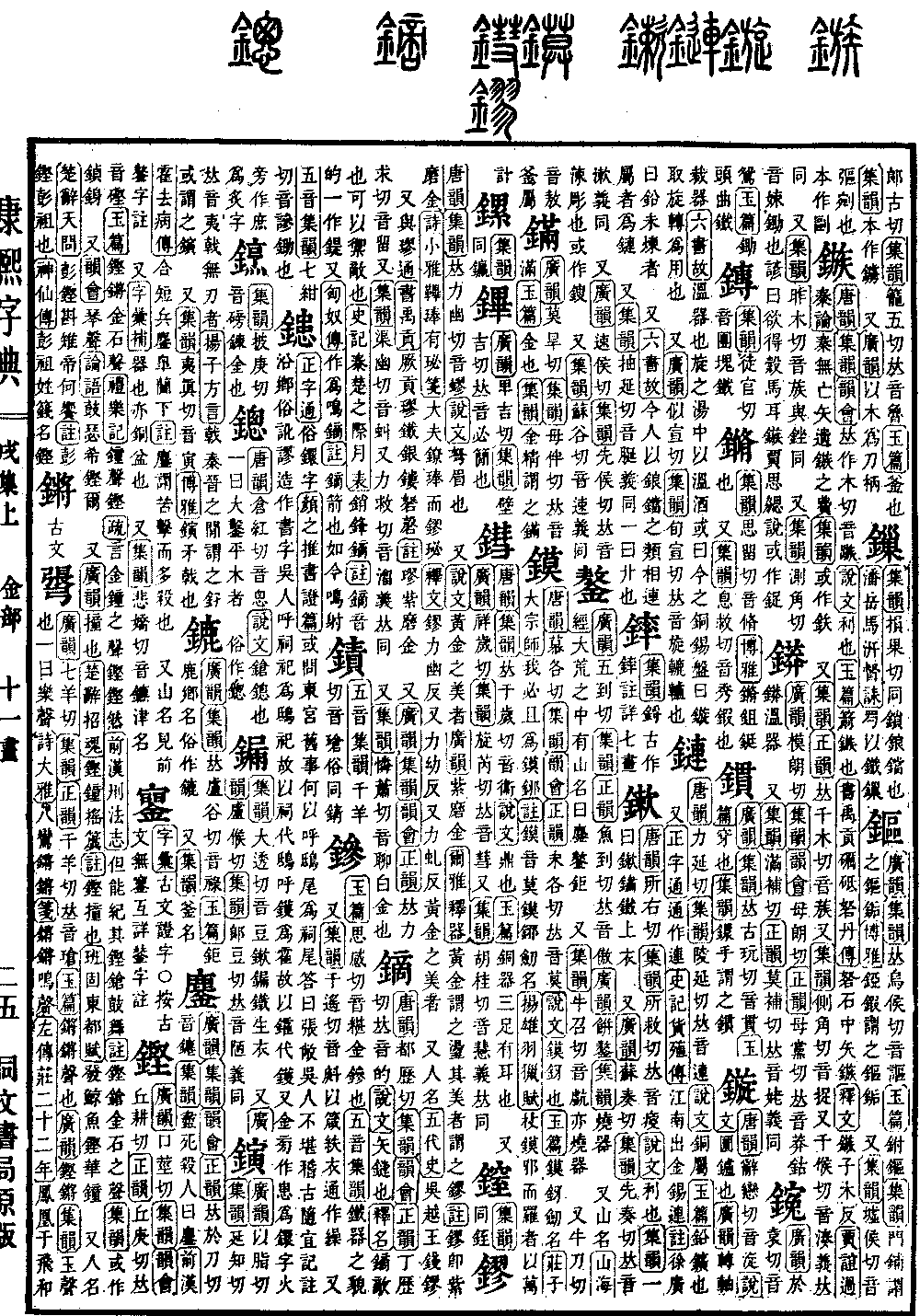
Xu Collection, Upper Volume
Radical: Metal (jīn)
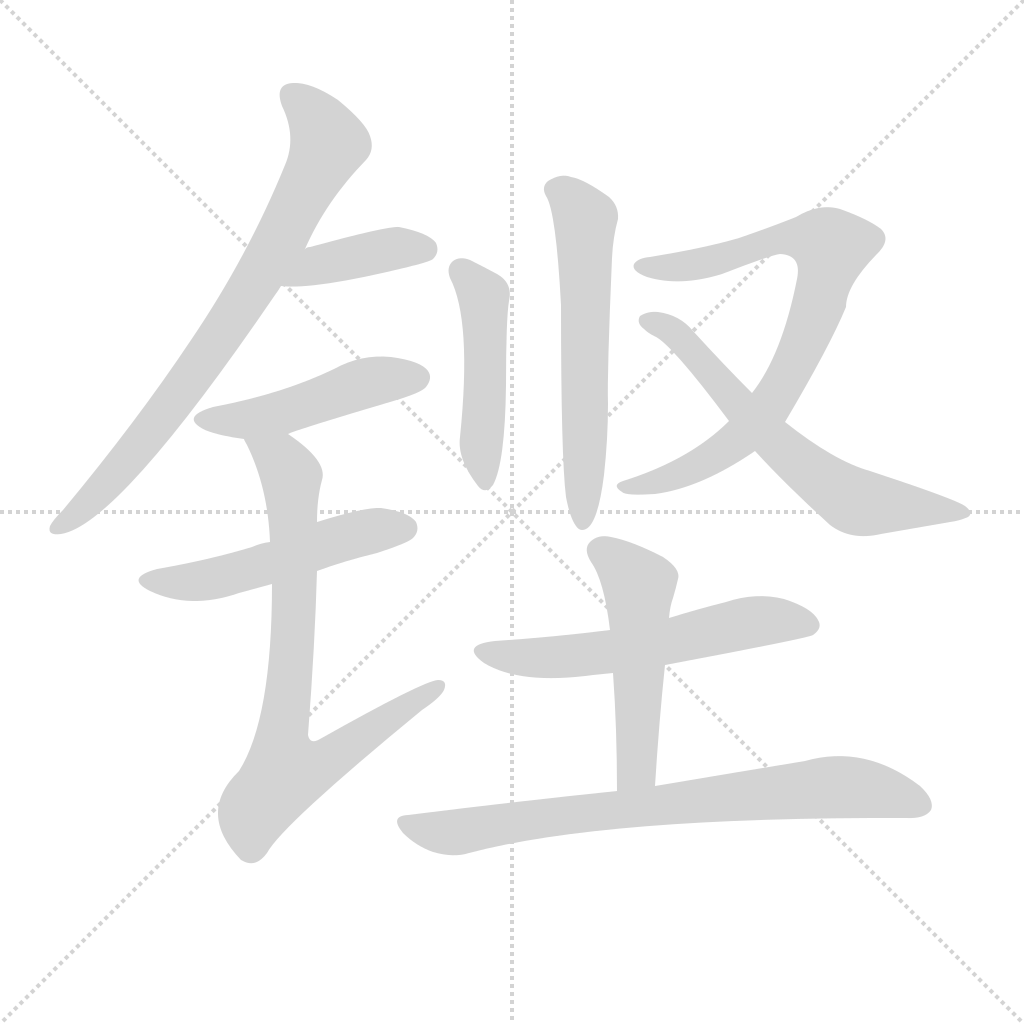
Character: Keng
Kangxi brush strokes: 19
Page 1319, Entry 06
Guangyun: Pronounced keng. Jiyun and Yunhui: Pronounced keng. Zhengyun: Pronounced geng.
Yupian: Kengqiang, the sound of metal and stone.
Book of Rites (Liji), Record of Music (Yueji): The sound of the bell is keng.
Commentary: This refers to the sound of the metal bell being keng-keng.
History of the Former Han (Qianshan Shu), Treatise on Rites and Music (Liyuezhi): Only able to record its kengqiang drumming and dancing.
Note: Kengqiang is the sound of metal and stone.
Jiyun: Sometimes written in variant forms (suo) and (han).
Also, Yunhui: The sound of a zither.
Analects (Lunyu): Playing the zither with sparse notes, then a final keng.
Also, Guangyun: To strike.
Chu Songs (Chu Ci), Summoning the Soul (Zhaohun): Striking the bell to shake the stand.
Note: Keng means to strike.
Ban Gu, Eastern Capital Rhapsody (Dongdufu): Striking the whale-shaped chime, sounding the magnificent bell.
Also, a person's name.
Chu Songs (Chu Ci), Heavenly Questions (Tianwen): Peng Keng offered pheasant soup, what did the Emperor enjoy?
Note: Peng Keng is Pengzu.
Biographies of Immortals (Shenxianzhuang): Pengzu, surname Qian, personal name Keng.
Textual verification: History of the Former Han, Treatise on Law (Fazhi): Only able to record its kengqiang drumming and dancing. Note: The cited text is from the Treatise on Rites and Music, not the Treatise on Law. Based on the original text, the Treatise on Law has been corrected to the Treatise on Rites and Music.