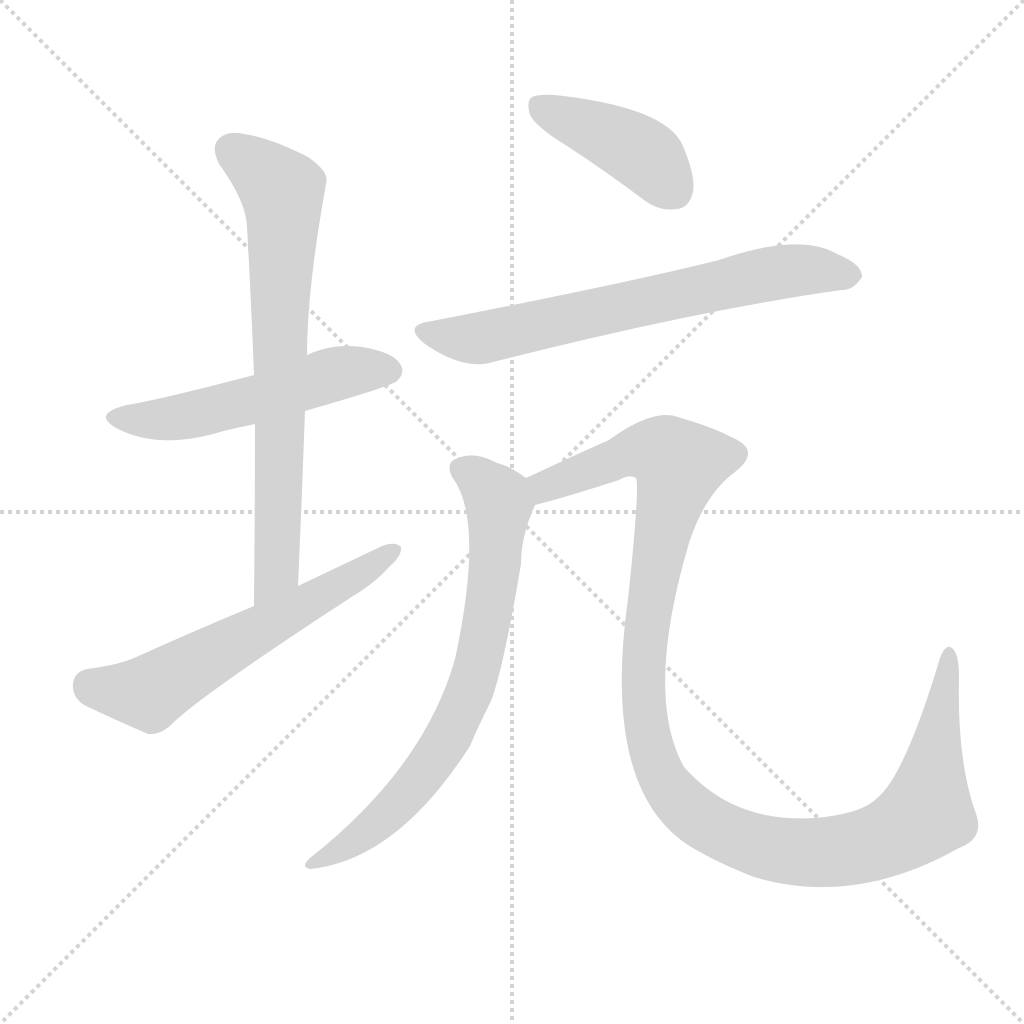
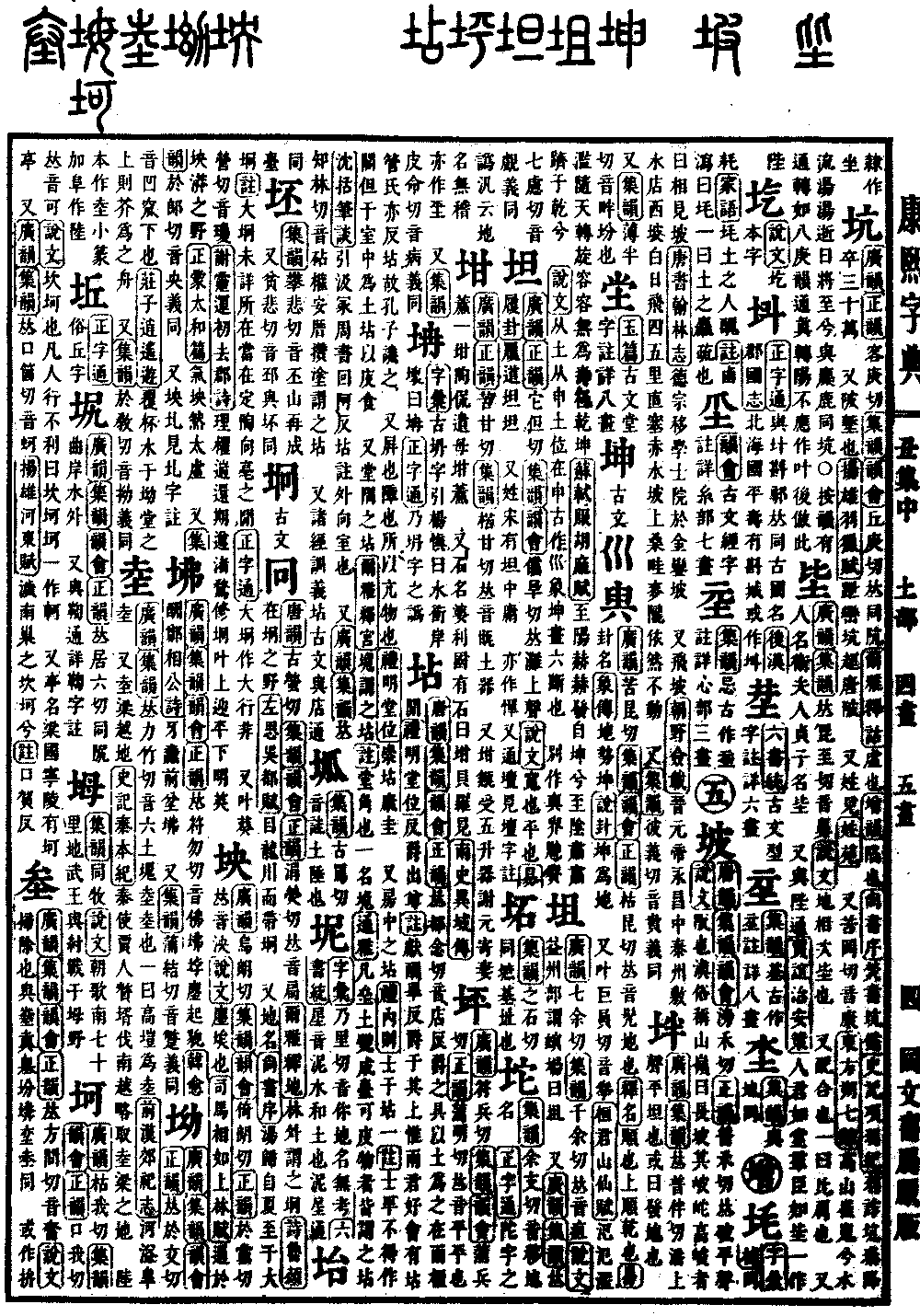
Chou Collection, Middle Volume. Radical: Earth (tǔ). Entry: Keng. Kangxi stroke count: 7. Page 226, Entry 01.
Pronounced keng. Same as the character meaning a pit or hole.
In the Classic of Nearness (Erya), section on the explanation of ancient terms, it means empty. In the Expanded Rhymes (Zengyun), it means to sink or fall into.
In the Preface to the Classic of History (Shangshu xu), it refers to the burning of books and the burying alive of Confucian scholars. In the Records of the Grand Historian (Shiji), biography of Xiang Yu, it states that Xiang Yu deceitfully buried alive three hundred thousand surrendered Qin soldiers.
It also refers to a ditch or a ravine. In the Feather Hunt Rhapsody (Yulie fu) by Yang Xiong, it describes leaping over mountains and pits, and vaulting over embankments.
Also a surname. Found in the Garden of Surnames (Xingyuan).
Also pronounced kang. In the Seven Admonitions (Qi jian) by Dongfang Shuo, it says, High mountains are craggy, water flows rushing; the passing days will soon arrive, I shall dwell in the same pit as the elk and deer.
Note: Regarding rhymes, there are cases of phonetic shift; for instance, the eighth rhyme category geng may shift to the zhen or yang categories. This should not be considered a forced rhyme to suit the verse; subsequent instances follow this principle.