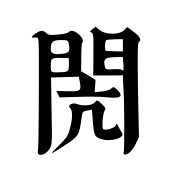
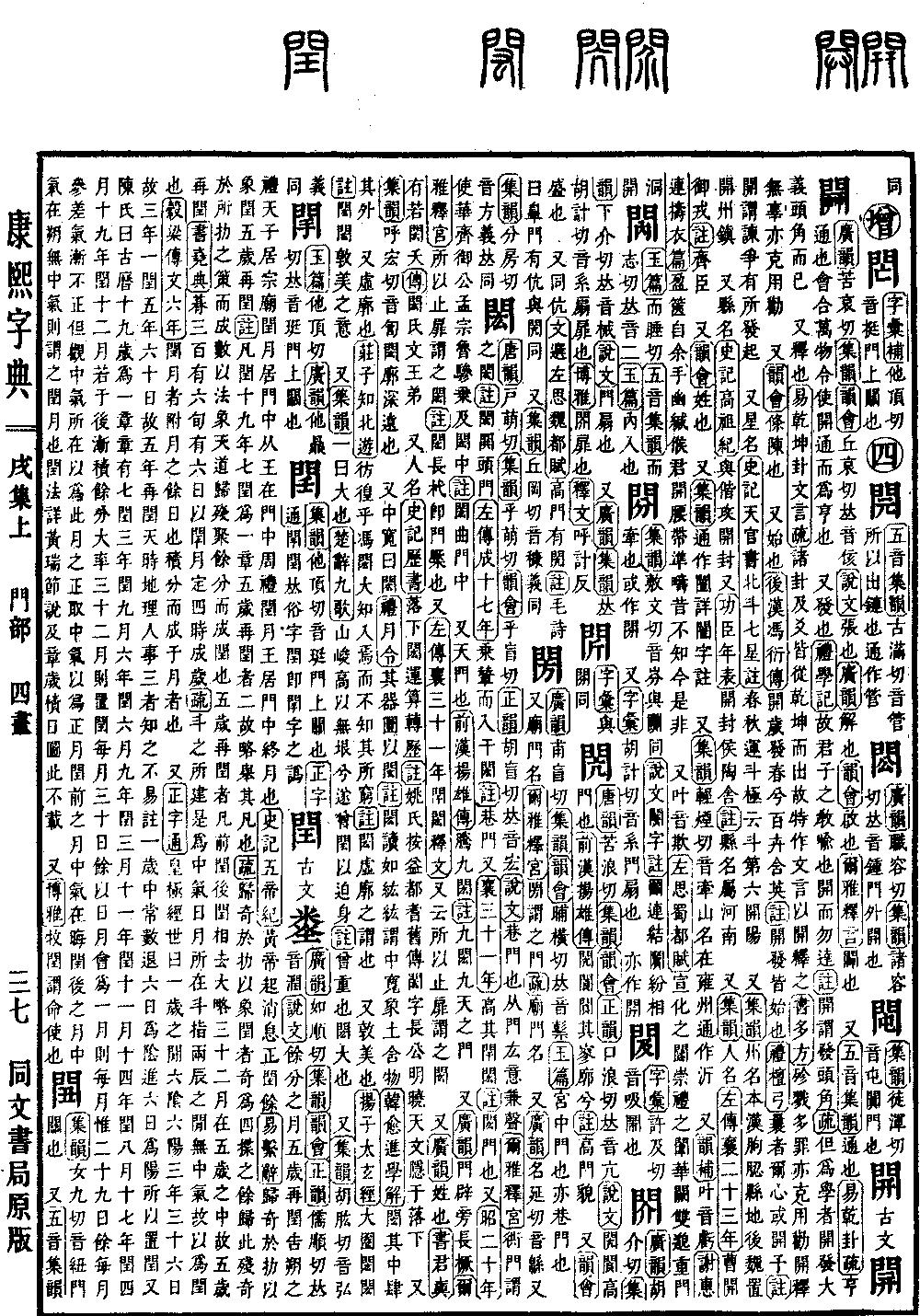
Xu Collection, Upper Volume
Radical: Gate (mén)
Kuang
Kangxi strokes: 12
Page 1331, Entry 13
According to the Tang Rhyme (Tangyun), the pronunciation is kang. According to the Collected Rhymes (Jiyun), Rhyme Meetings (Yunhui), and Orthodox Rhymes (Zhengyun), the pronunciation is kang (falling tone).
According to the Explaining Graphs and Analyzing Characters (Shuowen), the term kuanglang refers to a tall, imposing gate. In the Biography of Yang Xiong in the History of the Former Han (Qianhan Shu), it is written: "Kuanglanglang is vast and open." The commentary notes that this describes the appearance of a tall, imposing gate.
Also, according to the Rhyme Meetings (Yunhui), it refers to a grand, magnificent appearance.
Also written in a variant form (kang). In the Literary Selections (Wenxuan), Zuo Si's Rhapsody on the Capital of Wei states: "The tall gate has a kuang." The commentary notes: The Book of Odes (Shijing) says: "The Gao gate has a kang." This is the same as kuang.
Also, according to the Collected Rhymes (Jiyun), the pronunciation is kang.