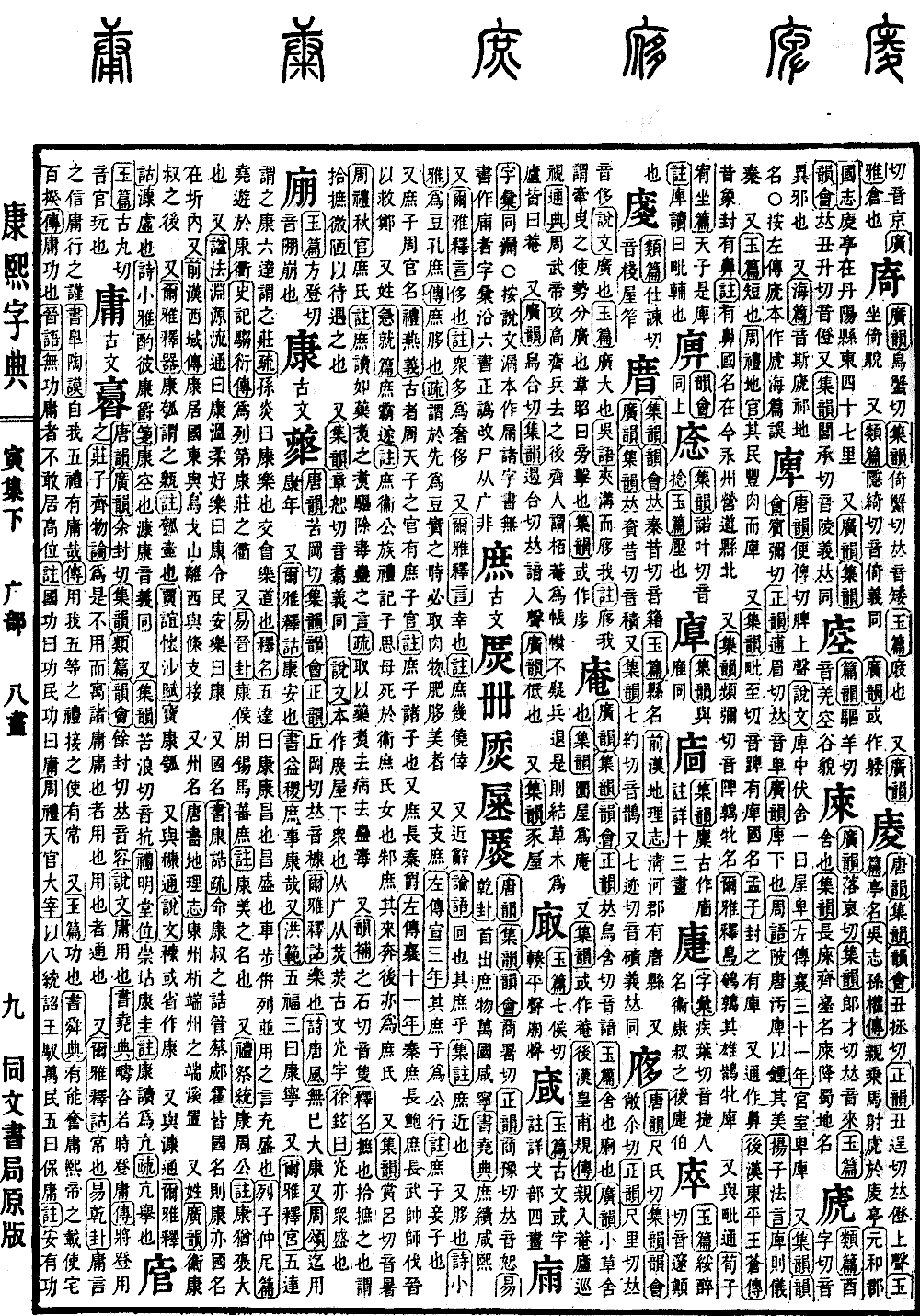
Yin Collection, Lower Volume
Radical: Broad (guǎng)
Kangxi Strokes: 11
Page 347, Entry 27
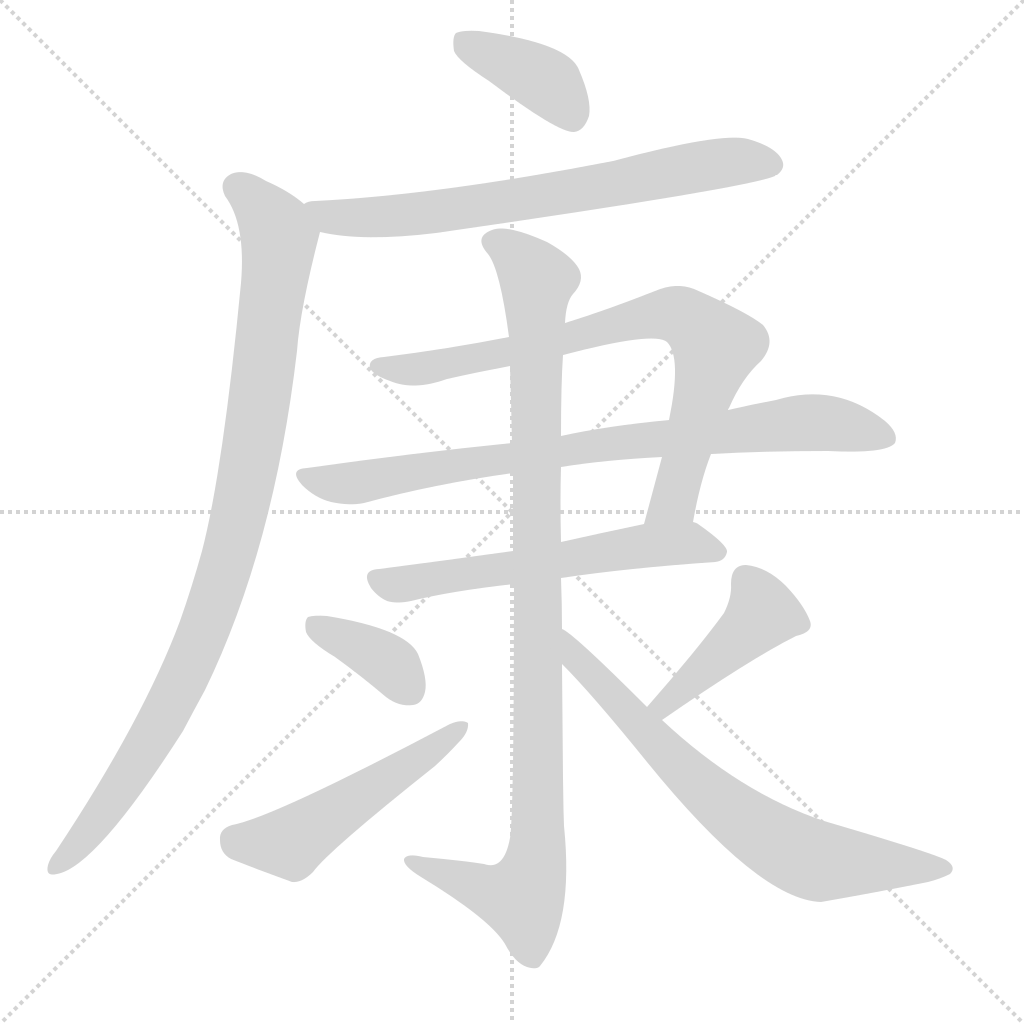
Ancient text. Pronounced kang.
Er ya: Commentary on Ancient Terms (Erya): Happiness.
Book of Odes (Shijing), Tang Odes: Do not be overly comfortable.
Also, Zhou Praises (Zhou Song): Thus using a year of peace.
Also, Erya: Commentary on Ancient Terms (Erya): Kang means peace.
Book of Documents (Shujing), Benefit to the Multitude (Yiji): All matters are peaceful.
Also, Great Plan (Hongfan): The five blessings, the third is peace and tranquility.
Also, Erya: Commentary on Explaining Palaces (Erya): A five-way intersection is called kang, a six-way intersection is called zhuang.
Commentary: Sun Yan says: Kang means happiness, a place of joyful convergence.
Explanation of Names (Shiming): Five-way intersections are called kang. Kang means prosperous; it is flourishing. Carriages and pedestrians use it together, describing a place that is full and flourishing.
Liezi, Master Kong Chapter: Yao traveled to the prosperous crossroads.
Records of the Grand Historian (Shiji), Biography of Zou Yan: Built rows of prosperous, wide roads.
Also, Book of Changes (Yijing), Progress Hexagram: The noble of Kang was presented with many horses.
Note: Kang is a name of praise.
Also, Book of Rites (Liji), Principles of Sacrifice (Jitong): The peace of the Duke of Zhou.
Note: Kang means to praise or enlarge.
Also, Posthumous Titles Law: Those whose virtues flow like a deep source are called kang; those who are gentle and love happiness are called kang; those who make the people peaceful and happy are called kang.
Also, the name of a state.
Book of Documents (Shujing), Announcement to Kang (Kanggao) Commentary: The announcement commanding Kang Shu. Guan, Cai, Cheng, and Huo were all names of states, so Kang was also a state name, located within the imperial domain.
Also, Book of the Former Han (Qian Hanshu), Account of the Western Regions: The king of Anxi ruled at Wandou City, and to the north it bordered Kangju.
Also, the name of a prefecture.
Old Book of Tang (Tangshu), Geography Treatise: Kang Prefecture, established by dividing Duanxi from Duan Prefecture.
Also, a surname.
Guangyun: Descendants of Kang Shu of Wei.
Also, Erya: Commentary on Implements (Erya): A pottery vessel is called kanghu.
Note: Hu is a pot.
Jia Yi, Lament for Qu Yuan: Treasuring the pottery vessel.
Also, interchangeable with the character for rice husks.
Explanation of Writing (Shuowen): The character for rice husks is sometimes abbreviated as kang.
Also, interchangeable with the character meaning empty or hollow.
Erya: Commentary on Ancient Terms (Erya): Kang means empty.
Book of Odes (Shijing), Minor Odes: Pouring from that empty cup.
Note: Kang means empty. The sound and meaning are the same as the character for hollow.
Also, pronounced kang (falling tone).
Book of Rites (Liji), Manners of the Bright Hall (Mingtangwei): The high pedestals and the raised jade tablets.
Note: Read kang as kang (raising/uplifting).
Commentary: Kang means to raise or lift up.