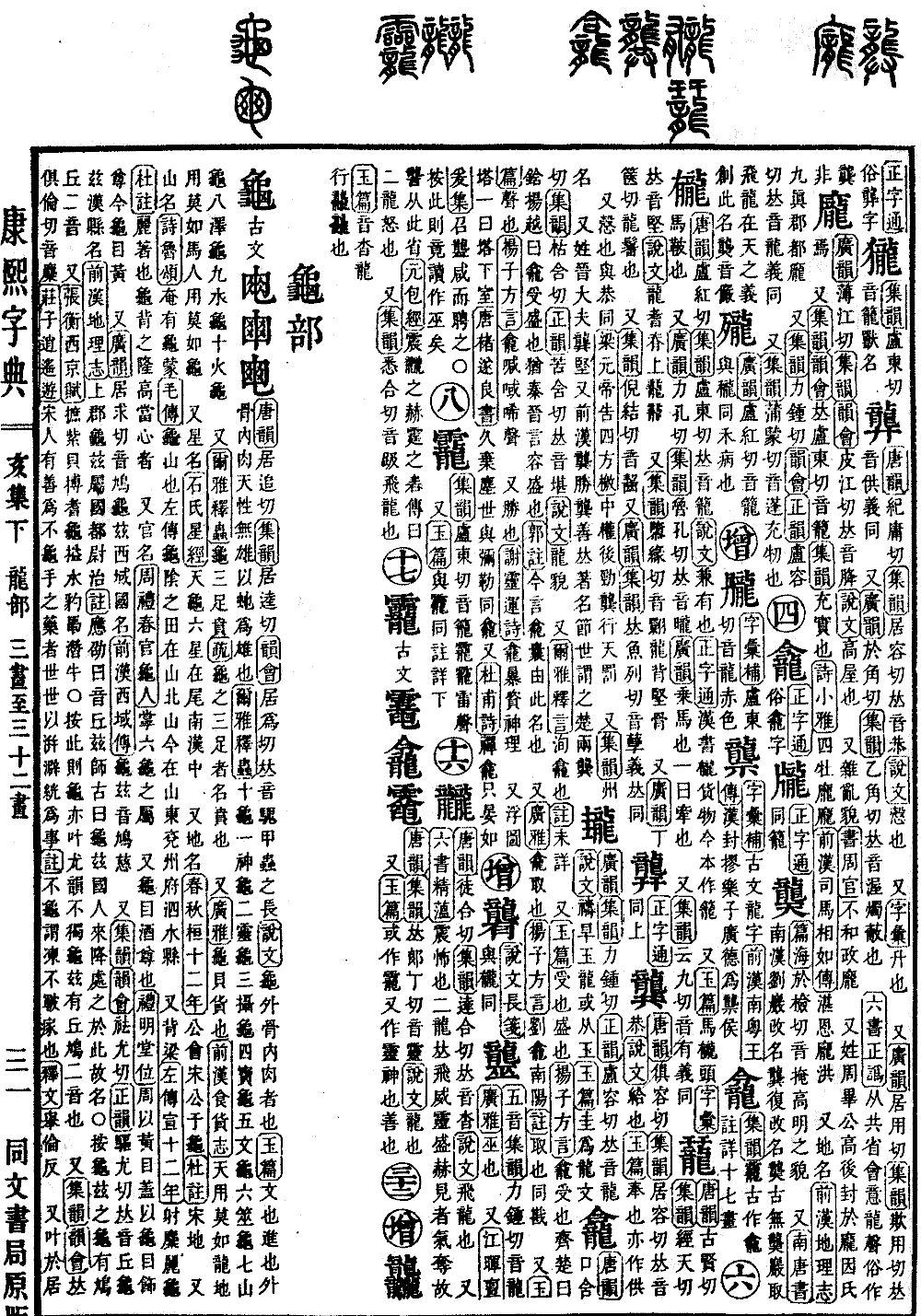
Hai Collection, Lower Volume
Radical: Dragon (lóng)
Kangxi Strokes: 22
Page 1537, Entry 16
Pronounced kan.
According to the Explaining Graphs and Analyzing Characters (Shuowen jiezi), it describes the appearance of a dragon.
According to the Approaching Elegance: Explaining Words (Erya Shiyan), it means to be sincere or honest. The commentary states the meaning is not fully understood.
According to the Jade Chapters (Yupian), it signifies receiving or containing.
According to the Regional Speech (Fangyan) by Yang Xiong, it means to sustain or receive. In the regions of Qi and Chu, this is called han; in the Yang-Yue region, it is called kan. It signifies containing or storing, similar to how the Qin and Jin regions use the term for capacity. The commentary by Guo Pu notes that the modern term for a pouch or container (kannang) derives from this meaning.
According to the Refined Extensions (Guangya), it signifies to obtain or take.
In the Model Sayings (Fayan) by Yang Xiong, it is used in the phrase Liu kan Nanyang, meaning to conquer or take over Nanyang. It is equivalent to the character meaning to pacify or suppress (kan).
According to the Jade Chapters (Yupian), it refers to sounds. According to the Regional Speech (Fangyan), it refers to the sound of shouting or crying.
It also signifies victory. In a poem by Xie Lingyun, it describes pacifying rebellion through divine principles.
It also refers to a Buddhist pagoda or a stone chamber beneath a pagoda, or a small cabinet used for enshrining Buddhist statues. In the writings of Chu Suiliang of the Tang Dynasty, it mentions having long abandoned the mundane world to be enshrined in the same Buddhist niche (kan) as the Maitreya Buddha.
In a poem by Du Fu, it describes the peaceful and tranquil appearance of a meditation cell (chankan).
Textual Research: In the Model Sayings (Fayan) by Yang Xiong, regarding the phrase Liu kan Nanyang, the reference to Regional Speech (Fangyan) has been corrected to Model Sayings (Fayan) according to the original text.