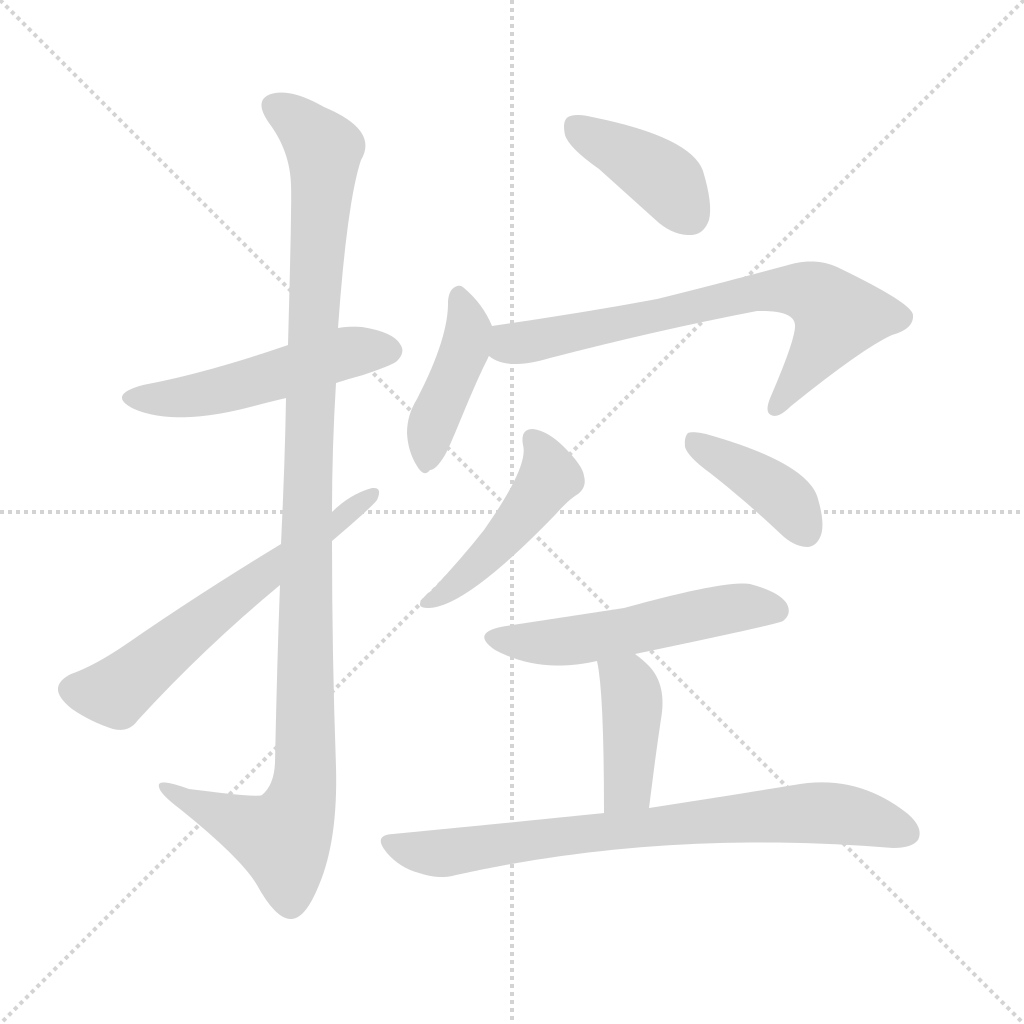
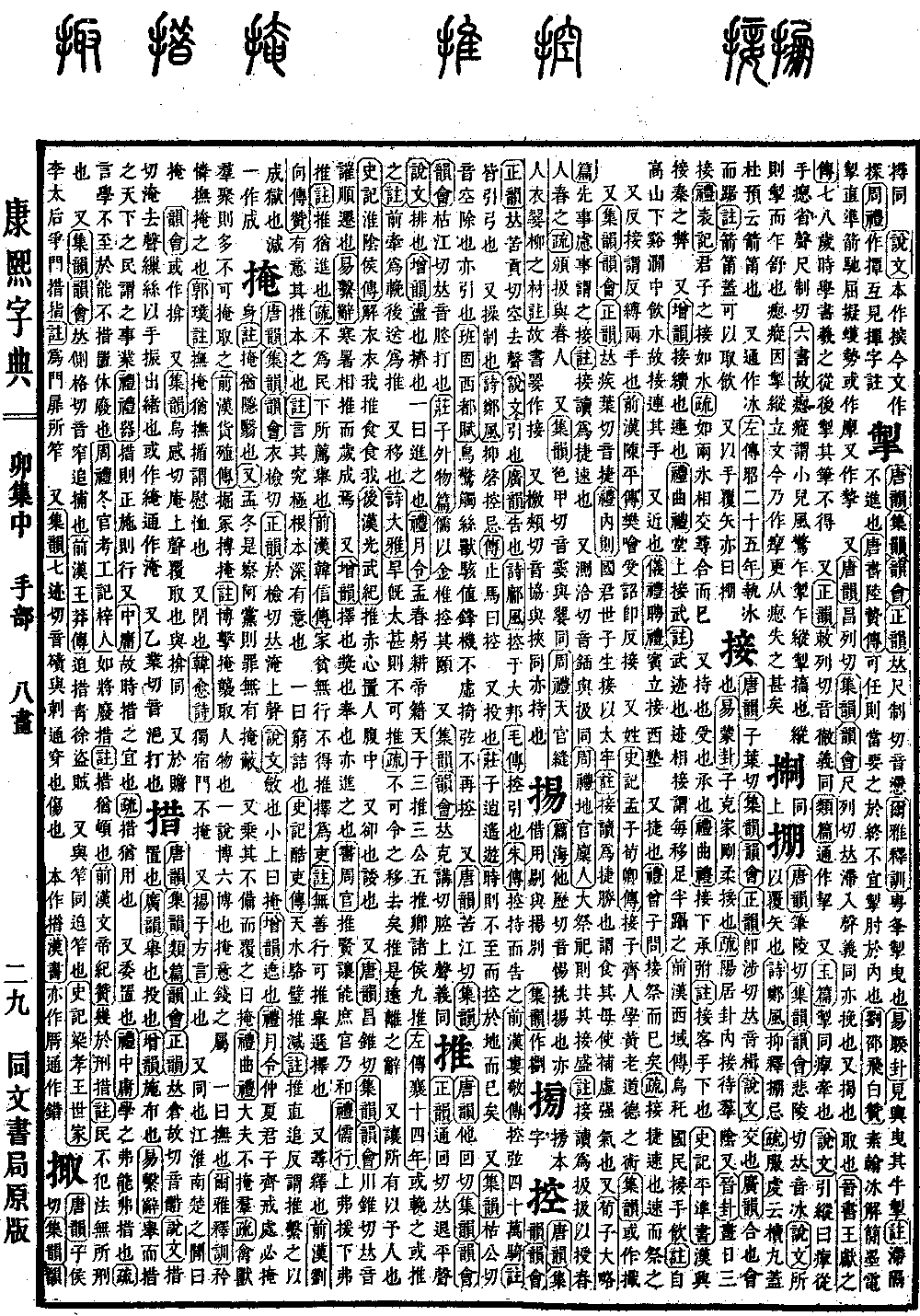
Mao Collection, Middle Volume
Radical: Hand (shǒu)
Kangxi stroke count: 12
Page 439, Entry 07
Tang Rhyme (Tangyun), Collection Rhyme (Jiyun), Rhyme Meetings (Yunhui), Correct Rhymes (Zhengyun): Pronounced kong (falling tone).
Explanation of Characters (Shuowen): To draw or pull.
Broad Rhymes (Guangyun): To report.
Book of Odes (Shijing), Odes of Yong: To report to a great state.
Mao Commentary (Maozhuan): To control is to draw.
Zhu Commentary (Zhuzhuan): To grasp and hold while informing.
History of the Former Han Dynasty (Qianhan), Biography of Lou Jing: To draw the bow with forty thousand horsemen.
Commentary: All refer to drawing a bow. Also refers to control or regulation.
Book of Odes (Shijing), Odes of Zheng: To repress the playing of chimes and the pulling of reins.
Commentary: To stop a horse is called controlling.
Also means to cast or throw.
Zhuangzi, Carefree Wandering (Xiaoyaoyou): When the time does not arrive, one simply falls to the ground.
Collection Rhyme (Jiyun): Pronounced kong (level tone). To remove. Also to draw.
Ban Gu, Western Capital Rhapsody (Xidu fu): Birds are startled and touch the threads, beasts are frightened and encounter the blades. The mechanism is not triggered in vain, and the string is not drawn a second time.
Tang Rhyme (Tangyun): Pronounced qiang (level tone). Collection Rhyme (Jiyun), Rhyme Meetings (Yunhui): Pronounced qiang (level tone). To strike.
Zhuangzi, External Things (Waiwu): The scholar used a metal hammer to strike his chin.
Collection Rhyme (Jiyun), Rhyme Meetings (Yunhui): Pronounced qiang (rising tone). Same meaning.