Zi Collection, Page Position: Lower
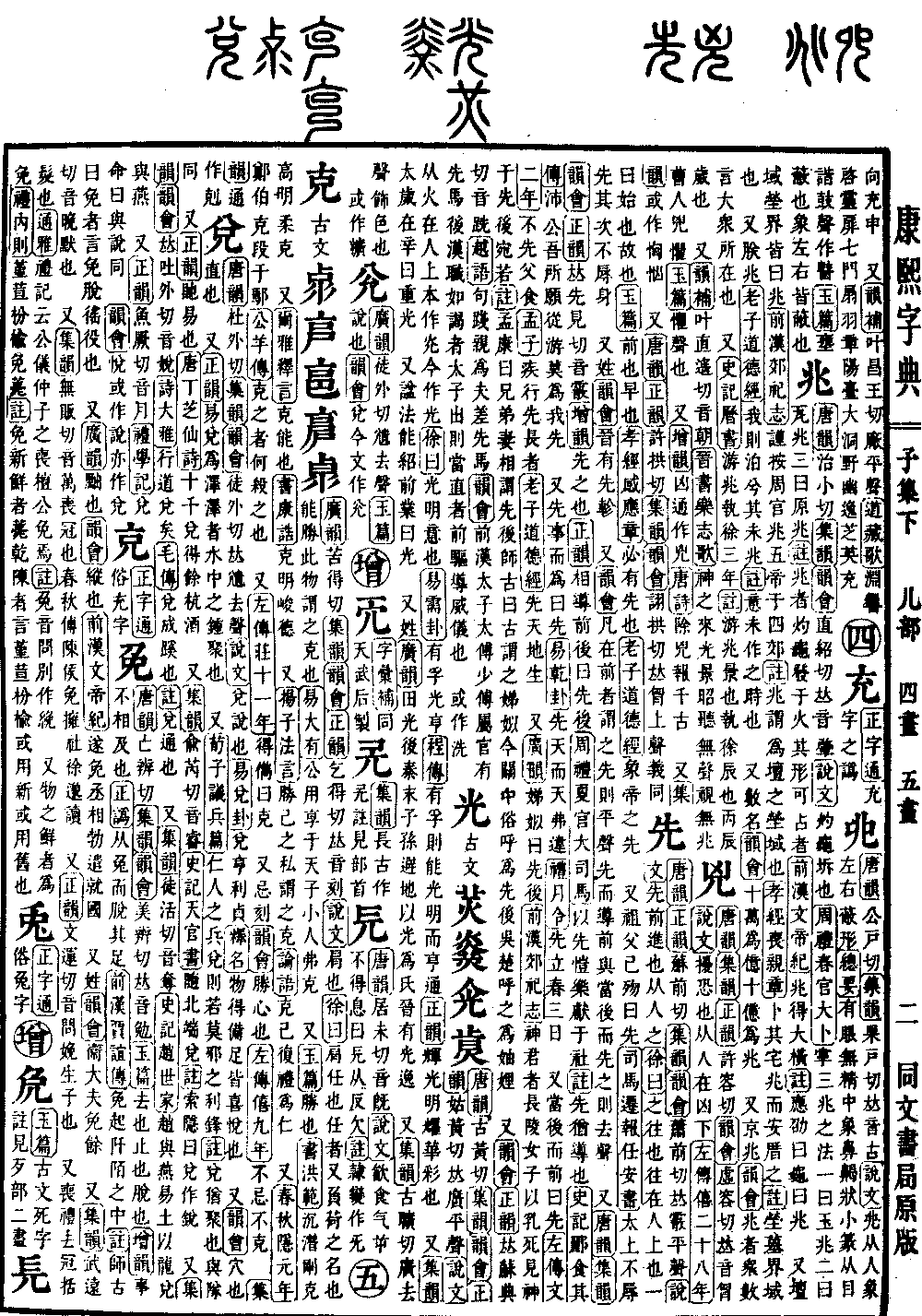
Radical: Child (ér)
Kangxi stroke count: 7
Page 124, Entry 15
According to ancient texts: Guangyun (Guangyun) pronounces this as ke (falling tone); Jiyun (Jiyun), Yunhui (Yunhui), and Zhengyun (Zhengyun) pronounce this as qi (rising tone) de (entering tone), with the same pronunciation as ke (entering tone). Shuowen Jiezi (Shuowen Jiezi) defines it as the shoulder. Xu Kai (Xu Kai) notes that the shoulder implies the act of bearing weight. To bear a load or burden is a form of carrying. To be able to handle such an object is called ke. In the Book of Changes (Yijing), in the Great Possession hexagram, it states that dukes and lords offer tribute to the Son of Heaven, which the common man cannot accomplish. According to Yupian (Yupian), it also means to overcome or triumph. In the Book of Documents (Shangshu), in the Great Plan, it states that those who are deep and reserved should be overcome with firmness, while those who are brilliant and outward should be overcome with gentleness. According to Erya (Erya), in the Explanations of Words, it is defined as to be able to. In the Book of Documents (Shangshu), in the Announcement to Kang, it states being able to make manifest high virtues. In the Model Sayings (Fayan) by Yang Xiong (Yangzi), overcoming one's own selfish desires is called ke. In the Analects (Lunyu), it is stated that restraining oneself to align conduct with ritual is considered benevolence. In the Spring and Autumn Annals (Chunqiu), in the first year of Duke Yin, the Earl of Zheng defeated Gongshu Duan at Yan. The Gongyang Commentary (Gongyang Zhuan) asks, what does ke mean? It means to kill him. In the Zuo Commentary (Zuozhuan), in the eleventh year of Duke Zhuang, capturing an enemy of high status is called ke. It also carries the meaning of jealousy or resentment. Yunhui (Yunhui) refers to a competitive or combative heart. In the Zuo Commentary (Zuozhuan), in the ninth year of Duke Xi, it mentions neither being jealous nor being overly competitive. Jiyun (Jiyun) notes that it is interchangeable with the character ke (meaning to overcome).