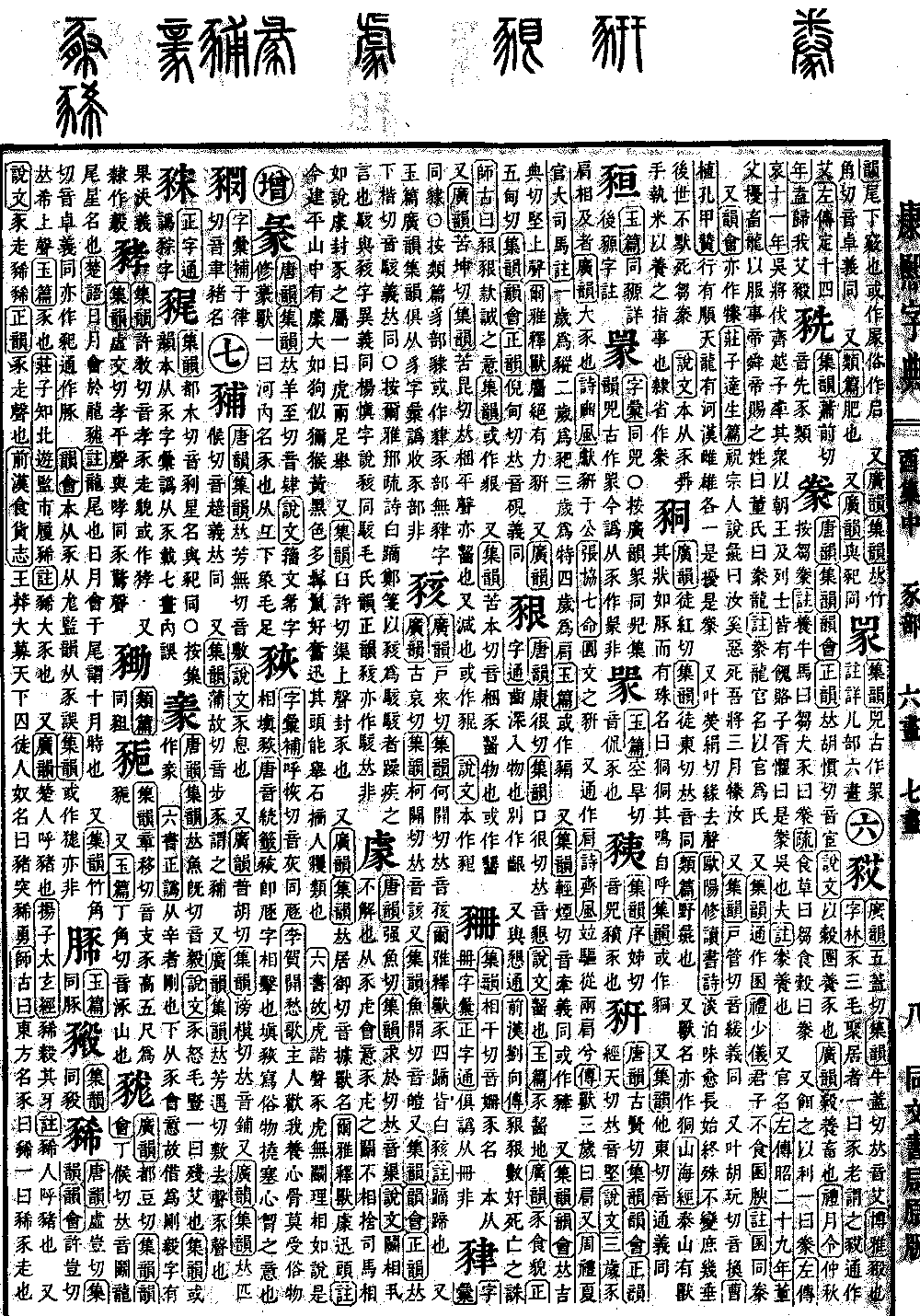
You Collection, Middle Volume
Radical: Pig (shǐ)
Kangxi strokes: 13
Page 1196, Entry 11
Pronounced kěn.
According to the Shuo Wen Jiezi (Shuowen), to gnaw or bite.
According to the Yu Pian, a pig rooting in the ground.
According to the Guang Yun, the manner in which a pig eats.
According to the Zheng Zi Tong, teeth biting deeply into an object. It is also written in a variant form (yín). It is also used interchangeably with the word for earnest (kěn).
In the Biography of Liu Xiang in the History of the Former Han (Qian Hanshu): The word appears in a phrase describing earnestness.
According to Yan Shigu, the phrase means earnest and sincere.
According to the Ji Yun, it is sometimes written in a variant form (kěn).
According to the Ji Yun, it is also pronounced kǔn. It describes a pig gnawing on something. It is also written in variant forms.
According to the Guang Yun and the Ji Yun, it is also pronounced kūn. It also refers to the act of gnawing or biting. It also expresses the meaning of reducing or decreasing. It is also written in variant forms.
The Shuo Wen Jiezi (Shuowen) notes that the original form was written differently. The character was originally derived from the form (kěn).