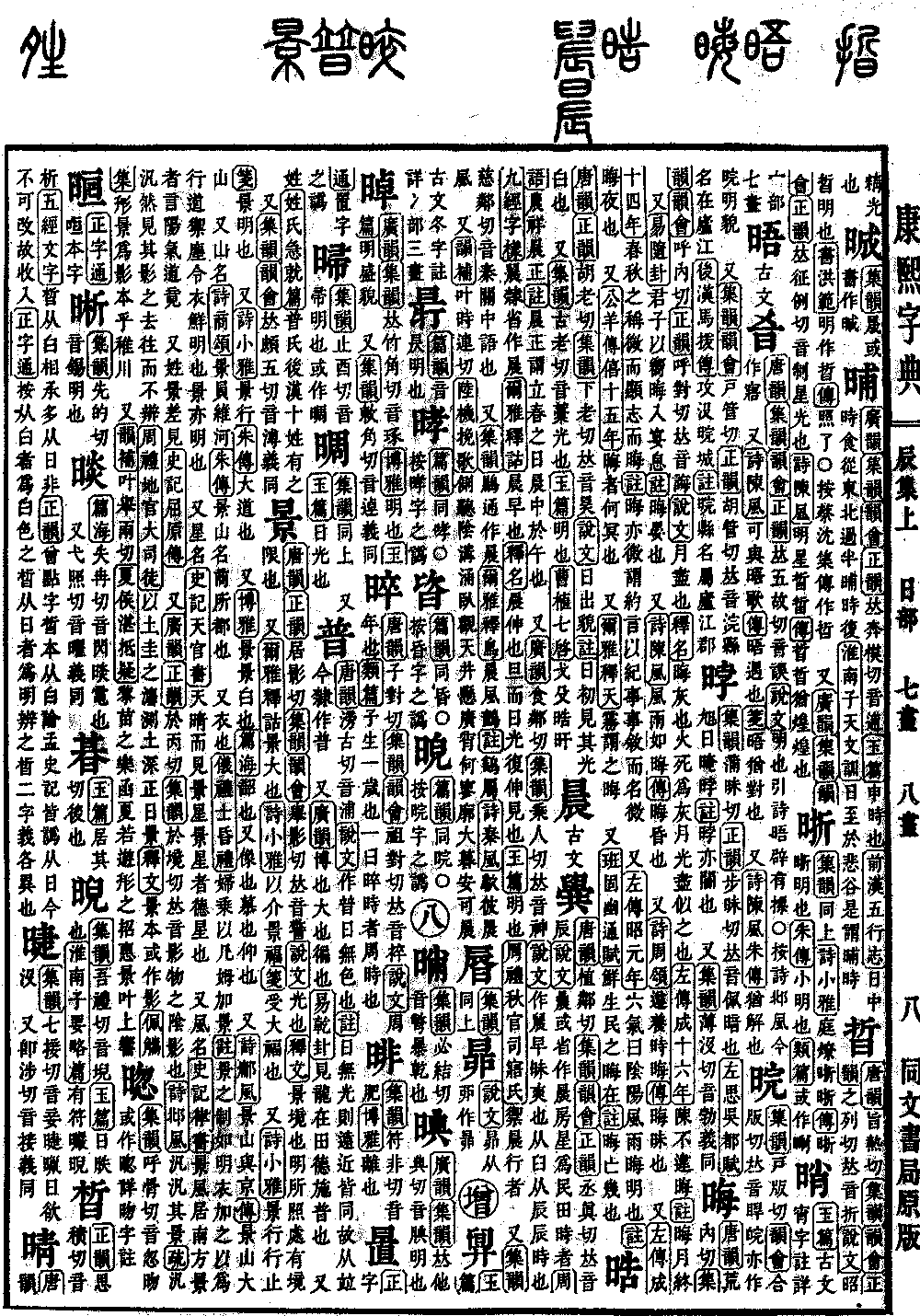
Chen Collection, Upper Volume
Radical: Sun (rì)
Kangxi stroke count: 12
Page 496, Entry 30
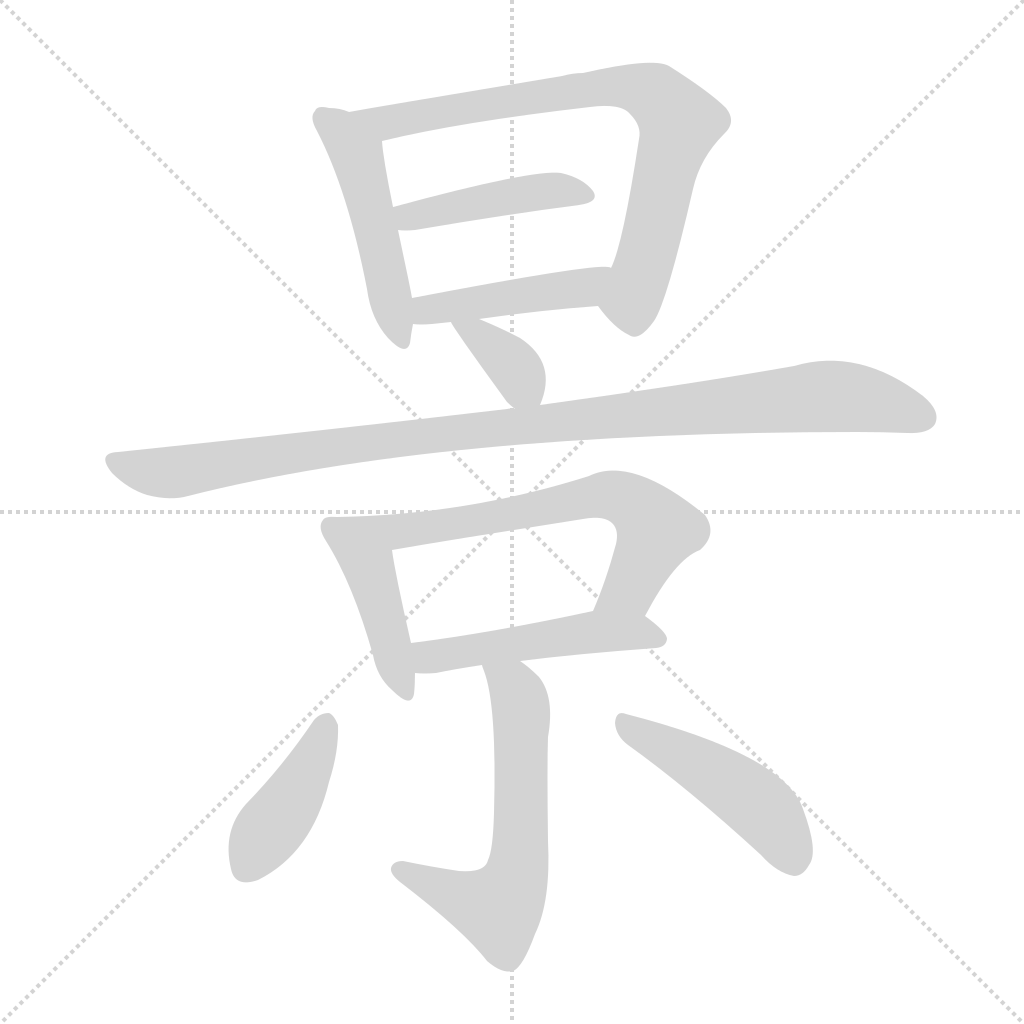
Pronounced jing. Also pronounced jing. In the Tang Rhyme (Tangyun) and Correct Rhymes (Zhengyun), it is pronounced jing. In the Collected Rhymes (Jiyun) and Rhyme Anthology (Yunhui), it is pronounced jing. The pronunciation is the same as the word for alert. The Explaining Graphs and Analyzing Characters (Shuowen Jiezi) defines it as light. The Explanatory Text (Shiwen) states: Jing refers to a boundary; where light shines, there is a limit. Also, the Er Ya: Explanations of Ancient Terms (Er Ya: Shigu) states: Jing means large. In the Book of Odes (Shijing): To receive great blessings. Zheng Xuan notes this means to receive great fortune. Also in the Book of Odes (Shijing): Great conduct is the path to follow. Zheng Xuan notes that here, jing means brightness. Also in the Book of Odes (Shijing): Great path. Zhu Xi's Collected Commentaries (Jizhuan) interprets this as a great road. Additionally, the Guang Ya states: Jing jing means white. The Pian Hai defines it as beautiful. It also carries the meanings of appearance, longing, and admiration. Also in the Book of Odes (Shijing): Mount Jing and the capital. Mao's Commentary (Maochuan) interprets Mount Jing as a large mountain. It is also the name of a mountain. In the Book of Odes (Shijing): The area of Jing is along the river. Zhu Xi's Collected Commentaries (Jizhuan) interprets Jing as a mountain name, where the capital of the Shang Dynasty was located. It also refers to clothing. In the Book of Etiquette and Ceremonial (Yili): The wife ascends using a small table, and the governess adds the jing. The commentary explains: The form of the jing resembles a bright garment (a type of undergarment); it is added to shield against dust while walking, keeping the clothes looking fresh. Jing also means bright. It is also the name of a star. The Records of the Grand Historian (Shiji): Celestial Officials Treatise states: When the weather is clear, one can see the auspicious star (jingsing). The auspicious star is a symbol of virtue. It is also the name of a wind. The Records of the Grand Historian (Shiji): Treatise on the Pitch Pipes states: The bright wind (jingfeng) is located in the south. Jing refers to the movement of the yang energy reaching its limit. It is also a surname. Jing Cuo is mentioned in the Biography of Qu Yuan in the Records of the Grand Historian (Shiji).
Additionally, in the Guang Rhyme (Guangyun) and Correct Rhymes (Zhengyun), it is pronounced ying. In the Collected Rhymes (Jiyun), it is pronounced ying. It refers to the shadow of an object. In the Book of Odes (Shijing): Its shadow floats about. Kong Yingda's Commentary (Shu) explains this as seeing only the shadow flickering back and forth, making it difficult to distinguish. In the Rites of Zhou (Zhouli): Using the method of the earthen gnomon to measure the depth of the earth and verify the shadow of the sun. The Explanatory Text (Shiwen) says: In some versions, the character for jing is written as the character for shadow. The Peixi states: Writing the character for appearance-shadow as the character for shadow originated with Ge Hong (Zhichuan). Also, in the Rhyme Supplement (Yunbu), it is rhymed as liang. In Xiahou Zhan’s Refuting Doubts (Diyi): The music of the Li and Miao tribes fills the summer, like the movement of a form attracting a favorable shadow. It rhymes with the word sound (xiang) in the previous line.