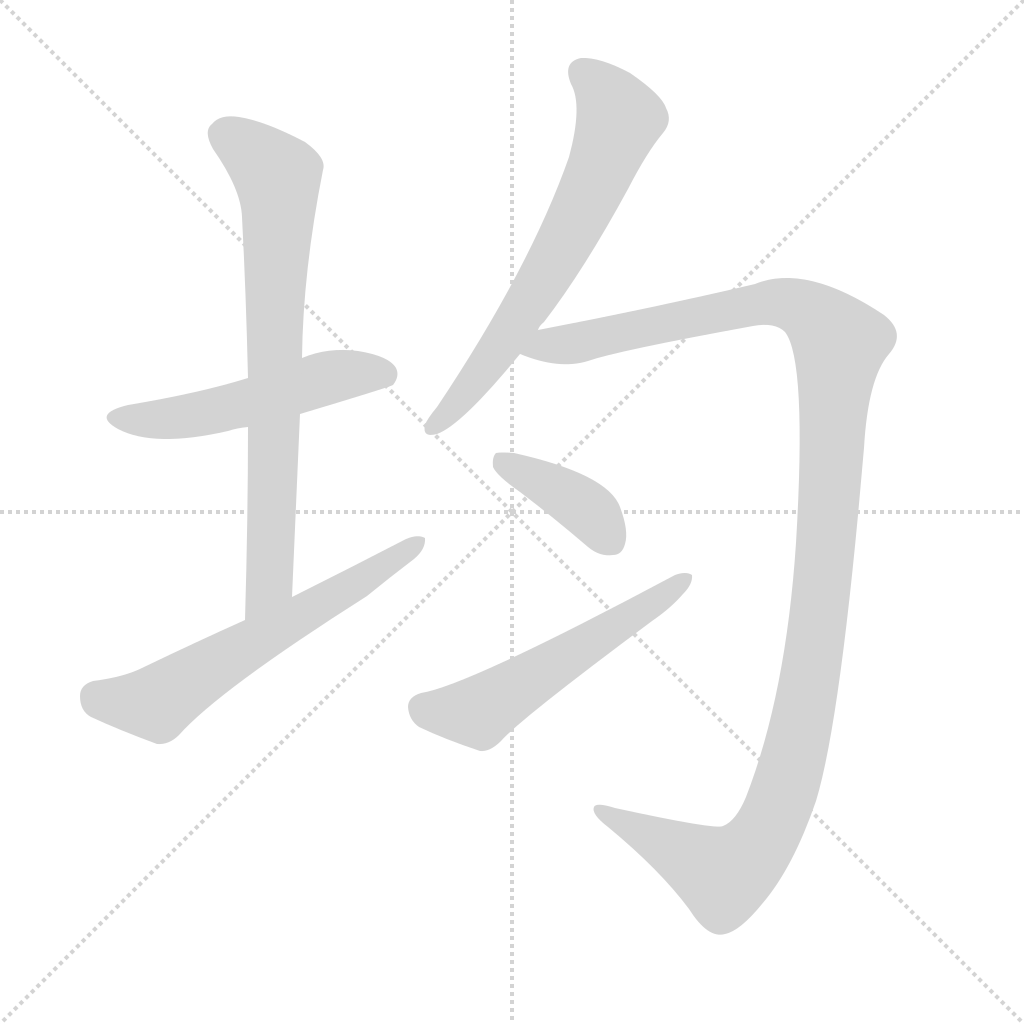
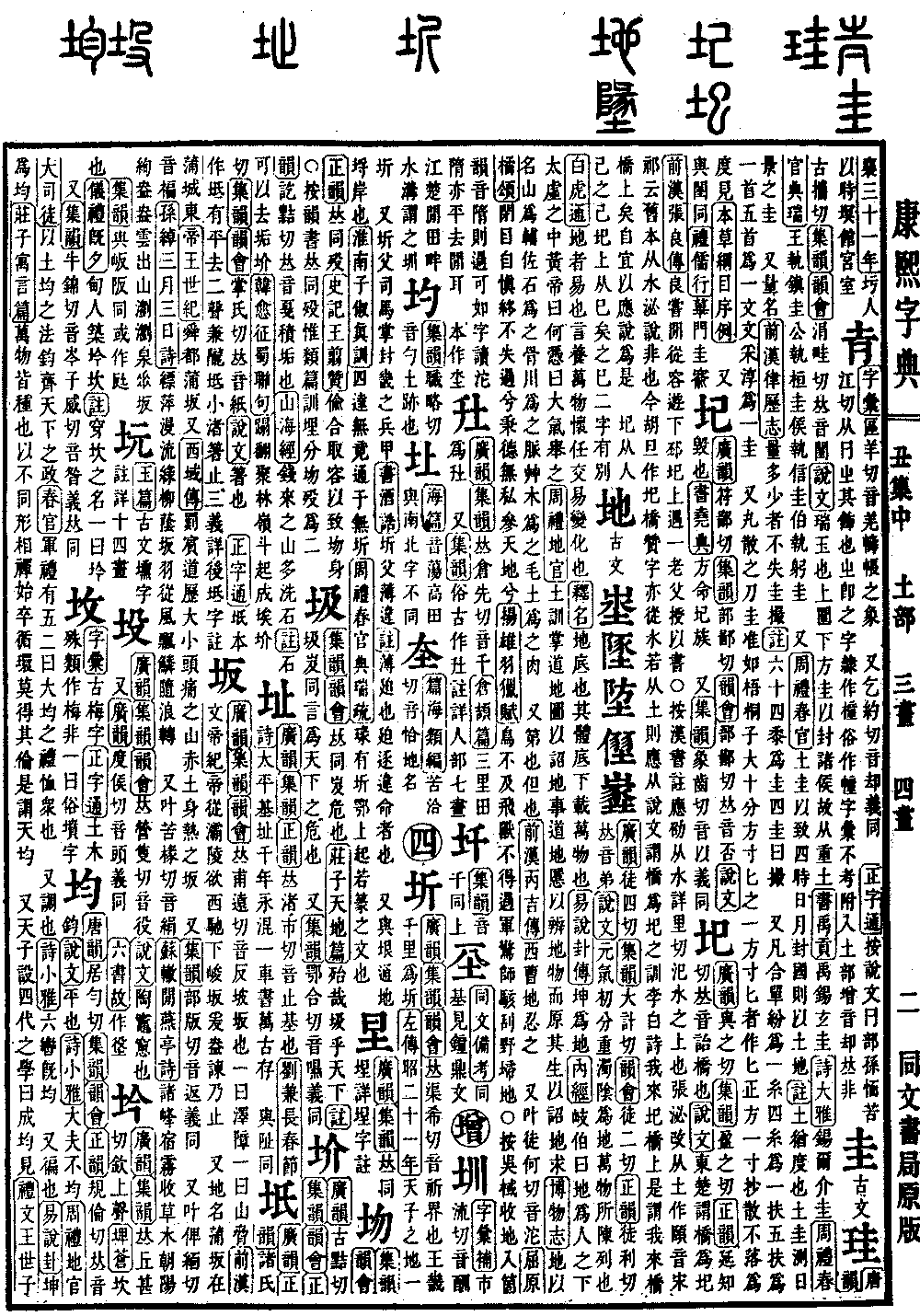
Chou Collection, Middle Volume. Radical: Earth (tǔ). Kangxi strokes: 7. Page 224, Entry 31.
Pronounced jun.
Shuowen Jiezi (Shuowen) states: level or equal. Book of Odes (Shijing), Xiaoya: The ministers are not treated equally. Rites of Zhou (Zhouli), Earth Offices, Grand Minister of Instruction: Use the land-leveling method to ensure the political affairs of the world are equitable and uniform. Spring Offices: Military rites consist of five categories; the second is the Great Equality rite, used to care for the populace.
It also means to regulate or adjust. Book of Odes (Shijing), Lesser Odes: The six reins have already been adjusted.
It also means universal or pervasive. Book of Changes (Yijing), Explanation of the Trigrams: The Kun trigram represents equality and levelness. Zhuangzi, Metaphorical Language Chapter: The ten thousand things are like seeds, alternating in different forms, cycling through beginnings and ends without a discernible order; this is called natural equality.
It also refers to the four types of schools established by the Son of Heaven, called Chengjun, as seen in the commentary to Record on the Scholar (Wenwang Shizi).
It also refers to the tool used for making pottery, which rotates. Dong Zhongshu stated: Clay on a rotating wheel depends entirely on the potter for its formation.
It also refers to a musical instrument. Book of Rites (Liji), Record of Music: Music is used to establish the standards of pitch. Book of Documents (Shangshu) Commentary: Music performed in the hall takes the sheng (reed instrument) as the pitch standard; music performed below the hall takes the qing (stone chime) as the pitch standard. History of the Later Han (Houhanshu), Treatise on Harmonics and Calendars: At the winter and summer solstices, when playing the eight sounds, one must listen to the five jun. Commentary: The jun is seven feet long, with silk strings attached, used to regulate musical tones.
It also refers to junfu, meaning military uniforms. Zuo Tradition (Zuo Zhuan), Fifth Year of Duke Xi: Military uniforms are neat and awe-inspiring. Sometimes also written in a variant form (jun).
It also refers to a place name. Jun was the ancient state of Jun, located in Xiangyang. Old Book of Tang (Tangshu), Annals of Emperor Zhongzong: In the first year of the Sisheng era, the Empress Dowager moved the Emperor to Fang Prefecture, and later moved him to Jun Prefecture.
Pronounced yun. Ancient teachings state that in antiquity the character for rhyme did not exist, and jun was used for the word rhyme.
Pronounced yan. Records of the Grand Historian (Shiji), Annals of Xia: Following the Yellow River and the sea, dredging the Huai and Si rivers. Zheng Xuan states: Jun is read as yan.
Pronounced guan (rhyming in a verse). Han Yu, Poem on Meng Jiao’s Loss of a Son: I ask Heaven, why is the birth of the common people unequal in favor? People say Heaven, Earth, and Man have always been unrelated.
Also used interchangeably with jun (weight/measure). Book of Documents (Shangshu), Great Declaration: Their crimes are all the same.
Sometimes written as xun. Book of Rites (Liji), Inner Chapters: Visit once every ten days. Rites of Zhou (Zhouli), Earth Offices: The Junren official manages public affairs using three days out of every ten. Commentary: In antiquity, jun was interchangeable with xun. Also written as the character for ten-day period.
Textual research: Rites of Zhou (Zhouli), Earth Offices, Grand Minister of Instruction: Use the land-leveling method to level the political affairs of the world. Note: The original text contained a different character for jun, which has been corrected to this character. Regarding the place name: Jun was the ancient state of Jun, located in Xiangyang. Note: Zuo Tradition (Zuo Zhuan) mentions the state of Jun, not the state of Mi, so the character Mi has been corrected to Jun.