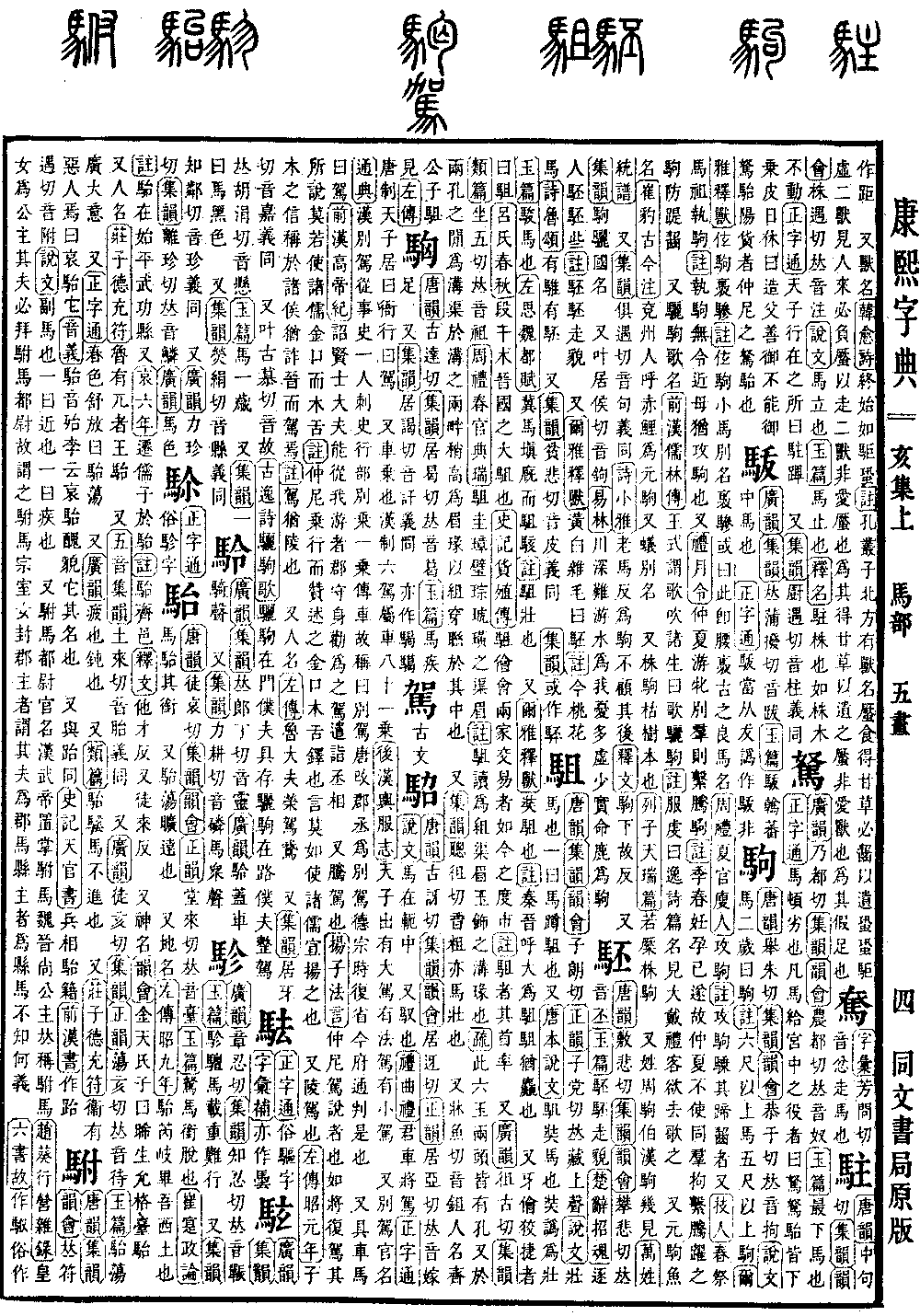
Hai Collection, Upper Volume
Radical: Horse (mǎ)
Kangxi Strokes: 15
Page 1436, Entry 05
Pronounced ju. According to the Analytical Dictionary of Characters (Shuowen Jiezi), a horse aged two years is called a ju. Note: A horse six feet tall or more is a horse; one five feet or more is a ju.
In the Er Ya (Erya), the term xuanju refers to a horse that is harnessed on the side, also known as niaocan. Note: Xuanju is a young horse, with another name being niaocan. Some say this refers to yaoniao, the name of an ancient fine horse.
In the Rites of Zhou (Zhouli), under the office of the Shouren, it mentions the gelding of a ju. Note: This means castrating horses that have a tendency to kick or bite. Under the Xiaoren and the Yue Ling (Yueling), the practice of zhiju refers to separating a foal from its mother, which shares a similar meaning to gelding.
In the Book of Rites (Liji), specifically the Yueling chapter, it is noted that in the middle of summer, mares are separated from other horses, and the lively young stallions are tied up. Note: By the end of spring, mares are already pregnant, so in mid-summer, they are kept away from the herd, and the lively young stallions are tied up to prevent them from kicking or biting.
Also, Liju is the name of a song. In the History of the Former Han Dynasty (Qianhan Shu), specifically the Confucian Scholars Biography, Wang Shi said to the students who were singing and playing music: Sing the Liju. Note: Fu Qian stated this is the name of a lost poem from the Book of Odes (Shijing), also found in the Da Dai Liji (Records of Rites by Dai the Elder), which was sung when a guest was about to depart.
Also, yuanju is the name of a fish. According to the Gujin Zhu (Notes on Past and Present), the people of Yanzhou call the red carp yuanju. It is also an alternative name for an ant.
Also, zhuju refers to the stump of a withered tree. In the Liezi, it says: Like a wooden stake or a withered tree stump.
There is also a surname. In the Zhou dynasty, there was Ju Bo; in the Han dynasty, there was Ju Ji, both found in the Wanxing Tongpu (Comprehensive Genealogy of All Surnames).
Also, pronounced ju. The meaning is the same. In the Book of Odes (Shijing), in the Xiaoya section, it says: An old horse is treated as a young horse, not caring about its future. In the collected commentaries, the character ju is rhymed in the departing tone.
Also, Juli is the name of a country.
Also, rhymed and pronounced gou. In the Yilin, it says: The river is too deep to swim across, the water causes me worry. There is much that is false and little that is true, appointing a deer to be a horse.
Textual Corrections:
In the Rites of Zhou (Zhouli), Xia Guan section, under the entry for Jiren, it mentions the spring sacrifice and the zhiju practice. Note: The original text Jiren has been corrected to Xiaoren.
In the Book of Rites (Liji), Yueling section, it mentions tying up a horse. Note: The original character has been corrected to zhi (meaning to tether).
In the Shiwen (Classic Explanations), it says: Ju is pronounced according to the fanqie system, but the text has been corrected to state that it is pronounced ju, and the fanqie characters are omitted. The fanqie notation in the collected commentaries was actually associated with the character hou, not the character ju. It has been corrected to reflect that in the collected commentaries, the character ju is rhymed in the departing tone.