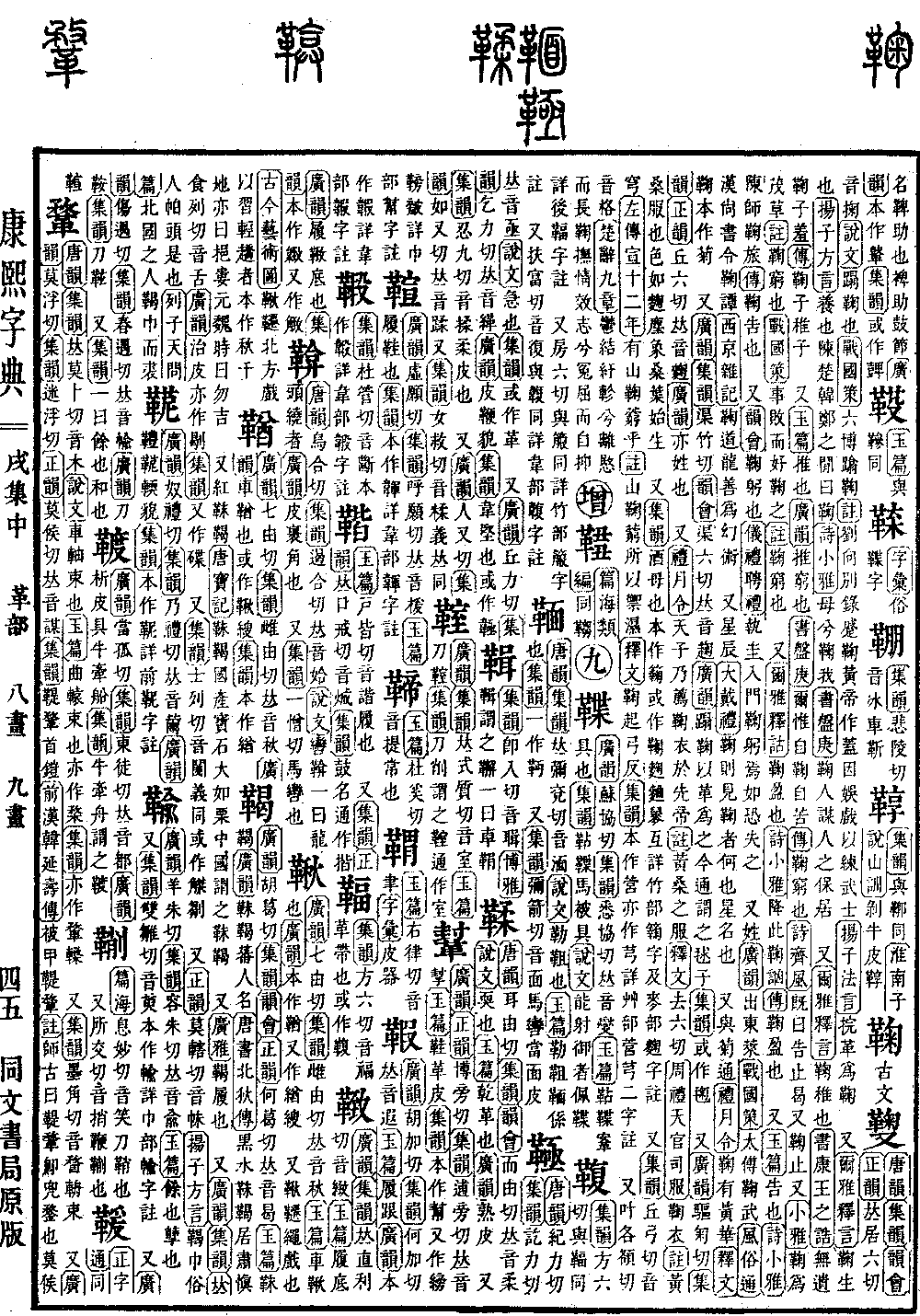
Xu Collection, Middle Volume
Radical: Leather (gé)
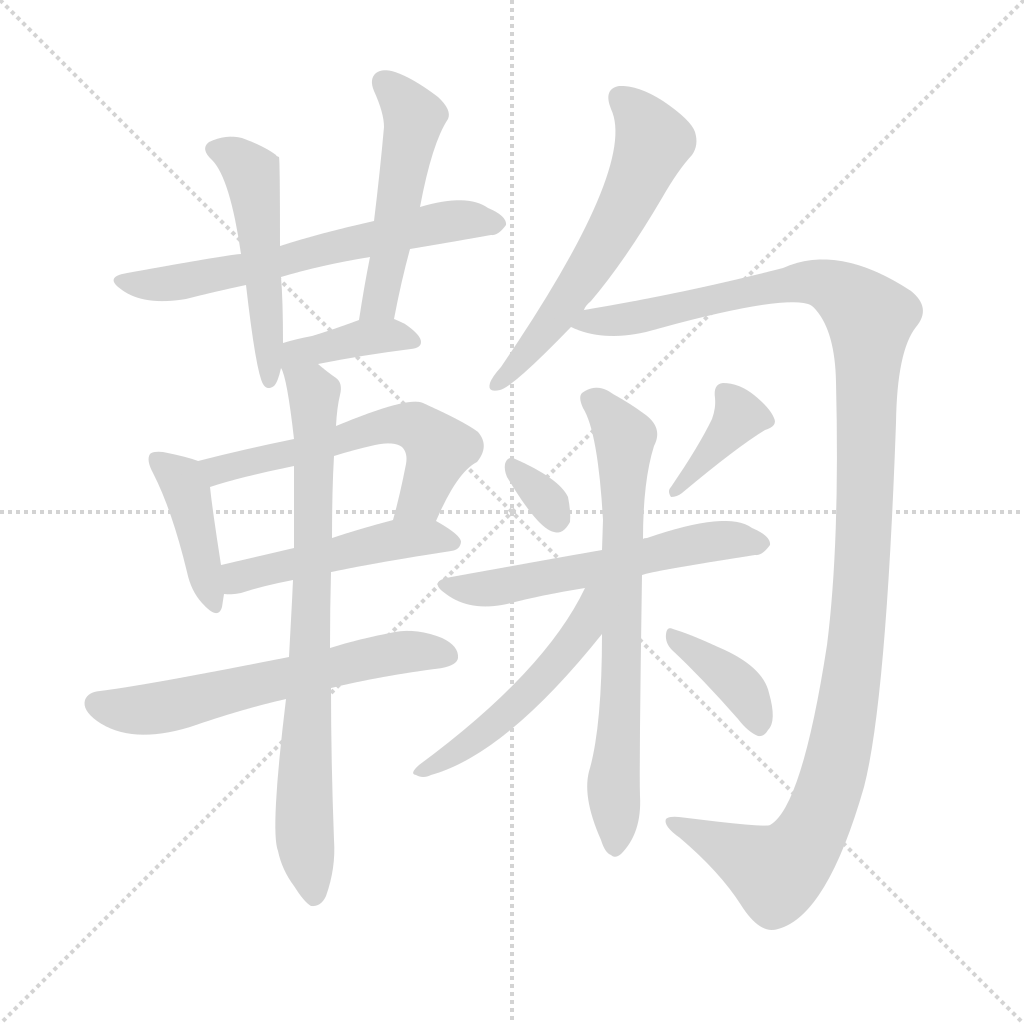
鞠
Kangxi strokes: 17
Page 1389, Entry 05
In ancient scripts. Pronounced ju.
Shuowen Jiezi (Explanation of Simple and Compound Characters): To kick a ball.
Strategies of the Warring States (Zhanguo Ce): Engaging in the six-board game and kicking balls.
Note: Liu Xiang's Miscellaneous Records (Bielu) states: The game of kicking balls was created by the Yellow Emperor; it served as a form of entertainment and a way to train soldiers.
Yang Xiong's Model Sayings (Fayan): Sewing leather together to make a ball.
Also, Erya: Explanations of Words (Shiyan): Ju means to be born.
Yang Xiong's Dialect (Fangyan): Means to nurture. Between the regions of Chu, Han, and Zheng, it is called ju.
Book of Odes (Shijing): Mother has nurtured me.
Book of Documents (Shangshu): The people of Ju deliberate on how to preserve their settlements.
Also, Erya: Explanations of Words (Shiyan): Ju means immature.
Book of Documents (Shangshu): Do not abandon the immature child to shame.
Commentary: Ju child means an immature child.
Also, Yupian: To push.
Guangyun (Broad Rhymes): To investigate to the very end.
Book of Documents (Shangshu): You bring this suffering upon yourself.
Commentary: Ju means to exhaust or reach the end.
Book of Odes (Shijing): Having already reported that it has stopped, why has it come to an end again?
Also, Book of Odes (Shijing): The land is covered in overgrown grass.
Note: Ju means to exhaust.
Strategies of the Warring States (Zhanguo Ce): When a matter fails, one likes to get to the bottom of it.
Note: Ju means to exhaust.
Also, Erya: Explanations of Evidence (Shizheng): Ju means to be filled or overflowing.
Book of Odes (Shijing): These calamitous words have descended.
Commentary: Ju means to be full or overflowing.
Also, Yupian: To announce.
Book of Odes (Shijing): The army is notified.
Commentary: Ju means to announce.
Also, Yunhui: To bow down.
Book of Etiquette and Ceremonial (Yili): When entering the gate holding the jade tablet, one bows down as if afraid of losing it.
Also, a surname.
Guangyun (Broad Rhymes): Originates from Donglai.
Strategies of the Warring States (Zhanguo Ce): Grand Tutor Ju Wu.
Customs and Traditions (Fengsutong): Han Dynasty Secretariat Director Ju Tan.
Western Capital Miscellaneous Records (Xijing Zaji): Ju Daolong was skilled in magic.
Also, celestial bodies.
Da Dai Liji (Record of Rites by Dai the Elder): When Ju appears. What is Ju? It is the name of a star.
Also interchangeable with Chrysanthemum (jú).
Book of Rites (Liji): The chrysanthemum has yellow flowers.
Annotation: Ju was originally written as the character for chrysanthemum.
Also. Pronounced qu.
Guangyun (Broad Rhymes): A ball made of leather, now commonly referred to as a ball.
Jiyun: Also written as the variant form (ju).
Also. Pronounced qu.
Guangyun (Broad Rhymes): Also a surname.
Also.
Book of Rites (Liji): The Son of Heaven offers ceremonial robes to his ancestors.
Note: Robes dyed with yellow mulberry.
Annotation: Pronounced qu.
Rites of Zhou (Zhouli): Ceremonial robes.
Note: Yellow mulberry robes. The color is like the dust of fermenting yeast, resembling the newly sprouted leaves of a mulberry tree.
Also, Jiyun: Leaven for making liquor. Originally written as a different character. Sometimes written as variant forms. See entries under the Bamboo radical and the Wheat radical.
Also, Jiyun: Pronounced qiong.
Zuo Commentary (Zuozhuan): Is there the medicinal herb shan ju qiong?
Note: Shan ju qiong is used to prevent dampness.
Annotation: Pronounced qiong.
Jiyun: Originally written as a different character, also written as the variant form (qiong). See entries under the Grass radical.
Also, rhyming with ge.
Songs of Chu (Chuci): My heart is heavy and knotted, grieving long in this state of exhaustion. I calm my emotions and align my will, feeling wronged and suppressing myself.
Textual research: In the Zuo Commentary (Zuozhuan), the mention of the medicinal herb was corrected to use the proper character for qiong.