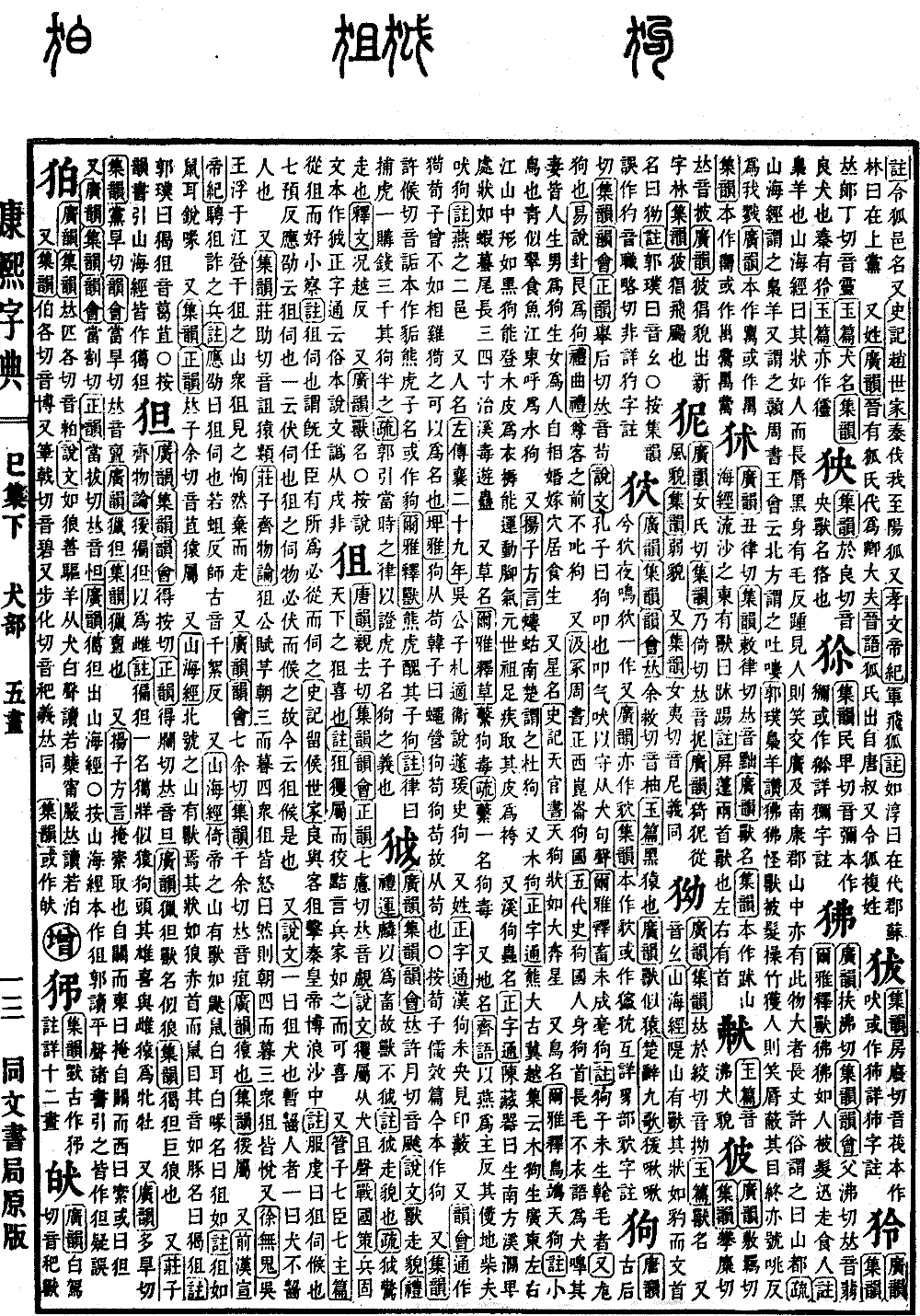
Si Collection, Lower Volume
Radical: Dog (quǎn)
Page 709, Entry 14
Pronounced qu.
In the Shuowen Jiezi (Shuowen), it is a type of macaque. Formed from the radical Dog, with the phonetic component qie.
In the Strategies of the Warring States (Zhanguo Ce), it states: Soldiers are naturally fond of the cunning of the macaque. The commentary notes: The macaque is a type of monkey that is clever and crafty; it says that military strategists are like this and are fond of such tactics.
In the Guanzi, in the chapter Seven Ministers and Seven Lords (Qichen Qizhu Pian), it states: To follow the monkey and be fond of petty inspections. The commentary notes: To watch or wait for. This means that once a minister is appointed to perform a task, one must follow and watch them.
In the Records of the Grand Historian (Shiji), in the Biography of the Marquis of Liu (Liuhou Shijia), it states: Zhang Liang and an assassin lay in wait to strike the Emperor of Qin at Bolangsha. The commentary by Fu Qian states: It means to watch or wait for. Ying Shao states: It means to watch or wait for. Another source says it means to lie in wait. A monkey waiting for its prey must crouch and move forward, which is why it is now said that this is the meaning of the word.
In the Shuowen Jiezi (Shuowen), another definition states: A dog that bites people unexpectedly. Another source says it is a dog that does not bite people.
Pronounced zu. A type of ape. In the Zhuangzi, in the chapter The Adjustment of Controversies (Qiwulun), it mentions the monkey keeper who distributes acorns. He says: I will give you three in the morning and four in the evening. The monkeys were all angry. He said: Then I will give you four in the morning and three in the evening. The monkeys were all pleased. In the Xu Wugui chapter, it states: The King of Wu was floating on the river and ascended the Mountain of Monkeys; the monkeys saw him, were terrified, and fled.
Pronounced ju. In the Guangyun, it is defined as a monkey. In the Jiyun, it is a type of ape.
In the Book of Han (Qianhan Shu), in the Table of Feudal Lords (Zhuhou Wang Biao), it mentions the employment of deceitful, monkey-like soldiers. The commentary by Ying Shao states: To watch or wait for. The sound is like the word for maggot. Yan Shigu states: The sound is like qian xu.
In the Classic of Mountains and Seas (Shanhaijing), it states: On the Mountain of Yidi, there is a beast that resembles a mole; it has white ears and a white beak and is named the Juru. The commentary notes: The Juru resembles a mouse with sharp ears and a sharp beak.
Pronounced ju. A type of ape.
In the Classic of Mountains and Seas (Shanhaijing), it states: On the North Hao Mountain, there is a beast that looks like a wolf with a red head and mouse-like eyes. Its sound is like a pig, and it is named the Heju. The commentary by Guo Pu states: The sound of Heju is like ge ju. Note: The rhyme dictionaries citing the Classic of Mountains and Seas all write this as the variant form.
Textual research: In the Book of Han, in the Annals of Emperor Xuan, it mentions the employment of deceitful, monkey-like soldiers. The commentary by Ying Shao says: To watch or wait for, with the sound like the word for maggot. We respectfully observe that this text does not exist in the Annals of Emperor Xuan. We have corrected it to the Table of Feudal Lords according to the original text. The sound note like the word for maggot has been corrected to reflect the pronunciation.