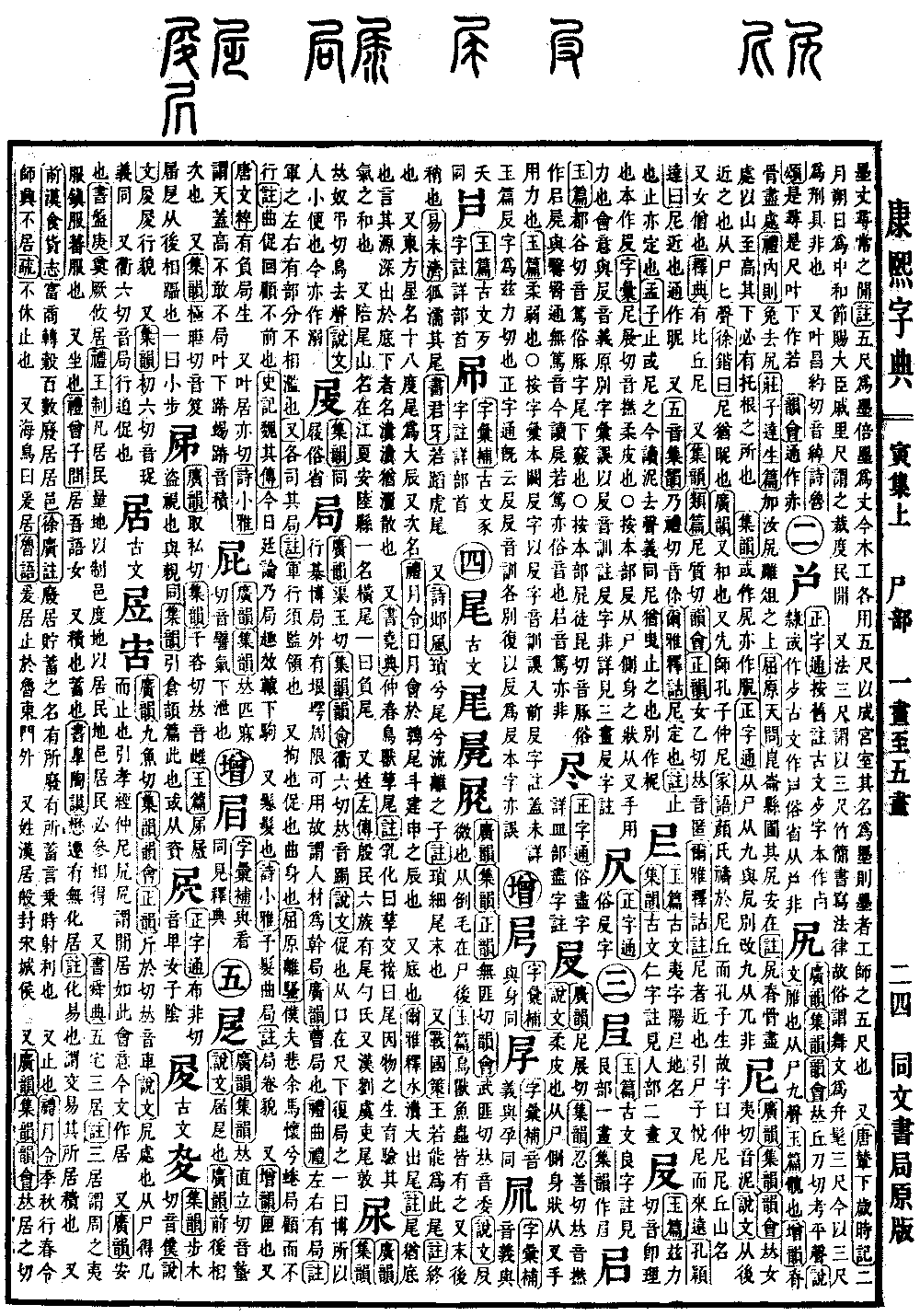
Yin Collection, Upper Volume
Radical: Corpse (shī)
Kangxi stroke count: 8
Page 300, Entry 30
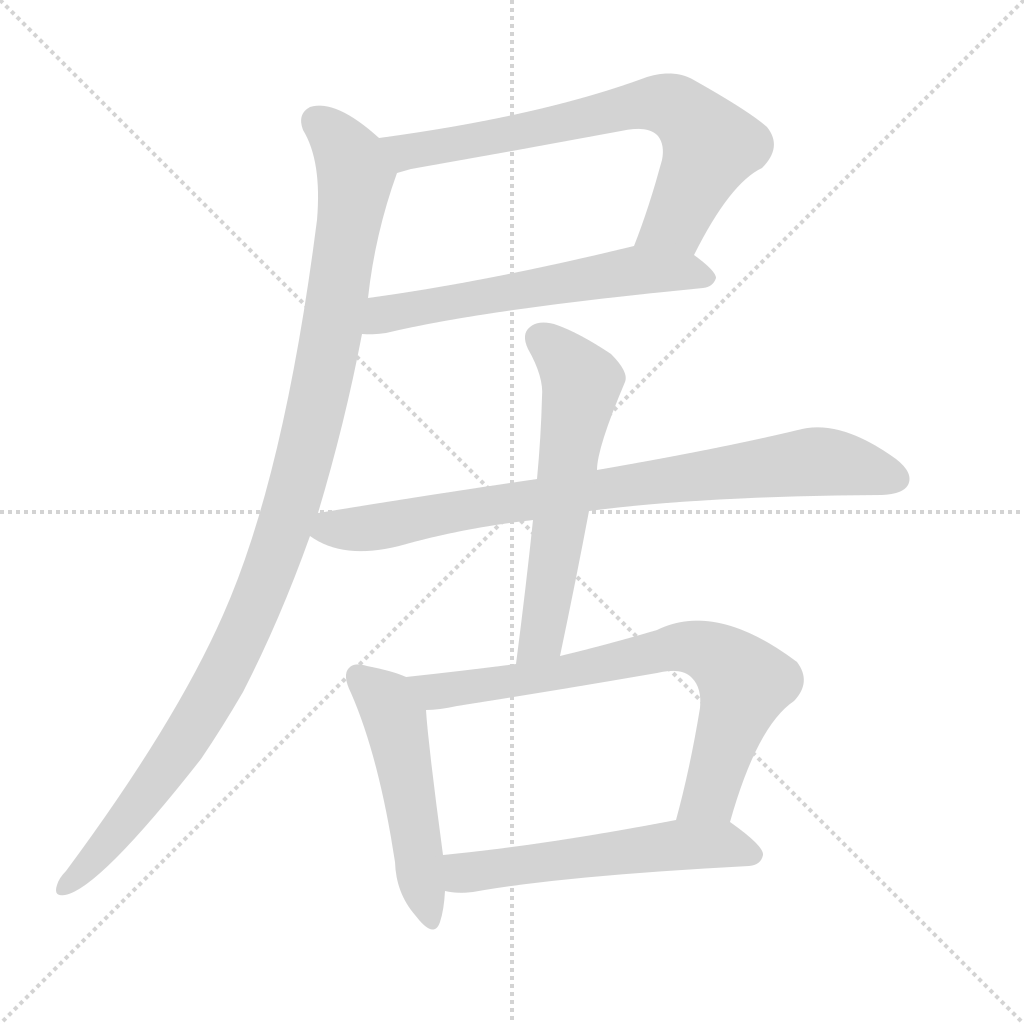
According to the Guangyun (Broad Rhymes), pronounced ju (level tone). According to the Jiyun (Collected Rhymes), Yunhui (Combined Rhymes), and Zhengyun (Correct Rhymes), pronounced jin. The pronunciation is the same as the character for carriage. The Shuowen Jiezi (Explaining Graphs and Analyzing Characters) explains it as a place of residence. The character structure uses the radical for corpse, indicating a person obtaining a low table (as the ancients sat on mats and leaned against tables) to rest. Citing the Book of Filial Piety (Xiaojing), where it is written that Zhongni rested, with the character variant used to denote leisure, which illustrates the intent behind the creation of the character. Modern writing uses the form currently in entry.
Also, the Guangyun (Broad Rhymes) explains it as to settle. In the Book of Documents (Shangshu), chapter Pan Geng, it refers to establishing the place where they reside. In the Book of Rites (Liji), chapter Royal Regulations (Wangzhi), it states that whenever settling the common people, one must measure the land to plan cities, and assess the land to settle the inhabitants; the land, cities, and inhabitants must be coordinated properly.
Also, in the Book of Documents (Shangshu), chapter Canon of Shun (Shundian), there is a mention of five dwellings and three residences. The commentary notes that three residences refers to the remote regions such as the Yi-territory, Zhen-territory, and Fan-territory within the Zhou dynasty system.
Also, it indicates to sit. In the Analects of Confucius (Lunyu), chapter Yang Huo, it states to sit down, and I will tell you.
Also, it indicates to accumulate or store. In the Book of Documents (Shangshu), chapter Counsels of Gao Yao (Gaoyao Mo), it encourages trade and the mutual exchange of goods, trading what one has for what one lacks, specifically referring to trading accumulated goods. The commentary notes that the term used refers to trading, meaning the exchange of stored supplies.
Also, in the Records of the Grand Historian (Shiji), chapter Treatise on the Balance of Standards (Pingzhun Shu), it notes that wealthy merchants and large traders numbered in the hundreds, hoarding goods and manipulating the market. The Xu Guang commentary states that the term used refers to hoarding and storing. It means to hold back or release goods to profit from timing.
Also, it indicates to cease. In the Book of Rites (Liji), chapter Monthly Ordinances (Yueling), it states that if one implements the governmental decrees of spring during the late autumn, the army will be mobilized and will not rest. The sub-commentary explains that this means not ceasing.
Also, a type of sea bird called the Yuanju. In the Discourses of the States (Guoyu), chapter Discourses of Lu (Luyu), it notes that a Yuanju bird rested outside the east gate of the state of Lu.
Also, used as a surname. During the Han dynasty, there was a man named Ju Ban who was enfeoffed as the Marquis of Songcheng.
Also, according to the Guangyun (Broad Rhymes), Jiyun (Collected Rhymes), and Yunhui (Combined Rhymes), pronounced ju (level tone). The pronunciation is the same as the character for base. Used as a modal particle. In the Book of Rites (Liji), chapter Tangong, it mentions Gongyi Zhongzi handled a funeral, abandoning his grandson to install his son as heir. Tangong asked: What is the reason for this? I have never heard of such a thing before. The commentary notes it as an expression of surprise, similar to asking what the cause is. Another view holds that the phrase is similar to asking where the logic lies. The character should be read in its original pronunciation and does not need to be changed to the sound of base. The Jiyun (Collected Rhymes) states this usage is equivalent to the character for that/it.
Also, pronounced ju (departing tone). In the Book of Odes (Shijing), chapter Odes of Shao (Shaonan), it refers to the cuckoo residing there. It rhymes with the following line containing the character for imperial. In the Book of Odes (Shijing), chapter Odes of Tang (Tangfeng), it advises not to be overly comfortable and to always consider one's duties. It rhymes with the following line containing the character for qu (departing tone).
Note: In the Shuowen Jiezi (Explaining Graphs and Analyzing Characters), another explanation for this character is to squat. The Chang Jian (Extended Notes) suggests the variant character represents a place of residence, while the current character represents squatting. The Yunhui (Combined Rhymes) and Zhengyun (Correct Rhymes) place it in the Yu rhyme category, citing a passage from the Book of Odes (Shijing) to show that the character also carries the pronunciation for arrogant. The Zhengzitong (Correction of Characters) states that the character for squatting is commonly used for arrogant. The meanings of residing or residence, and squatting or arrogant, should be distinguished based on their usage in classical texts.
Verification: In the Book of Rites (Liji), chapter Inquiry of Zengzi (Zengzi Wen), there is the phrase Sit, I will tell you. I have carefully examined this, and this phrase does not appear in the Inquiry of Zengzi (Zengzi Wen); it has been verified as a text from the Analects of Confucius (Lunyu). Based on this, it has been corrected to Analects of Confucius (Lunyu), chapter Yang Huo. In the History of the Former Han (Qian Hanshu), chapter Treatise on Food and Money (Shihuo Zhi), there is the phrase wealthy merchants hoarding goods, residing in cities, with the Xu Guang commentary stating that the term refers to the name of storage. I have carefully examined this, and the Xu Guang commentary is found in the Records of the Grand Historian (Shiji), not the History of the Former Han (Qian Hanshu). I have changed the reference from History of the Former Han (Qian Hanshu) to Records of the Grand Historian (Shiji), chapter Treatise on the Balance of Standards (Pingzhun Shu).