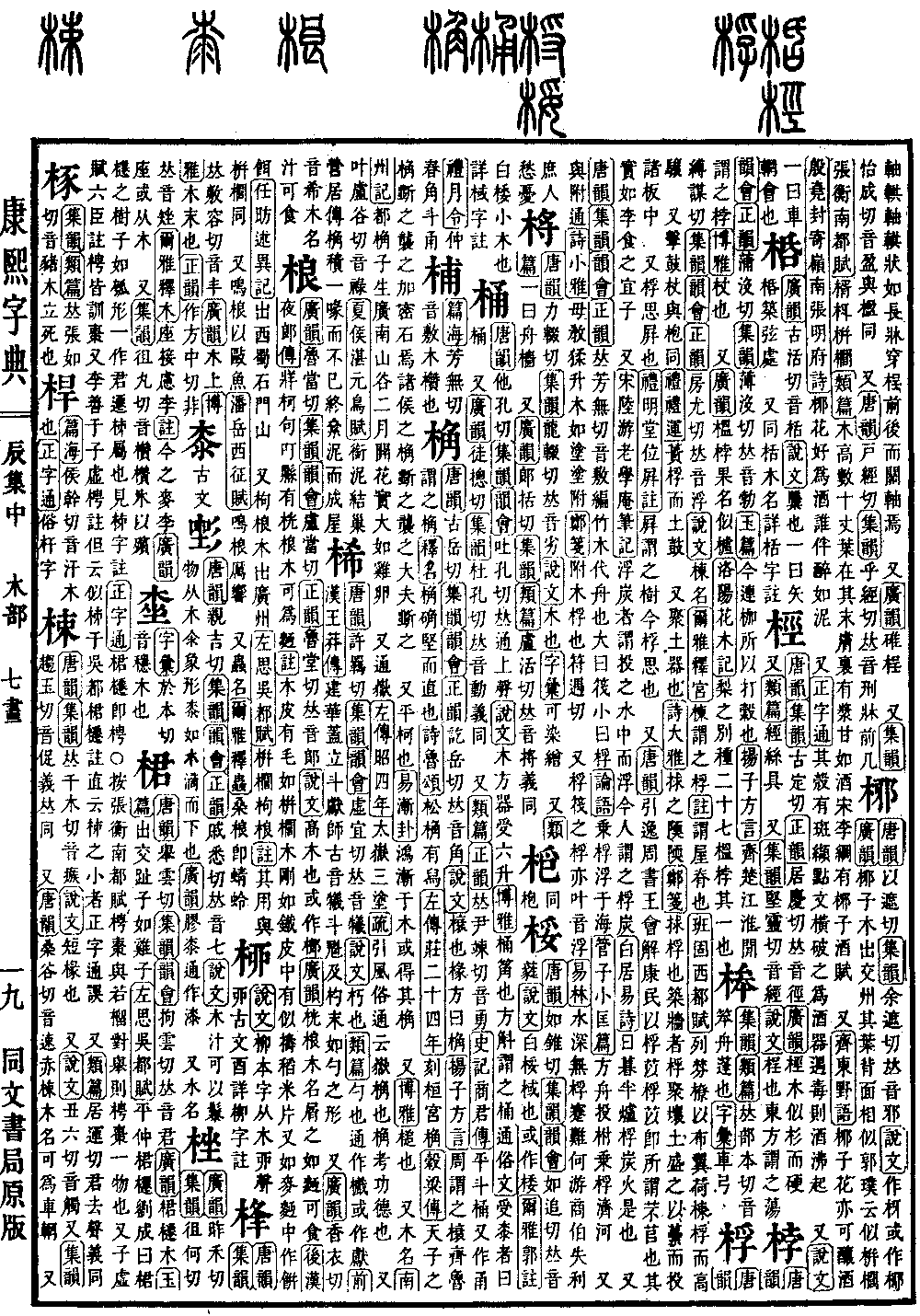
Chen Collection, Middle Volume
Radical: Tree (mù)
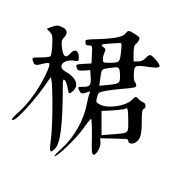
Entry: Gun
Kangxi stroke count: 11
Page 527, Entry 21
Pronounced jun.
According to the Tang Dynasty Rhymes (Tangyun), the Collected Rhymes (Jiyun), and the Rhyme Compilation (Yunhui), the pronunciation is jun.
The Expanded Rhymes (Guangyun) describes it as the gun-xian tree. The Jade Chapters (Yupian) states it originates in Jiaozhi, with fruit resembling a chicken egg. In the Rhapsody on the Capital of Wu (Wudu Fu) by Zuo Si, it is mentioned as the pingzhong and gun-xian trees. Liu Cheng states the gun-xian tree has fruit shaped like a calabash. It is also written in a variant form (jun-qian), a type of species; see the annotation for that entry.
The Corrected Character Guide (Zhengzitong) states that gun-xian is the same as the ying tree. Note: In the Rhapsody on the Southern Capital (Nandu Fu) by Zhang Heng, the ying-jujube is paired with the pomegranate, suggesting the ying-jujube is a single entity. Furthermore, the annotations of the six scholars on the Rhapsody on Sir Fantasy (Zixi Fu) all define ying as a type of jujube. Li Shan, in his annotation to the Rhapsody on Sir Fantasy, only mentions its resemblance, while in the annotation to the Rhapsody on the Capital of Wu, he describes it specifically as a small variety of the tree; the Corrected Character Guide is mistaken in its interpretation.
According to the Categorized Compilation (Leipian), it is also pronounced jun (departing tone). The meaning remains the same.